Unweaving the Rainbow: An Introduction to Quantum Thaumodynamics
Assume a spherical reality bender in a vacuum.
Assume a spherical reality bender in a vacuum.
Thumbnail for crom
.
Previous chapter: Interaction of EVE Fields with Matter Fields
By Dr Cyprog, PhD, lecture notes for Michaels-Reynders University Thaum 307 section 5 Quantum Thaumodynamics
$f = -\color{red}{\alpha_\mathbf{x}}^2 |\color{blue}{\psi}|^2 + \color{orange}{\beta_\mathbf{x}} |\color{blue}{\psi}|^4$ $+ \frac{1}{2\color{red}{\alpha_\mathbf{x}}} \left|\left( \frac{\hbar}{i}\nabla - \frac{s}{c}\color{teal}{\vec{V}} - \frac{d}{c}\color{purple}{\mathbf{\vec{ע}}}\right)\color{blue}{\psi} \right|^2$ $+ |\nabla \times \color{teal}{\vec{V}}|^2 + |\nabla \times \color{purple}{\mathbf{\vec{ע}}}|^2$
This is the (simplified, low energy) formula for the free energy $(f)$ of the hume fieldⓘHumesA field which has traditionally been used to explain how stable reality is at all points. $(\color{blue}{\psi})$ in a fixed Mill environmentⓘMill fields A collection of poorly understood fields that define the local structure of reality. with an arbitrary interacting EVEⓘEVEThe fundamental energy that powers unified thaumaturgy, defined by a vector four-potential V.$(\color{teal}{\vec{V}})$ and AkivaⓘAkivaA form of radiation given off by acts of faith, can be broken down into 14 different orthogonal terms. $(\color{purple}{\mathbf{\vec{ע}}})$ field1 in a vacuum. This equation should be familiar to anyone with an understanding of the Anderson-Higgs mechanism. By the end of this course, you should be able to understand what this equation means at a high level, as this equation describes how magic works.
Other key aims of this course are to explain why mountains have such a high hume level, how beryllium bronze works as a thaumic conductor, and why scrantonite can be used to inhibit magic.
For most of this discussion, we will assume that the Akiva field is zero. The two fields interact in the same way with the hume field as they are both different forms of the same Evekiva2 field that have been split into the two by an unknown scalar interaction currently designated the "Leiner field".3 At high energies, the two fields merge back into a single field. Additionally, relativistic terms are ignored here.
Refresher on Terms
Hume Field: Humes are traditionally a measure of the density of reality. This definition is not quite accurate, as we will see, but it is a good first order approximation.
EVE radiation: EVE is the fundamental energy that creates thaumaturgic effects, frequently known as magic.
Akiva radiation: Akiva is a related form of energy closely aligned to religious concepts and other forms of faith.
Mill fields: a new concept introduced in this course, these esoteric fields give structure to other fields.
The Hume Field at Rest
The Hume field is at its core a complex numberⓘcomplex numberA form of numbers that have both a magnitude/length and a direction/phase.- for every point in space. Compare this with the electromagnetic field which has four values for every point in space (one electric and three magnetic). However, one major difference with fields like the electromagnetic field is that the lowest energy state of the hume field is not zero. In the absence of any charges the lowest energy state for the electromagnetic field has zero electromagnetism, while the hume field does have a lowest energy (this is typically 100hm4 but it can change).5 In the energy equation this is the $-\alpha(\mathbf{x})^2 |\psi|^2 + \beta(\mathbf{x}) |\psi|^4$ term. As a note, the negative term in front of the alpha term is by convention, this is the mass of the hume field and this mass is normally an imaginary number, that negative sign is so that alpha stays as a real number. Furthermore, the hume particle is strictly real massed so it is only the field with an imaginary mass. To put numbers on this alpha/the mass of the hume is about 0.1ev6 while beta is the hume coupling constant (generally about 0.25) leading to a hume vacuum energy of 0.15ev. However the phase of the hume field does not matter here, only the magnitude, it does not matter which direction the hume field is pointing for the ground state.

Energy of the hume field at a point for a given complex value. x and y are the real and imaginary parts of the field at that location, height is the energy. There is a clear circle of minimum energy.
Then we have the gradient term, the hume field is like a bar magnet and does not like it when different parts of the hume field want to point in different directions, as such, a change in the phase of the hume field is energetically unstable.
The takeaway here is that the hume field is naturally non zero everywhere and that the field is self aligned in space.
The Interaction Between the Hume and EVE Fields
The hume field interacts with the EVE field, effectively filling space with a fluid that acts to drag on EVE particles (vitonsⓘVitonThe smallest possible excitation of the EVE field, alternatively anEVE particle.). This drag slows down these particles and effectively grants them mass; as mass is the energy needed to push against the hume field to accelerate in the molasses that is the hume field. In a zero hume environment, the viton loses all mass and moves at the speed of light. The mechanism for this is identical to the higgs mechanismⓘHiggs mechanismThe traditional method for granting particles mass, was confirmed to exist in 2013. granting mass to all other particles.7 The akivonⓘAkivonThe smallest possible excitation of the akivia field, alternatively the akivia particle, has 14 different variants. The akivon decays into lighter particles fairly quickly leading to akiva sources being fairly short ranged. also gains mass this way, but most of the akiva's mass is granted via other currently unknown processes.
The hume field grants mass to neutrinos as well, explaining their very low masses.
Working Properties of the Hume Field
While not covered in this book, the gravitational inclusion to the equation of state for the hume field is significant. As such when in a strongly curved spacetime, the energy value of the hume field spikes dramatically. In non-euclidean geometries (areas bigger on the inside, non-trivial topologies, etc.) this tends to lead to two effects: firstly, the hume field in strongly distorted environments is significantly lower than baseline levels, as humes are ejected. Secondly, distorted spacetime tends to be constrained into smaller and smaller areas. This constraining is why most non-euclidean environments tend to be internally euclidean with connection points that are topologically weird.
Furthermore, the hume expulsion effect is explained by the aforementioned spacetime interaction. As the hume field increases, so does the energy required to maintain non-euclidean environments, thus if the force maintaining the non-euclidean environment is not sufficiently powerful, then spacetime will snap back to normal Minkowski spacetime, reestablishing Euclidean geometry.
A sufficiently high hume field may lead to gravity being canceled out entirely by flattening spacetime, however, this requires such a high hume level that it has never been created or observed.
Statistical Thaumodynamics of the Hume Field
So, the hume field wants to self-align in space, like water wants to align into a single crystal in ice. Thinking about frozen solids is a very useful metaphor here and should be held in your head at all times from now on.
Moreover, the hume field can host energetic excitation within it. When a system like this interacts with an external energy source (in this case effectively everything), statistical thermodynamics kicks in and the "sloshing" of the hume field can form temperature systems. Thermal coupling between the hume field and baseline reality is complicated, but it is safe to assume the field is at the same temperature as its surroundings.
The first question is what happens above the "melting point" of the field. At low energies, the complex values of the hume field align; however as the system heats up, there are more and more distortions until the hume breakdown temperatureⓘBreakdown TemperatureThe temperature at which an ordered system undergoes a phase transition to a disordered system, examples include melting temperatures and the Curie point of magnets. , which is at approximately 2000K (~1700°C). At this point the effective hume field falls to zero as thermal fluctuations dominate over self-interaction. At these temperatures, vitons lose all mass and move at light speed. The Akiva field remains massive due to other, currently unknown interactions.
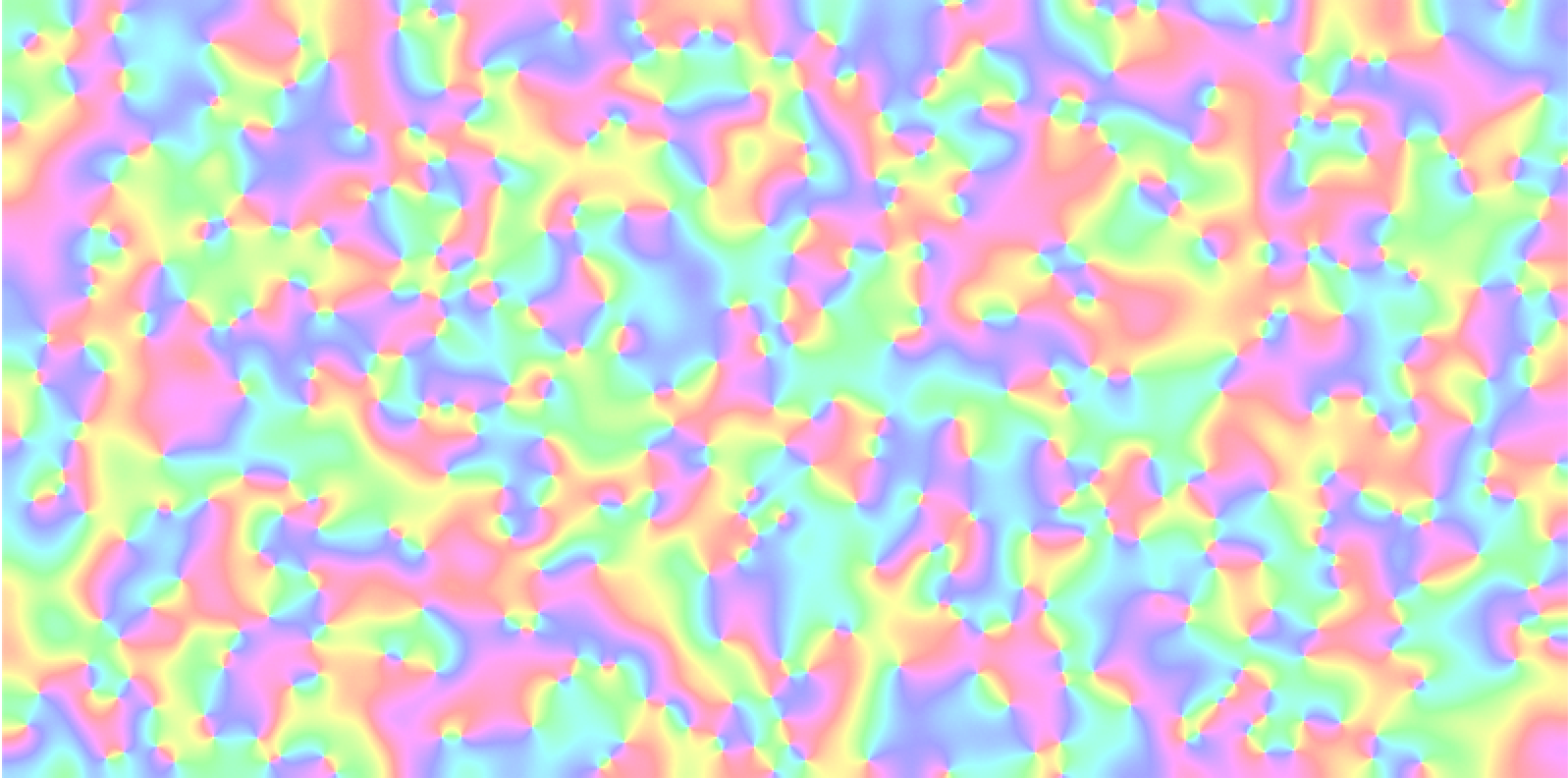
Now, the key thing about this system is that this field can freeze imperfectly. When ice is frozen in the freezer, a single crystal is not produced, instead, a large number of small crystals with fault lines within are formed. In the hume field, there is less the formation of crystals and more the formation of vortexes.
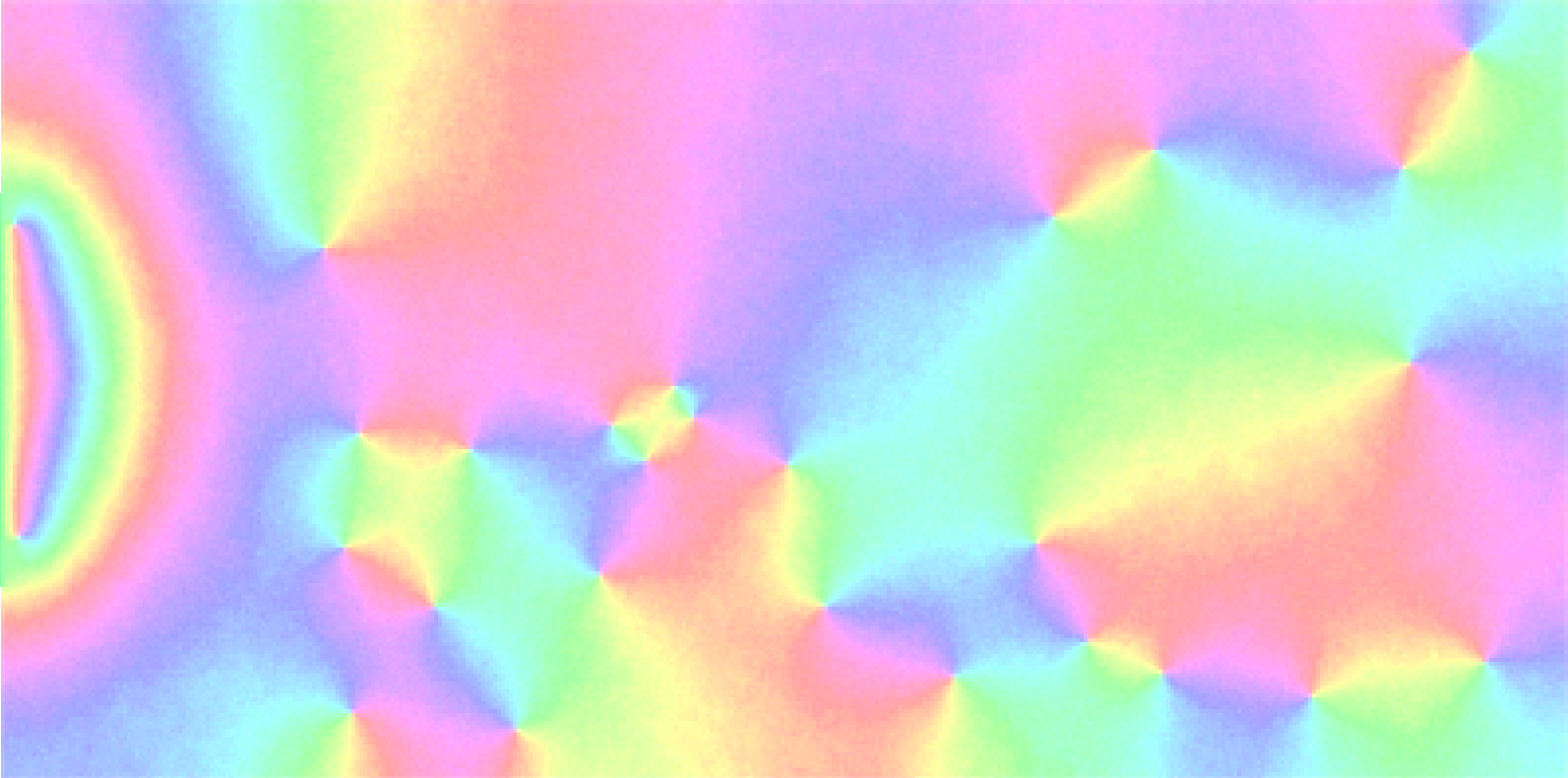
Example of the hume field after rapidly cooling, the phase angle is the color, while hume intensity is the saturation.
We can see this process in leylinesⓘLeylinesInvisible lines crisscrossing the world, containing intense thaumic potential.. In a two dimensional environment it is possible to have the phase of the hume field wrap around a point, which means that the central point will have a hume value of zero. In three dimensions, instead of a point, there is a line of zero hume values cutting through space. The direction of the curl is also why leylines are inherently directional and why some leylines attract and repulse each other. Leylines that curl in the opposite ways attract each other while leylines that curl in the same way repel each other.
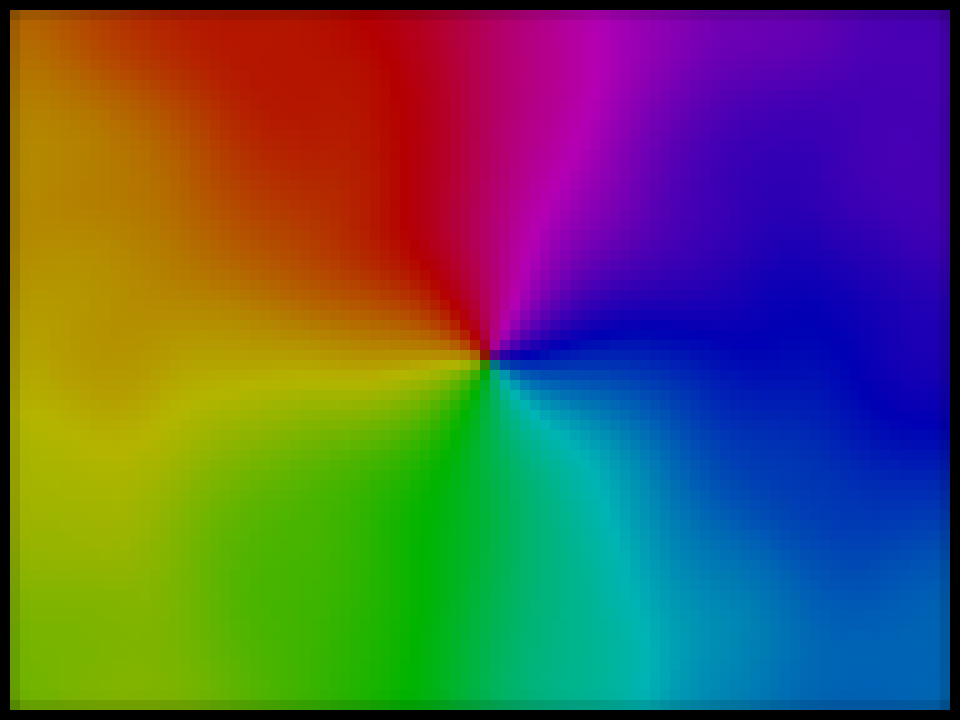
An example of how the hume field curls around a leyline.
Leylines act as thaumic superconductors containing vast amounts of energy, and as thaumic conductors, can be used to send spells much further than normal, potentially globally.
The key takeaway here is that while the hume field wants to be in total alignment with itself, like the higgs field does, because of its lower energy compared to the higgs field, it does not crystallize into a single condensate and is instead an amorphous kaleidoscope of different directions.
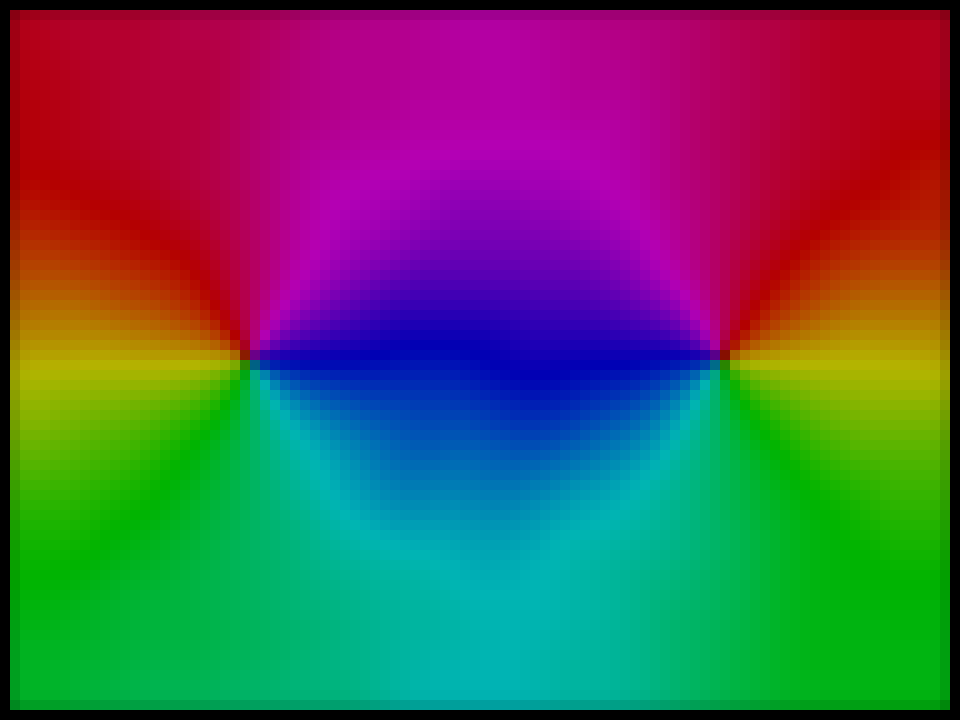
The curl of the hume field around two attracting antiparallel leylines.
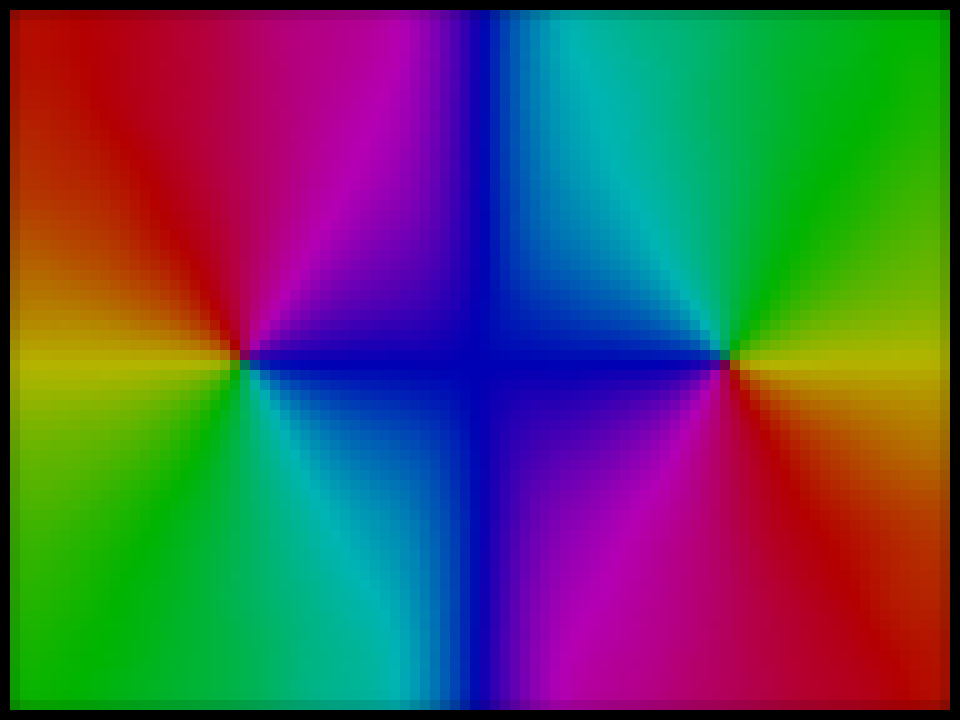
The curl of the hume field around two repelling parallel leylines.
Interactions with the Mill Fields
Of course, it is clear that the hume field is experimentally not constant across space. For example, mountains tend to have a much higher hume field than most other locations. The explanation for this is the interactions with the little-understood mill fields. How these fields work is currently the subject of much debate, with the consensus that they are either described by the 496-dimensional $E_8$ lie group or the 370-dimensional $F_4$x$E_7$ lie group. Given the frankly incomprehensible math this produces, it will not be covered in this book and is a subject for a more specialized graduate monograph.8 The major issue here is that the mill field is basically impossible to measure and we can only track the effects on actually measurable fields.9 While the mill field is a singular field, it is also so complicated that it frequently acts like multiple self-interacting fields, because nature does not like us having simple equations.
In any case, there are a large number of self-interacting vectors and many different stable states of the system. Like the hume field, mill fields form condensates as well as also form crystals of many different sizes. Due to potentially other symmetry-breaking interactions, some dimensions of the fields will crystalize while others remain fluid.
The key takeaway of this section is that there is a collection of secondary barely observable fields that strongly alter the local nature of the hume, EVE and akiva fields. These fields are the cause of most forms of paranormal activity.
Mill Fields and the Thaumic Soul
Now, what we have is a large pile of highly complicated physics; we can turn that physics into magic. Systems at disequilibrium can create highly fragmented localized mill fields, as these fields are false vacuums and the lagrangian10 is neither time nor space invariant, these interactions can violate conservation of momentum and energy.
Via the process of evolution, biological entities managed to develop a structure that creates this kind of mill spinglass, referred to as a thaumaturgic soul. The primary driver of the creation of this fractal false vacuum is the nervous system;11 as such upon brain death, this structure disintegrates into the environment. Furthermore maintaining this structure requires constant upkeep and may break down if support is not provided.12 In some cases, this soul may become metastable, leading to the creation of ghosts when the host passes away. Most of the time, thought processes are not encoded into the ghost, leaving behind a non-sapient structure. When electricity is passed through such a mill structure, boundary effects cause most of the electrons' energy to be discharged as light. The link between the thaumaturgic soul and the theological soul are currently unknown.
The nature of the soul structure is what defines the interaction of a person with EVE, reality bending and Akiva. Akiva production seems to be fairly constant across all known humans for currently unknown evolutionary reasons. On the other hand, thaumaturgically active individuals and reality benders have soul structures that only occur randomly.
This is also the cause of the distinctive opalescent purple eyes of reality benders. For currently unknown reasons, there is a highly conserved fragmentation of the hume field around the eyes regions of reality benders with a length of 380nm.13 As this purple color is due to the structure of the hume field, it goes away when this structure falls apart. This can occur due to intense reality anchoring, which will revert the purple color to its "natural state", alternatively when the reality bender dies the hume field anneals far more rapidly than the mill field, causing the purple to fade from their eyes rapidly after death.
When a person significantly changes themselves or undergoes a near-death event, this can trigger a soul reforging event, where the soul is partially annealed into baseline, then when the near death event is over and the nervous system is functioning again, it reforms. Furthermore, such an event can be triggered much more slowly as a reannealing and restructuring by a significant change in thought patterns, usually due to their perceived world drastically changing.14
The key takeaway here is that the source of magic is an evolutionary phenomenon, where the nervous system couples to the mill fields creating a fractal environment in which some key principles of classical physics are violated.
Hume/Mill/EVE Interactions
An EVE phase wave (left) being distorted by the hume field (right).
Now there are the interactions between the hume, mill, and EVE fields. Firstly, vitons are strongly influenced by changes in the mill fields, thus whenever a viton passes over a drastic change in the mill field it is deflected. This deflection is the cause of thaumic backlash, as vitons scatter as they are transferred over space. Highly distorted mill fields, such as souls, produce the largest distortions, as such, shoving a thaumaturge inside of a whale is an effective way to neutralize them. Akivions, on the other hand, being much more massive, are far less disturbed but can still be trapped under odd circumstances.
Now, as the hume field grants the viton mass, higher hume fields mean two things: firstly, because of the increases in energy required by the massive vitons, more energy is needed to perform thaumaturgic actions, most notably spellcasting; however, the higher mass means that the momentum ensures less deflection due to phase walls in the mill fields, allowing for far more precise casting with fewer issues of backlash.
Spellcasting 101
For a thaumically active soul, the coupling between the nervous system and the soul is what generates thaumic activity. Upon activation (which is a complex blend of mental states and other factors), a condensed pulse of EVE is produced. As the EVE travels though the fractal structure of the soul, it is refracted into the structure desired by the caster producing the spell. The interaction between EVE and matter fields were covered in thaum-303 for the effects of the spell.
A secondary principle is that as EVE is shaped by the mill fields, EVE pushes back on them. Thus the casting of a spell distorts and damages the soul as it is cast. This damage is repaired over time, as it is a higher energy state than the baseline soul. However, distorting the soul like this does have broad physiological consequences, which usually manifests in tiring the user out, but can also produce other effects. In particular, it also increases the likelihood of thaumic misfire due to misalignment of the facets of the soul.
More dangerous is the rare case of thaumic burnout. If a thaumically active person uses too much magic in a short period of time, these distortions can build up to a point where the structure of the soul snaps. Such burnout frequently causes death or a complete loss of magic, as the soul reanneals into a new structure. Though such an event requires actively channeling large amounts of magic, while being well past the point of exhaustion and is not an active threat unless the spellcaster is in an absolutely desperate situation and pushing themselves.
Thaumodynamics in Action
The standard thaumodynamic model also provides a lot of useful data on thaumic materials.
One very interesting case is when the mill fields produce a positive hume alpha value, where the mass of the hume field goes from being an imaginary value to being a real value. In this case, the hume value of the region is zero. IrriliteⓘIrriliteEsoteric element atomic number 164, an extremely rare metal which acts as a thaumic superconductor, the vast majority of which was mined and lost during the Fae Empire 300,000 years ago. gains most of its properties from the quantum structure of the system, inducing such a state.
When the hume field hits zero, via leyline or irrilite, EVE particles lose all mass. Because leaving the system requires energy to regain the lost mass, EVE builds up inside of irrilite and leylines, leading to them acting as massive EVE batteries. Beryllium bronze ⓘBeryllium bronzeAn alloy of copper and beryllium, invented by the Mechanites in 1000BC as a cheaper substitute for irrilite. is different, in that while it does mostly eject the hume field like irrilite, it also has hume tubes inside of it. These very fine tubes of non-zero hume field exist due to complex quantum mechanical effects that are out of scope for this course. These tubes do have the interesting effect of stabilizing the material at very high hume values; irrilite loses its properties at 600hm, while beryllium bronze retains stability up to 1000hm (at room temperature).
Because these properties are structural and not intrinsic to the metal, molten irrilite and beryllium bronze lose all properties. Furthermore, the hume flux tubes in beryllium bronze do act to dampen the effects of EVE buildup, which is much less effective. Though these tubes do disappear at very low temperatures or hume levels.
There are many other metals which act as EVE superconductors at low temperatures and hume values, but none of them are commonly used outside of laboratory conditions due to the costs of cryogenic cooling. Though there is a lot of interesting development in the field of thaumically active ceramic metamaterials, and true synthetic irrlite may still be created.
Next is scrantoniteⓘScrantoniteEsoteric element number 126, commonly used in reality anchors and other anti thaumic/ontokinetic materials, which acts as both a strong hume insulator and a thaumic disruptor. Here, scrantonite acts to create a mill environment with a very high alpha and beta value.
(1)A reminder of the energy equation for the hume field (using the unitary gauge to simplify the equations).
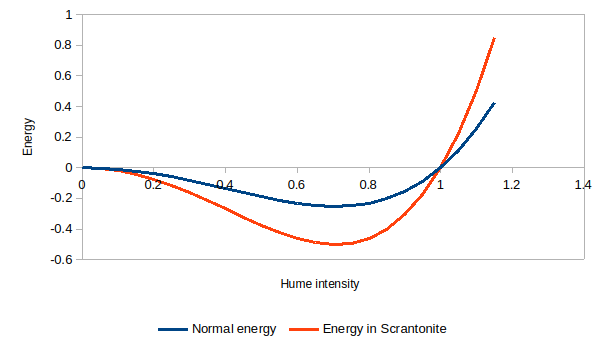
A comparison of the energy of the hume field in normal environments and inside scrantonite. Note how it takes far more energy to change the intensity of the hume field in scrantonite. Not to scale.
This means that altering its hume value is very energy-intensive, thus the hume value of scrantonite is mostly unaffected by the external hume field. Additionally, the hume/EVE coupling constant spikes, drastically increasing the mass of vitons passing through it.
This alpha/beta spike means that scrantonite has a very constant hume value, requiring a lot of energy to alter, which means that it can pump humes around like any other fluid. And the drastic mass increase means that any EVE that intersects with scrantonite is deflected and scattered. This is why rough scrantonite is preferred in anti thaumic applications to prevent mirroring. Of course scrantonite microparticles, when injected into the bloodstream or implanted, also tend to disrupt the mill field of the soul, preventing thaumic casting. Thankfully this has never been used at scale.
One of the other interesting properties because of this fixedness is the Cyprog Junction. When two pieces of scrantonite are placed next to each other with an EVE insulator in the middle, like lead, the offset phase creates an EVE differential between the two. This differential generated from the EVE field can be treated as phase differences in the hume field. Furthermore a microwave interaction will create a fixed amount of EVE. This is less effective than how Evenhart resonators work, but the EVE generated is extremely exact and is thus used for calibrating EVE sensors.15 The SI unit for the casper16 is defined via this effect.
"Cold iron," AKA meteoric iron, is also a fascinating substance. Chemically it is just an iron-nickel alloy; however, it has a wide range of thaumic activity and is used in the construction of spellcasting focuses among other things. The most interesting part of cold iron is that it loses all magical properties when it is heated above 400°C, becoming a normal iron-nickel alloy. Thus, all cold iron must be cold worked. The formation of this is based in deep space, where the metal is held at a very cold temperature for billions of years. This annealing causes the defects in the mill field to totally equalize, leaving a totally smooth system. Once heated up to 400°C, this systematization is lost and cold iron loses all of its properties.
Finally, there are thaumically active minerals. Namely the thaumaorphicⓘThaumaorphicRocks altered by EVE flux to have magical properties, analogous to metamorphic rocks., igneaturgeⓘIgneaturgeThaumically active rocks infused by magic as they solidified, analogous to igneous rocks. , and effervementaryⓘEffervementaryThaumically active rocks composed of smaller ground up rocks, analogous to sedimentary rocks. rocks. These minerals also tend to have fixed mill structures, acting as mill spin glasses. This thaumic activity is the core of all thaumic properties. Igneaturge rocks form these structures as they are cooled while under high energies, in contrast, thaumaorphic rocks started with a normal mill structure, before becoming more glass-like with strong interactions with external fields.
The intense instability of effervementary rocks is because the constituent minerals are all out of alignment, which create vast numbers of domain walls at very high energies. As the minerals in thaumaorphic and igneaturge break down, they lose their alignments — thus, when they are reformed, they are all out of alignment.
The Strange Conservation Laws of the Hume Field
A key principle is that value of the hume field is conserved. Because the hume wavefunction is complex-valued, the observed hume field may not appear to be conserved, but inside the hidden phase the wavefunction is conserved.17 Consider two points that both have a hume value of one (natural units), and thus also an observed hume value of one. Then, via some form of interaction, some hume value moves from one point to another. A unit of hume value might move from one point to another, such that one has a hume value of two (and thus an observed hume value of four as the observed hume value is the square of the hume wavefunction) and the other has a value of zero, creating the Scranton quadratic bias effect. Alternatively, an imaginary unit of hume value may move from one point to another so that one point has a hume value of 1+i and the other has a value of 1-i, here both points have an observed hume value of square root of two. While the observed hume value is nonconserved, the true hume value is. Hume conservation is a function of the invariance of reality to changes in perspective; interactions that change with different perspectives may not conserve the hume field.18
Temperature Fluctuations and Anomaly Formation
Given so much of the mill and hume fields are temperature dependent, environments with frequent temperature fluctuations will have an elevated level of non trivial hume and mill structures. These structures are behind most paranormal activity. Regions with such rapid and constant temperature fluctuations are the Saharan desert, Siberia, and the continental United States. Oceans, with their more stable temperatures, tend to have a much lower level of paranormal formation. Though, with oceans being big, there are still a lot of strange fish in the sea.
False Vacuums and Decay
Given that the mill fields are always in a high-energy state, this means that we exist in a thaumic false vacuum and that a more stable state for the universe exists. Changes in global structures could lead to a slow change in the mill fields drastically changing the nature of all entities that interact with magic as we know it, or a massive high-energy event which could lead to a dramatic and sudden change in it, completely destroying magic as we know it.
Assignments
For all assignments assume that there are zero akiva fields. Furthermore assume that the mass of the hume is 0.1eV, the hume self interaction coefficient is 0.25 and the EVE interaction term is 1. Use natural units.
Compute equilibrium hume value
Calculate the expectation value to the hume field with no EVE fields.
Question one: Calculate the energy of a hume field
Let $\psi = \psi_0 e^{i(\vec{K}\cdot \vec{X})}$ where K is some vector and $\psi_0$ is the vacuum expectation value of the hume field.
Compute the average energy density of this hume field in the absence of an EVE field.
Question two: Covert an EVE field to a hume field
Let $\vec{V} = (0,e^{irx},0,0)$ be the EVE potential and $\psi = \psi_0$ AKA the unitary gauge. Convert this from the unitary gauge to the scranton gauge.
Question three: Construct the relativistic lagrangian
Given the non relativistic free energy equation, construct the full relativistic lagrangian.
Next chapter: Self Defence Against Bears
Source: SCP Foundation · CC BY-SA 3.0
Community rating
Was it worth the sleep you're about to lose?