The 7th Occult War: The Role-Playing Game
Play as a member of the Allied Occult Initiative and participate in pulp action adventures during the Seventh Occult War.
Play as a member of the Allied Occult Initiative and participate in pulp action adventures during the Seventh Occult War.
Suggested Listening: "Veteran of the Psychic Wars" by Blue Öyster Cult
This RPG Kills Fascists.
Here's my Author Page.
— GW
Suggested Listening: "Primo Victoria" by Sabaton
Writing this nearly killed me. It's the best thing I've ever done, and I couldn't be more proud of it. Kill the fascists. Win the war. Good luck.
Here's my Author Page.
— DrGrimoire
Suggested Listening: "Put Traffic Cones Over Tear Gas Canisters" by Doll Chaser
Kill 'em all and let God sort them out. I'm so happy seeing how this has shaped up over the past few months(??). RIP tabs, I hardly knew ye.
— Anorrack
Suggested Listening: "Dead Nazi Stomp" by the Hub City Stompers
i keep changing my mind on what song to put here. maybe i should make a playlist. kill nazis. it's good for society.
— ch00bakka
Suggested Listening: "War Pigs" by Black Sabbath
Tis a game. Have fun and tell a story. And check out my art!
— Gelbsucht_IE
Suggested Listening: "Life During Wartime" by Talking Heads
"It's one balance pass, Ty. How long could it take? Two hours?"
Here's my author page!
— TyGently
|
Contents
Rules
Core Rules
Common Terms
The Zeroeth Rule
Specific Beats General
Tags
Rolling the Dice
Checks
Attacks
Saves
Accuracy and Difficulty
Statistics
Story Phases
Combat Scenes
Actions and the Turn
Non-Combat Scenes
The Mission
The Briefing
Insertion
Operations
Exfiltration
Advanced Rules
Operatives
Operative Creation
Backgrounds
Organizations
Archetypes
Skills
Levelling Up
Basic Actions
Tags
Talents
Organization Talents
Gormogon Talents
BOS Talents
Templar Talents
ICSUT Talents
GRU-P Talents
Scholomance Talents
Archetype Talents
Clairvoyant Talents
Conjurer Talents
Evoker Talents
Guardian Talents
Infiltrator Talents
Knight Talents
Ritualist Talents
Soldier Talents
General Talents
Equipment
Armor
Melee Weapons
Ranged Weapons
Other Equipment
Heavy Munitions
Thaumaturgy
Basic Workings
High AP Workings
Non-Combat Workings
Working Lists
Universal Workings
Battlefield Architecture
Demonology
Greater Demonology
Gormogon Antimasonry
Grand Occident Rites
Unified Rites
High-Energy Rituals
Unified Evocations
Scholomance Necromancy
Advanced Necromancy
Scholomance Wards
Solomonari Rites
Lore
Organizations
Allied Occult Initiative
Neutral Powers
Axis Forces
Locations
Allied Occult Initiative
Neutral Powers
Axis Forces
Characters
Allied Occult Initiative
Neutral Powers
Axis Forces
Timeline
GM Tools
Gamemaster Guide
Using Skill Checks
Designing the Mission
Insertion and Exfiltration
Optional Rules
Bestiary
AOI Vehicles
Demons
Mundane Creatures
Obskuracorps Troops
Obskuracorps Specialists
Obskuracorps Vehicles
Supernatural Creatures
Spirits
The Undead
Sample Mission: The Battle of Prague
Other
Resources
Frequently Asked Questions
Inspirations
Changelog
Credits
Index
Introduction
The World Is At War.
Europe has fallen. Hitler's armies have swept through Poland and France. In the East, the Red Army fights a grueling war of attrition, forcing the Nazis to pay for every inch of ground. In the West, Great Britain remains resolute, despite regular bombardment by the Luftwaffe. Across the sea, American factories roar to life, churning out munitions by the millions. All of the world's energies are turned towards one thing: total war against the Axis.
You already know about that war. This is not that war.
Europe has fallen. Nazi occultists loot and pillage the ancient and sacred places of power with impunity. Thule sorcerers sacrifice hundreds in perverted rituals. The forces of evil are hellbent on a singular goal, although only they know what it is. Arrayed against them is a desperate coalition of strange bedfellows — secret societies, holy orders, research institutes, governments-in-exile, military units, resistance cells, mercenaries, and more — united in one cause: to stop the Nazis, by any means. They will use every science and magic at their disposal to wage a parallel war. A secret war. An Occult War.
This is the Seventh Occult War. And the stakes are the fate of the world.
A Message From The Designers
This is a game about killing fascists. We want to emphasize this, so we'll say it again: This is a game about killing fascists.
The members of Obskuracorps you will face are awful, evil people. Each and every one of them has made an active choice to participate in Obskuracorps' plans, because "just following orders" is no excuse. If you find yourself wanting to play as one of them, do not play this game. You are not welcome here.
However, as long as that is not you, you are welcome here. This is a game for everyone, and should be played with friends who accept you for who you are. While in the 1930s and '40s the mundane world was deeply racist, sexist, and homophobic (as well as bigoted in virtually every other way), the occult world was already less so. While the canonical AOI was certainly not progressive by today's standards, there is no reason your individual version cannot be, if it's what makes you and your friends more comfortable. Even in our canon, women served in every role, at every level of the AOI from its inception, and there's no reason that an organization which employs wizards and mad scientists should have any issues with fielding any other kind of person.
Remember that when you play this game you're working with your friends to tell a story. That experience should be fun and comfortable. There is only one hard and fast rule:
Kill All Fascists
Do you have questions or feedback, want to talk about the game, or want to find a group to play a campaign with?
Join our Discord!
Concepts
The following section is a brief overview of a few key concepts which may be unfamiliar to those who have not read the Seventh Occult War stories within the SCP Wiki's Third Law Canon.
The Anomalous
A catchall term for anything which does not obey the accepted laws of physics and science; anything which is super- or paranatural in nature. Historically, the Anomalous was a fact of life, however following the Sixth Occult War and the imposition of the Veil of Normalcy, and concurrent with the rise of the scientific method, the Anomalous has been suppressed, and the vast majority of humanity believes that the supernatural is nothing but folktales and legends.
Apportation
A powerful thaumaturgic working that allows for the instant teleportation of an object or person from one location to another, arbitrarily distant location. Apportation requires large amounts of EVE, equivalent to multiple human sacrifices, and produces a high level of backlash. Apportation is also inherently imprecise — targets frequently arrive multiple meters or more from their intended destination, which can have fatal results if this causes them to intersect a solid object. This targeting uncertainty grows larger the greater the distance being apportated. Despite this, apportation remains one of the most powerful applications of the parascience of unified thaumatology.
Elan-Vital Energy (EVE)
The fundamental particle of aetheric energy, which can be manipulated by some beings to cause seemingly-magical effects. The study of this energy, and the laws it obeys, is known as Thaumatology. Historically, human beings capable of manipulating this energy were known as wizards, sorcerers, shamans, warlocks, and countless other terms. EVE appears to be linked in some way to life and consciousness, though seemingly-simple animals are sometimes capable of manipulating or harnessing it, and inanimate structures may channel or affect it.
The manipulation of EVE causes Backlash, an often-unpredictable overspill of energy which can be deadly if not properly contained.
Everhart Resonator
A cutting-edge prototype constructed by Dr. John Everhart which allows the conversion of electricity into EVE. While the process still requires a thaumaturge to act as a catalyst, it is vastly more efficient than any other method of generating EVE, and as such allows the Allied Occult Initiative to regularly perform high-energy workings, such as Apportation.
Sixth Occult War
A large-scale occult conflict which occurred from 1875 to 1882. The war ended with the destruction of the Thaumarch, an ancient, artificially-constructed being with control over humanity's thaumaturgic potential. The backlash of its demise caused a mass-extinction of supernatural life, destroyed the pocket dimension containing the Kingdom of Avalon, and led to massive storms which killed thousands. At the end of the war, the world's various occult powers agreed to establish the Veil of Normalcy, concealing the existence of the anomalous from the general population. Additionally, the demise of the Thaumarch led to a steady uptick in the number of humans born with thaumaturgic potential.
Thaumatology
The parascientific study of paranormal phenomena historically referred to as magic. Originally developed by J.S. Carter by applying the newly-discovered field of quantum physics to what was then known as magic, the theory of Unified Thaumatology allows its practitioners unparalleled flexibility. It classifies what were once known as "spells" as "workings", and interprets EVE as having quantifiable, predictable properties much like any other physical phenomenon.
Veil of Normalcy
The policy of world governments and occult organizations to hide the existence of the supernatural from the public. Ostensibly intended to prevent the breakout of another Occult War, the Veil has instead had the effect of bringing occult organizations and mundane governments closer together, as they work together to establish "Normalcy Preservation" operations. In the fires of the Second World War, and concurrent Seventh Occult War, the Veil is closer to falling than it ever has been, as both Axis and Allies seek to weaponize the paranormal for their own ends.
Way
An anomalous connection between two universes, also known as "dimensions", or "worlds" which collectively make up the "world tree" — a multiversal structure of interlinked universes. Ways allow matter and energy to move between the universes of the world tree, acting as portals or gateways between realities; they can also be used as a means of transportation, for while a Way cannot link a universe to itself, it is possible to travel through one Way to a different universe, travel within it, and then cross through another Way to return to one's original universe, vastly shortening travel times.
Core Rules
This section contains the core rules necessary to play the 7th Occult War: The Roleplaying Game. These are the highest-level, most fundamental principles of the game, which are augmented by the rules in other sections.
Common Terms
Throughout this document, we use several shorthand terms to refer to recurring concepts. These include:
- 7OW:RPG: 7th Occult War: The Roleplaying Game; the game you are currently reading the rules for
- AOI: The Allied Occult Initiative, a coalition of supernatural and normalcy-preservation groups formed to oppose the Obskuracorps and their goals, within which all Operatives serve.
- Character: An entity in the game which is capable of making and being the target of rolls. Operatives and NPCs are characters.
- D2: A 2-sided die. These can be approximated by flipping a coin (heads is 2, tails is 1) or by rolling any even-sided die. When using another die, we recommend using all odd values as 1 and all even values as 2.
- D20: A 20-sided die, also known as an icosahedron.
- D3: A 3-sided die. We recommend approximating this by rolling a D6 and dividing the result by 2, rounding up. (ie. a result of 1 or 2 is 1, 3 or 4 is 2, 5 or 6 is 3)
- D6: A 6-sided die, also known as a cube.
- GM: The gamemaster, the player responsible for arbitrating the rules, narrating the events of the game, and controlling NPCs.
- NPC: A non-player character, typically controlled by the GM.
- Operative: A character controlled by a non-GM player, who is a member of the Allied Occult Initiative.
- Org: A member organization of the Allied Occult Initiative. Each Operative is a member of an org in addition to the wider AOI.
- Stat: Statistic, one of the core attributes shared by all characters, representing their capabilities and reserves.
- Tag: A tag is an atomic unit of rules which can be attached to virtually any game element. These indicate conditions, properties, and interactions; for instance, a character which is on fire has the Burning (x) tag. Tags are bolded and hyperlinked when mentioned in rules text.
- Talent: A talent is a rule which Operatives can gain access to by selecting it, which allows them to do things that would otherwise be impossible within the game's rules. Talents may be selected upon levelling up, or may be Base Talents, granted by an Operative's selection of Org and Archetype.
The Zeroeth Rule
The Seventh Occult War Roleplaying Game is a game about telling stories with your friends. The rules are there to guide you through that process, but at the end of the day, GMs should feel free to modify, ignore, change, or house-rule them however they see fit. What matters is that everyone has fun.
Specific Beats General
Sometimes, two rules will conflict. Most often, this will be because a talent, a piece of gear, or some other specific rule allows something that’s forbidden by the general game rules. When this happens, the more specific rule wins out. For example, the general rule that characters cannot move through solid walls is beaten out by the more specific rule that characters with the Spirit tag can.
If two equally-specific rules conflict, rules which allow actions or violations of other rules win out over rules which forbid such actions or violations. If there are still conflicts, whichever creates the more interesting, compelling story wins.
Tags
Tags are rules which are re-used throughout 7OW:RPG. They apply their rules to whatever they are attached to, and interact with each other and the core rules to create the mechanical “engine” of the game. Some tags have meanings which seem redundant or obvious; remember that what seems obvious to you might not be for everyone! You do not need to memorize or even be familiar with every tag to play this game, even if you are the GM, and over time you will learn the ones that are relevant to your group.
Rolling The Dice
In 7OW:RPG you will roll dice to determine the outcome of various actions. Whenever you see a reference to one of the dice terms mentioned earlier — D2, D20, D3, or D6 — that means "roll the indicated die and use the result". For example, a weapon which deals D6 damage means that when you inflict damage using it, you roll a single D6 and inflict the result of that roll as damage.
Sometimes, we will reference rolling multiple dice at the same time, which is notated as XDY. In such cases, you roll X dice of size Y, and add their results together. For example, to roll 2D6, you would roll 2 6-sided dice and add their results, giving a range of potential outcomes from 2 to 12. If there is no X before a dice term, you always roll a single die of the indicated size.
These rolls may also have modifiers, a + or - after them, indicating you should add or subtract that amount from the total result.
In addition to rolling dice whenever you see a dice term, you will also make several special types of rolls using a D20: Checks, Attacks, and Saves. When a rule specifies that it applies to "rolls" it specifically means these three kinds of D20 rolls.
Checks
Checks are tests of a character's skills (more on those later). Outside of combat, they are the most common type of roll you will attempt. Each check has an associated skill; if that skill has the Exceptional tag, then characters can only attempt to make checks using it if they have at least 1 Level in that skill.
To make a check, you simply roll a D20, add the relevant skill modifier, apply Accuracy or Difficulty (see below), and determine the result. If the total is greater than or equal to 11 (the Target Number), you succeed, while if it is less than or equal to 10, you fail. Under normal circumstances, the GM cannot alter the Target Number directly, but they can apply Accuracy or Difficulty to the check.
Attacks
Attacks are a special kind of check made to attempt to deal damage or some other harm to an opponent. They can be modified by any skill, though Melee (for close-combat attacks) and Ballistics (for ranged attacks) are the two most common skills used. Weapons that use a different skill are identified in their stat block, such as Grenades, which are an Athletics Weapon.
Unlike a standard check, Attacks do not have a standard Target Number of 11. Instead, their Target Number is the target character's Evasion statistic. If a character does not have an Evasion statistic, attacks targeting them automatically succeed. If the Attack is successful, it is said to have hit the target.
Additionally, unlike normal checks, Attacks can achieve Critical Hits and Critical Failures. A Critical Hit is achieved when the total result of the Attack roll, after all modifiers are applied, is at least 10 greater than the target's Evasion. A Critical Failure, meanwhile, is achieved when the total result of the Attack roll is at least 10 less than the target's Evasion.
On a Critical Hit, the attack has greater than normal impact. At the GM's discretion, you might:
- Apply a beneficial tag to the attack, like Armor-Piercing (x) or Ignores Armor
- Apply a detrimental tag to the opponent for a Round, such as Blind or Slow (x)
- Deal the maximum possible damage of the attack
- Gain a momentary advantage that helps you in another way
On a Critical Failure, you suffer a significant mishap. You might:
- Apply the Dulled (x) or Jammed tag to the weapon you used to make the attack
- Put yourself in a vulnerable position
- Gain Difficulty on your next action
- Suffer another momentary disadvantage
You may only make an attack against an opponent who is within range of the weapon you are using for that attack. This range is typically specified as a tag on that weapon, excluding weapons with the Melee tag, which are only able to attack targets in hexes adjacent to the character making the attack.
Multi-Weapon Penalty
If a character makes an attack using a weapon with the Range tag, if they have made attacks using different weapons with the Range tag on the same turn, they make that attack with Difficulty equal to 2 * the number of other weapons they have used on their turn.
For instance, if a character were to take three Attack actions on their turn, the first with a Pistol, the second with a Carbine, and the third with the same Pistol as the first attack, the first Attack would be made with no added Difficulty, the second with +2 Difficulty, and the third with +2 Difficulty.
Saves
Saves are checks made to attempt to defend against negative effects. Like Attacks, Saves may have a target number that is different from 11, usually based upon the stats of the opponent forcing the character to make the save. A save will specify the skill required (referred to as the skill the save is against), and the roll is made as if it were a standard check (that is, by rolling a D20, adding the relevant skill, and applying Accuracy or Difficulty). If the Save is failed, the character making it suffers the negative effect specified by the action forcing the save, while if it is succeeded, they do not.
If a Save is made which requires a skill with the Exceptional tag, and the character making the skill does not possess that skill, they automatically fail that Save.
Accuracy and Difficulty
Accuracy and Difficulty are mechanical representations of how various advantages and disadvantages affect a character's checks, attacks, and saves. The source of Accuracy or Difficulty will specify which rolls it applies to, and the duration for which it applies. There is no limit to how much Accuracy or Difficulty that may apply to a given roll. If a character has Accuracy or Difficulty, they must apply them to every roll they affect for their entire duration.
Accuracy and Difficulty cancel each other out at a 1:1 ratio. Thus, making a roll with +2 Accuracy and +1 Difficulty is the same as making a roll with +1 Accuracy.
To make a roll with accuracy, roll a D6 for each Accuracy applied. After rolling all of these D6, take the highest result and add it to the total of the roll.
Difficulty works in the opposite way. For each Difficulty applied, roll a D6, and then subtract the highest result from the total of the roll.
The Roll Formula
Checks, Attacks, and Saves all calculate their result according to the following formula:
Total Result = D20 + Skill Level [+ (Highest Accuracy Result) or - (Highest Difficulty Result)]
Statistics
Every character in 7OW:RPG has statistics, or stats, representing their physical and mental capabilities and reserves. Every stat has a max and a current value.
If a rule states that a character regains a stat, they increase their current value, but not above their max. If a rule instead says that the character gains a stat, then that effect may bring them above the stat's listed max. Stats cannot be reduced below zero unless otherwise stated.
Unless specifically stated otherwise, all rules referring to a stat refer to the current value of that stat.
The stats characters have are:
Health
Health is a measure of a character’s physical ability to take punishment. At the start of each mission, your Health is equal to its max. Unless otherwise specified, attacks which deal damage to a character reduce their Health by that amount, to a minimum value of 0. A non-player character reduced to 0 Health dies; see Death under Advanced Rules.
An Operative reduced to 0 Health instead gains the Prone, Unconscious, and Dying (1) tags, and increases their Wounded (x) tag by 1. If still present, this Unconscious tag is removed at the end of the scene. If an Unconscious Operative with the Wounded (x) tag takes damage, they increase their Wounded (x) tag by 1.
If a character is Unconscious due to falling to 0 Health and regains health, they remove their Unconscious tag after 1D6 - [Health Regained] rounds, or immediately if the result is less than 1.
Once per scene, if an operative would be reduced to 0 Health by an attack, they may choose to spend 1 point of Willpower to remain standing. If they do so, they remain at 1 Health after the attack is resolved and increase their Wounded (x) tag by 1.
Willpower
Willpower is a measure of a character’s mental toughness and focus. At the start of each mission, your Willpower is equal to its max. A non-player character reduced to 0 or lower willpower gains the Broken tag. An operative reduced to 0 or lower willpower gains the Unconscious tag for 1D6 rounds, and reduces their Max Willpower by 1 for the duration of the mission. This effect stacks.
Armor
Armor is the amount of physical protection a character has against attacks. A character subtracts their Armor value from any damage they suffer targeting their Health stat.
Speed
Speed is a measure of how far and fast a character can move. In combat scenes, a character can move a number of hexes up to their Speed using the Move action.
Encumbrance
Encumbrance is a measure of how much gear and equipment a character can carry without being overwhelmed. Operatives may start each mission with a loadout of gear whose total Bulk does not exceed their Encumbrance. If during the mission they acquire items such that their carried Bulk exceeds their Encumbrance, they gain the Slow (x) tag, with x equal to the difference between their Carry Weight and their Encumbrance. This tag is removed once their Bulk is reduced to less than or equal to their Encumbrance.
Evasion
Evasion is how difficult a character is to hit with attacks. Attacks targeting a character must have a result equal to or greater than their Evasion statistic to hit them.
Stat Modifiers
In some cases, a Check or Save may be made with a Stat instead of a Skill. In such cases, the modifier to the Check or Save is calculated as follows. This modifier is used in place of a Skill value.
Evasion, Health, and Willpower: Current Stat Value - 10
Armor or Speed: Current Stat Value
Encumbrance: Current Stat Value - Current Carried Bulk
As such, a character with a Health Stat of 12 would make a Health Save with a +2 bonus, a character with an Armor Stat of 1 would make an Armor Check with a +1 Bonus, and a character with an Encumbrance Stat of 5 and a Carried Bulk of 6 would make an Encumbrance Check with a -1 Penalty.
Skills
In addition to Statistics, characters may have Skills. These are explored in greater detail in the "Operatives" section. NPCs may also have skills, which follow the same rules.
Story Phases
Games of 7OW:RPG are stories, and those stories are broken down into a few subdivisions, or phases, which represent varying and flexible amounts of in-universe time. The highest-level subdivision is the Campaign. A campaign is an overarching story focused around the adventures of a team of operatives. Throughout a campaign, operatives will grow and develop, die and be replaced, and fight the good fight against fascism generally and Obskuracorps specifically.
Each campaign is itself divided into Missions. A mission is a specific deployment of the operatives into an area to achieve a goal. During the mission, the operatives engage with the world, fight battles, or solve puzzles, all in the pursuit of that mission's objectives. After completing a mission, operatives return to their base and level up (see more on this in the Operatives section). They, and any allied characters, also clear all negative and positive tags not innate to them and their equipment (again, see more on this in the Operatives section), and restore all their Stats to their base values.
A mission may play out over one or several Sessions. A session is any length of time where a group is together and actively playing the game. The length of these may vary; some groups like day-long marathon sessions, while others prefer brief one-hour long ones. There is no "right" length of a session, though we advise that GMs try not to end in the middle of a Scene.
A scene is the next level of division below a mission, and each mission is made up of many scenes. In a scene, the characters engage with some event or challenge, which defines the nature of that scene. These events may be fairly low-stakes, such as sitting around the fire swapping stories, or extremely high-stakes, like a pitched firefight. Their in-game length may vary as well, from just a few seconds to several hours.
Scenes are divided into two broad categories, which operate under different rules: Combat Scenes and Non-Combat scenes.
Combat Scenes
In a combat scene, characters fight their enemies using their talents and their weapons. Each combat scene is divided into rounds, which are themselves divided into turns.
A round is a flexible unit of time, within which each character takes exactly one turn. A new round begins once every character has taken a turn.
A turn is a character's time to act during a round. During their turn, each character performs Actions to attempt to influence the battle to their benefit.
At the beginning of a round, the players nominate one Operative to take the first turn. If they cannot agree, the Operative who acted last in the previous round gets the first turn. Then, the GM selects one enemy NPC which has not taken a turn this round, and plays out their turn. The player who took the previous turn then selects another player who has not taken a turn yet this round to take the next turn, and the process repeats until all characters have taken their turn. Non-player allies of the players can be nominated to take their turn as if they were players, with players either choosing their actions collectively or nominating one particular player to control them.
After all eligible characters from one side have taken their turn, if not all characters on the other side have taken their turn, then those characters which still have turns to take perform theirs sequentially, until there are no characters on the battlefield which have not taken their turn.
After all characters have taken a turn, the round ends, and a new round begins.
Combat Scenes are played out on a battlefield, a map of the location in which the combat is occurring. A battlefield is represented by a grid of regular hexagons, called "hexes" or "hex". Each side of a hex is a meter long, and characters move across and interact with these hexes in the course of combat. Hexes may also be occupied by terrain features, which mechanically represent the attributes of objects, structures, and effects on those hexes.
At the start of a Combat Scene, the GM places the terrain features and enemy NPCs on the battlefield, and typically allows players to select their operatives' positions within a specified area of the battlefield.
A Combat Scene usually ends when all characters on one side have died, fled, or surrendered.
Actions and the Turn
At the start of a character’s turn in a combat scene, they gain two Action Points (AP). These AP can be spent on performing various actions, which specify their AP cost in their description. Should no cost be specified, an action costs 1 AP to perform. Characters may perform any combination of actions they desire on their turn, including repeating actions. In addition to spending their two AP, characters may perform one action with a cost of "Bonus". Only one Bonus Action may be taken per turn.
Any AP not spent at the end of a character’s turn are lost.
All characters may perform any action or bonus action listed in the Basic Actions section in addition to any other actions to which they have access.
Non-Combat Scenes
In non-combat scenes, characters advance their mission by talking to NPCs and interacting with the world. The only rolls characters typically perform during these scenes are checks. There is no strict turn order in these scenes, with players able to act and move around the world in fluid ways, though GMs should ensure that all players get an equal opportunity to be in the spotlight during non-combat scenes.
The Mission
A mission is a formal military deployment of capable operatives by the Allied Occult Initiative, and as such is fairly rigidly broken down into a four-phase structure. Operatives are active participants in each of these phases, though in different ways.
These phases are:
The Briefing
At the start of a Mission, the operatives receive a briefing from their AOI superiors about the mission they are to be deployed on. This briefing is usually a single scene, set inside of a briefing room (usually a converted classroom), where they are given mission parameters, objectives, and relevant intelligence. These always include:
- Details of the AO, or Area of Operations: the location or area in which the mission will take place.
- The actual goals of the mission: typically a target to eliminate, a facility to destroy, an item to recover, or a character to retrieve.
- Relevant intelligence about the opposition. The AOI always attempts to give their operatives as much relevant information as possible, but actually getting that information can be very difficult. The GM is under no obligation to tell the players every opponent that they are up against, but a general warning about certain hazards which require preparation for is typically appropriate.
During the briefing, operatives are free to ask clarifying questions, though often the answer to requests for more detail is "we do not know".
In this phase, the operatives should begin making a plan for how they intend to achieve their goals. The AOI does not provide them with a step-by-step walkthrough; they trust their operatives to figure out the details on their own.
Before the end of this phase, operatives also select which equipment they wish to bring along on the mission. Each operative can select equipment issued by the AOI or the Org of which they are a member, provided they meet all other requirement for that equipment. Operatives may not start the mission with a total Bulk greater than their Encumbrance stat.
Also before the end of this phase, characters with access to Workings select which of the ones available to them they will memorize for the mission, up to the limit described in the Thaumaturgy section.
Insertion
In the insertion phase, which is usually a single scene, the players enter the AO. There are many methods by which this can be achieved, all with advantages and disadvantages, most with the potential for serious failures. A failed insertion can be an interesting way to shake up the mission structure, since it may radically reduce or change the resources the Operatives have available, start them in a worse position, or both, but GMs should be careful not to make such failures too common!
A full overview of the available methods of insertion, and their risks and benefits, is included in the GM Tools section.
Operations
In the Operations phase, the Operatives travel through the AO and attempt to accomplish their goals. This is by far the largest phase of the mission, and will be made up of a mixture of Combat and Non-Combat scenes. They will encounter resistance, solve problems, and improvise on the fly as they pursue their goal, sometimes with far-reaching consequences.
Before issuing a mission, the GM will typically spend time preparing events and encounters for this phase. Advice on doing so is provided in the GM Tools section.
Exfiltration
In the exfiltration phase, the Operatives attempt to leave the AO, by either prepared or improvised means. This can be a single scene if all goes well, or several if the team must improvise.
Advanced Rules
The following rules govern specific terms, interactions, and general principles important to the running of the game. Many of these rules may seem obvious or extremely specific. They exist to close potential loopholes or to allow groups to settle frustrating debates around minutiae.
Actions Outside Combat
At the GM’s discretion, any action may be performed outside of combat. The time required and results of these actions should be adjusted by the GM to reflect their narrative impact.
Armor Coverage
Armor items specify which body parts they cover: Head, Chest, Legs, or Full-Body. You may not have more than one item of armor which covers the same body part. Full-Body armor covers Head, Chest, and Legs.
Armor Mitigation and Damage
If a character takes 0 damage from an attack as the result of their Armor, they are not considered to have taken damage from that attack.
Battlefield Medicine
An Operative can attempt to perform a First Aid check outside of combat to stabilize a character. In order to do so, they must be able to touch the character they wish to stabilize. If the check is successful, it reduces the value of the target’s Wounded (x) tag by 1. A result of 20 or above instead reduces the value of the target's Wounded (x) tag by 1D3 + 1.
A character may only receive Battlefield Medicine once per non-combat scene.
Coup de Grace
Any valid attack against a target with the Unconscious tag can be declared to be a Coup De Grace. If the attack is successful, damage is not applied; instead, the character is instantly killed.
Death
When a character dies, they are removed from the battlefield, leaving behind a Corpse terrain feature on the hexes the character occupied at the time of their death (see below).
Corpse
Health: See Below
Armor: See Below
Special Rules: This terrain feature inherits all tags the dead character possessed at the time of their death which are applicable to terrain features. This terrain feature has Health equal to the Maximum Health of the dead character, and Armor equal to that of the dead character. This terrain feature gains the Cover (x) tag with x equal to half the value of the dead character's Size (x) tag. The Corpse remains equipped with any weapons the dead character was equipped with, but may not use them.
Tags: Passable
Driving Vehicles
Some vehicles specify a minimum Drive skill requirement to operate them; characters without this Drive skill can attempt a Drive check with Difficulty equal to the minimum skill to operate them. If not stated, no Drive skill is required; the vehicle is assumed to be so similar to a civilian equivalent that it can be operated without difficulty.
Duplicate Terrain Features
While hexes may possess multiple unique Terrain Features, they may not possess more than one copy of any given Terrain Feature. Actions which would place a certain Terrain Feature into a hex that already possesses that Terrain Feature have no effect. For instance, a Bone Wall working cannot affect hexes which already contain a Bone Wall Terrain Feature, and operatives cannot place a Frag Trap on a hex that already contains a Frag Trap.
Expending Stats
If a rule states that a character expends a stat, they reduce their current stat value by the indicated amount. This reduction is not treated as damage for rules which reduce damage, such as the Armor (x) tag.
This rule also applies to Skills.
Fall Damage
For every 3 meters of distance beyond a safe fall distance of 3 meters a character falls, they take 1D6 damage. This means that a 6 meter fall causes 1D6 damage, a 9 meter fall causes 2D6, etc. At GM discretion, this may be waived if a character lands on a soft surface. Falls of greater than 30 meters are instantly lethal.
Flight, Levitation, and Terrain
In some cases, a character with the Fly tag might want to move across hexes which have tall terrain features, huge pillars of fire, or other circumstances which seem too substantial to be ignored. In such cases, the GM may decide that the character cannot move across those hexes, or that doing so will still treat the character as having occupied those hexes.
Characters with the Levitate tag can float above many terrain features, but they do not get to ignore the effects of hexes in the same way that characters with the Fly tag do. For their movement, GMs should consider them as moving across a plane of hexes above the battlefield. Some features from below might extend up into this plane, and those features would apply their terrain effects as appropriate.
Increasing and Decreasing Tags
If a rule states that a tag a character does not possess should be increased, that character is treated as having that tag at level 0 before the increase is applied. For example, a rule which states “increase a character’s Wounded (x) tag by 1” would give a character without the Wounded (x) tag the Wounded 1 tag.
If a rule states that a tag a character does not possess should be reduced, it is ignored. If a rule states that a tag a character does possess should be reduced, the value of the tag is reduced by the amount specified. If the new value of the tag is less than or equal to 0, the tag is removed.
Languages
At the time of the 7th Occult War, multilingualism was far less common than it is today, and in many languages, accents were far stronger, sometimes to the point of unintelligibility. In general, we assume that all AOI operatives speak English as a common working language, a legacy of the Initiative’s founders being majority English, and German, as the AOI trains its soldiers to understand the language of their enemy. If your character comes from a country which speaks a language other than English and German, you can assume they are fluent in the language of that country as well.
Measuring Distances
When measuring distances from an origin point to a target point, select the smallest possible number of contiguous hexes which start at a hex adjacent to one containing the origin point, and end at the hex containing the target point. The number of selected hexes, which includes the endpoint but not the origin point, is the distance between the start and end point.
Measuring with Large Characters
When measuring distances to or from a character which occupies multiple hexes, any hex that character occupies is a valid start or end point for measurement.
Multi-Weapon Penalty
If a character makes an attack using a weapon with the Range tag, if they have made attacks using different weapons with the Range tag on the same turn, they make that attack with Difficulty equal to 2 * the number of other weapons they have used on their turn.
For instance, if a character were to take three Attack actions on their turn, the first with a Pistol, the second with a Carbine, and the third with the same Pistol as the first attack, the first Attack would be made with no added Difficulty, the second with +2 Difficulty, and the third with +2 Difficulty.
Overencumbrance
Characters with a total Bulk greater than their Encumbrance stat gain the Slow (x) tag, with x equal to the difference between their Carry Weight and their Encumbrance. This tag is removed once their Bulk is reduced to less than or equal to their Encumbrance.
Pulling Punches
When making a melee attack against an opponent, a character may declare that they are pulling their punches, or attempting to avoid killing their opponent. As long as a character is pulling their punches, their attacks gain the Non-Lethal tag, however they also gain +1 Difficulty on all Attack actions as they deliberately strike away from vital areas.
Rounding
Whenever a calculation performed as part of 7OW:RPG results in a fraction or decimal, that result should be rounded up to the nearest whole number.
Selecting Targets
When a rule states that it selects a character or characters, the selected character or characters are considered the target(s) of that rule.
When a rule specifies that a character must select a target or targets, unless otherwise stated, they may only select target(s) to which they have a sightline.
Self-Targeting
Characters are always able to target themselves with actions which require the selection of a target character, unless that action specifies a condition which the character does not meet.
Sightlines
A sightline is an imaginary straight line drawn connecting the center of one character’s hex to the center of another character’s hex. If that line is unbroken (ie, it does not pass over any terrain with the Blocks Vision or similar tags), the sightline is said to be valid and the characters are said to have line of sight to each other. A sightline cannot be drawn to a target that crosses over the central hex of a character with a Size (x) tag that is more than double the target’s Size (x) tag.
Summon Limit
Each Operative has a Summon Limit equal to half their level. Operators cannot perform actions with the Summon tag which would cause the number of characters with the Minion and Controller (Operative) tag to become greater than their Summon Limit.
Tag Transience
Certain tags are transient; that is, elements with a tag automatically apply them to certain other elements. Specifically:
- A weapon used to make an Attack action applies all tags on that weapon to that Attack action.
- Damage caused by an action automatically receives all tags from that action. However, these tags only apply effects if the tag specifies it has an effect when applied as damage. For example, damage dealt by an attack with the Explosive (3) tag itself has the Explosive (3) tag, but that damage is not applied to all characters within 3 hexes of the character receiving the damage, since the Explosive (x) tag has no effect on damage.
- Terrain features apply all tags they have to the hexes they occupy.
Terrain Feature Stats
Terrain Features with a Health stat may be targeted by attacks as if they were characters, and are destroyed when their health is reduced to 0. Such terrain is treated as having an Evasion of 11. Terrain without a Health stat is considered indestructible, though may be removed at GM’s discretion if subjected to sufficient punishment.
Too Stubborn to Die
Once per scene, if an operative would be reduced to 0 Health by an attack, they may choose to spend 1 point of Willpower to remain standing. If they do so, they remain at 1 Health after the attack is resolved and increase their Wounded (x) tag by 1.
Within vs. Wholly Within
If a rule states that it applies to a target Within x of a point, any target which occupies at least 1 hex which is x or fewer away from the origin point has that rule applied.
If a rule states that it applies to a target Wholly Within x of a point, it is only applied to a target character if all hexes that character stands on are within x of the origin point.
Your Level vs. Your X Level
In cases where a rule refers to “your level”, it refers to your overall character level. If a rule instead refers to your level in a skill, ie. “your Athletics level”, it refers to the level of the specified skilll.
Yourself vs. Your Position
For the purposes of measuring ranges and distances, the phrases “yourself” and “your position” are to be considered equivalent, both referring to the hex your character occupies.
Operatives
Player characters in 7OW:RPG represent operatives of organizations (Orgs) within the Allied Occult Initiative, or AOI - a joint effort between occult, scientific, religious, and government entities operating below the Veil of Normalcy, united in their opposition to the Obskuracorps and its goals. The AOI largely corresponds to the Allied powers in the mundane conflict of World War 2, while the Obskuracorps and its allies are agencies of the Axis powers.
Your Operative is your actor in the story the group is telling. They are the weapon you personally wield in the 7th Occult War, and you should forge that weapon to be one you’re excited to use. They’re also people. Extraordinary, unusual people, but people nonetheless, and fleshing them out as more than just a set of statistics makes the war, the game, and the experience better for everyone.
Operative Creation
This section guides you step-by-step through the creation of an operative. While there are many rules to follow, the most important is this:
Be a Team Player
Your operative has been selected to play a role on a team, and as their player it is your duty to make them an effective part of that team. Your teammates are your friends, and you should be rooting for them! Even if you want to create a loner character, you should be sure that they still are someone their teammates can rely upon and trust.
From this point on, you will likely need a character sheet to continue. This is available in the Resources section. Each step will indicate statistics, skills, and talents to add to your character sheet, and you should be sure to record those changes as you make them.
Step 0: Core Concept
Before you make any mechanical choices about your operative, you should come up with a core concept for who they are, both on and off duty. The more fleshed-out and lifelike your core concept is, the more fun you'll have playing as that operative. We recommend answering the following questions to develop your core concept:
- Who were they before the war started? Were they a researcher, a soldier, or something more esoteric?
- How did they find out about the supernatural? Were they born behind the Veil, did they stumble upon it, or were they told of its existence by someone else? Some characters may have been born with supernatural abilities, but that does not necessarily mean they were born knowing about the supernatural
- Why did they join the organization they serve? Were they recruited, did they happen upon it and fall into its ranks, or were they given little choice?
- Where are they from? In the early 20th century, your place of origin mattered a lot more than it does today. Even within America, regions had strong cultural and sometimes linguistic barriers, which have since been eroded by mass media.
- What do they look and act like? What is their personality? Use the answers to the previous questions to inform your answer, or work backwards.
Step 0.5: Base Statistics
Before you have made any choices, your operative is an average human, and has the following statistics:
Health: 10
Willpower: 10
Armor: 0
Speed: 3
Encumbrance: 5
Evasion: 11
Additionally, they have the following tags:
Faction (AOI), Human
Step 1: Background
Select one of the backgrounds listed in the backgrounds section. Your background is who your operative was before they joined their organization, or the role they filled within their organization. The mechanical consequences of these are minor, but they can be a great way to help tie in to the questions you just answered.
Step 2: Organization
Select the AOI member organization your operative is a member of, from those listed in the Organizations section below. This choice provides you with increases to your base statistics and skills, determines which archetypes you can pursue, and gives you your first Base Talents. A Base Talent is a talent granted by your choice of Org or Archetype, and generally cannot be taken outside of operative creation. Together, these define your role in the wider occult world, and the unusual tactics you can bring to bear on the field.
As an example, if you chose to make a character who is a member of the Gormogons, they would increase their Ballistics, Combat Engineering, and Thaumatology skills by 1, their Willpower stat by 1, and get the Gormogon Arts and Thaumaturgy talents.
Step 3: Archetype
Select one of the Archetypes listed under your org. Your archetype defines your role on a mission — how you apply your abilities on the battlefield. When you select your archetype, you automatically gain two talents: the base talent for that archetype, listed in the Archetypes section, and one talent that represents how your Org teaches you to embody that archetype, listed in the Organizations section.
Continuing the previous example, if you chose to make your Gormogon character a Ritualist, they would get the Unified Rites Talent (from their archetype), and the Precision Demolitions Talent (from being a Gormogon Ritualist).
Step 4: Increase Skills
In addition to the skills you are provided by your Background, Org, and Archetype, you have 6 points to spend increasing your skills. At Operative Creation, you cannot increase any skills with the Exceptional tag that you do not already have at least one level in, and you cannot raise any skill above +3. See the Skills section for descriptions of all the available skills.
Step 5: Select a Talent
In addition to the Base Talents provided by your Org and Archetype (see steps 2 and 3), you may select a single non-Base Talent for which you meet all requirements. These can be found in the Talents section of the rules. This can be an opportunity to connect your character firmly to their backstory, advance your Class development early, or just pick up an ability which you think looks interesting.
Backgrounds
Athlete
You were an athlete, whether professional or amateur, and spent a substantial amount of time improving your physical strength and stamina.
+1 Athletics
+1 Melee
Artist
You were an artist, or possibly an Anartist, expressing concepts through a medium and developing an eye for detail and composition. While you may have worked other jobs to make ends meet, your passion was always first for your craft, and second for any other employment.
+1 Camaraderie
+1 Deceit
Criminal
You were a criminal. You might have been part of a gang or another criminal organization, or you might have worked alone. Either way, you broke the law for a living, and know all about scams, rackets, heists, and other criminal ventures.
+1 Deceit
+1 Stealth
Detective
You were a detective, maybe working for the police or as a private investigator. You may even have specialized in cases involving the Veil. You have an unusually sharp eye for detail, and a strong sense of intuition that lets you make sense of seemingly disconnected clues.
+1 Ballistics
+1 Camaraderie
Doctor
You were a doctor, almost certainly college-educated, and stayed on top of the rapidly-advancing field of medicine at one of its most exciting times. You likely remember the success of the miracle drug penicillin, and sulfa drugs before it, the introduction of insulin as a treatment for diabetes, and the invention of the iron lung.
+1 First Aid
+1 Science
Laborer
You worked a manual job for a wage, be it on a farm, in a factory, or at a store. Anyone from a butcher to a barber to an undertaker might be a laborer, and you were likely a member of the lower class, especially amidst the tumult of the Great Depression.
+1 Athletics
+1 Drive
Lawyer
You practiced law, either by yourself or as part of a law firm or government agency. You may have experience with Paralaw, the branch of law concerned with crimes and regulations below the Veil of Normalcy, or you may have spent your entire career in the more mundane arm of your profession.
+1 Camaraderie
+1 History
Merchant
You were a dealer and trader of goods. Whether you sold bulk commodities or dealt with more unique wares, you are intimately familiar with the flows of commerce. The Great Depression was hard for you, but rearmament and war have turbocharged the economy and brought a change in fortunes for many.
+1 Deceit
+1 History
Pilot
You flew aircraft, either for a commercial airline, another business, a military organization, or simply for pleasure. You are likely wealthy, educated, and highly respected, and know how to manage anything with a propeller and wings.
+1 Pilot
+1 Navigation
Soldier
You were a professional soldier in your nation’s military. Depending on your age, you may have fought in the Great War, one of the various imperial wars of the European powers, or one of the countless rebellions across the world as various ideologies vied for dominance.
+1 Ballistics
+1 Navigation
Scholar
You were a college-educated scholar dedicated to a particular field, in a time where only about one in ten people had more than a high school diploma. You may have been a professor, a scientist, or an engineer, working for a variety of institutions from the military to agricultural concerns.
+1 History
+1 Science
Organizations
Ancient Noble Order of the Gormogons (Gormogons)
Opponents of the Freemasons, the Gormogons are an elite corps of demolition experts specializing in destroying anomalous structures and breaking defensive wards. Gormogons are organized into local chapters, called Wedges, under the leadership of the Oecumenicus Volgi from the Grand Occident Wedge in London.
Skill Increases
- +1 Ballistics
- +1 Combat Engineering
- +1 Thaumatology
Stat Increases
- +1 Willpower
Base Talents
Archetypes
Evoker
Gormogon Evokers specialize in destructive applications of magic and backlash. They tend to be more flexible within their role compared to traditional Evokers, as membership in the Wedges requires an understanding of both ritual and evocation.
Base Talent: Explosive Evocations
Guardian
Gormogon Guardians are some of the earliest examples of EOD specialists. Their heavy armor and willingness to be caught in their own blast radius allows them to draw immense amounts of enemies in close, then punish them for their proximity.
Base Talent: Front Toward Enemy
Infiltrator
Gormogon Infiltrators specialize in controlled demolitions and sabotage, cracking enemy armor and ruining infrastructure far behind enemy lines.
Base Talent: Saboteur
Ritualist
Gormogon Ritualists use precision and careful planning to take out key points in any structure or enemy battle line, with minimal collateral damage.
Base Talent: Precision Demolitions
British Occult Service (BOS)
The premier occult agency of the British Empire, and one of the founders of the Veil. Long opposed to the Obskuracorps, they are the main political force behind the Initiative, and its primary connection to the Allied governments.
Skill Increases
- +1 Camaraderie
- +1 Deceit
- +1 Tradecraft
Stat Increases
- +1 Evasion
- +1 Health
Base Talent
Archetypes
Infiltrator
The greatest spies of a nation famed for its intelligence gathering, BOS Infiltrators use technological gadgets and skullduggery to appear where they are least expected and defuse enemy plots.
Base Talent: Quartermaster Division
Knight
Continuing an ancient martial tradition, BOS Knights charge into battle for King and Country, heedless of the dangers. They are true believers that it is the duty of the nobility to lead from the front.
Base Talent: Commando Crusade
Soldier
The odd fellows in the BOS, their soldiers lack noble birth or great wealth, but are well-trained, hard-fighting men and women with almost unbreakable wills.
Base Talent: Tommy
Holy Order of Knights Templar, Reformed (Templars)
Officially disbanded in 1312 by Pope Clement, the Knights Templar remained in hiding until 1939, when they reformed and founded the Allied Occult Initiative to oppose the Obskuracorps. As a founding member of the AOI, the Knights Templar enjoy substantial prestige within the organization. Their troops provide the backbone of the Initiative’s forces.
Skill Increases
- +1 Camaraderie
- +1 Melee
- +1 Templar Doctrine
Stat Increases
- +1 Health
- +1 Willpower
Base Talents
Archetypes
Clairvoyant
Templar Clairvoyants are members of the order blessed with holy visions or a sense of angels whispering in their ear. Many of them are believed to be on the fast-track to sainthood, as they seem to have a direct line to Heaven.
Base Talent: Holy Visions
Guardian
Templar Guardians are members of the Order’s inner circle who stride into battle with the name of God on their lips and heavy armor on their bodies. Their miraculous abilities and complete lack of fear make them the lynchpin of many AOI strike teams.
Base Talent: Guardian Angel
Knight
Templar Knights are inner-circle brethren of the Order who channel their faith into fire, wielding ancient, blessed longswords which strike like the wrath of an archangel.
Base Talent: Sainted Blade
Soldier
Templar Soldiers are the single largest contribution of the Order to the AOI, forming the Initiative's commando backbone. They bring faith and firearms to meet the enemies of God wherever they may lurk.
Base Talent: Divine Munitions
International Center for the Study of Unified Thaumatology (ICSUT)
The largest occult college in the world, ICSUT is the Allied Occult Initiative’s primary research partner. Founded in 1913, ICSUT specializes in the study and teaching of thaumatology — the scientific investigation of the mystic and occult.
Skill Increases
- +1 Science
- +1 Thaumatology
- +1 Veiled History
Stat Increases
- +1 Willpower
Base Talents
Archetypes
Conjurer
A rare and relatively new breed at ICSUT, their Conjurers specialize in summoning and binding the many species of demonic life that their research into the multiverse uncovers. Despite widespread prejudice against Demons, most ICSUT Conjurers see them not as biblical foes but as wondrous (if sulfur-smelling) forms of life to be studied and understood.
Base Talent: Demonologist
Evoker
Masters of natural and physical forces, ICSUT Evokers channel the raw forces of the universe into powerful battlefield magics. Most are graduates of the wartime battlemage programs, designed to pump out thaumatological support for the AOI as quickly as possible, with the promise of a broader education after the war’s conclusion.
Base Talent: Unified Evocations
Ritualist
Graduates of ICSUT’s longest-running program, its Ritualists are scientists first and foremost, with a vast repertoire of workings and a knack for remembering just the right one at just the right moment. Many of them are recruited out of labs and classrooms, and it is not uncommon to see a ritualist professor giving a mission briefing to her former students.
Base Talent: Inspired Memory
Main Intelligence Directorate, Psychotronics Division (GRU-P)
The Soviet Union’s primary paranormal defense agency, created shortly before the Second World War to protect the USSR from occult and paranormal threats while utilizing esoteric weaponry against the Union’s enemies. Despite the Molotov-Ribbentrop Pact between Nazi Germany and the Soviet Union, GRU-P has been covertly working with the Allied Occult Initiative to thwart the Obskuracorps since the beginning of the war.
Skill Increases
- +1 Deceit
- +1 Psychotronics
- +1 Tradecraft
Stat Increases
- +1 Evasion
- +1 Willpower
Base Talents
Archetypes
Clairvoyant
Initially trained as intelligence assets, GRU-P Clairvoyants have been pressed into combat roles after a series of early failures in developing a complete prophecy of the course of the war. Their brief insights into the near future and powerful psionic abilities, it was reasoned, would be better used on the frontline, where they would also be less of an embarrassment to the Directorate.
Base Talent: Remote Viewing
Infiltrator
Particularly strong telepaths recruited by GRU-P are conditioned to reduce empathy and increase willpower to the point they can dominate and control weaker minds. Currently the most promising avenue of the Directorate’s research, their Infiltrators enjoy prestige and choice appointments, and many are officially Red Army Commissars in addition to their clandestine duties, drawing a double salary with formal approval.
Base Talent: Mind Control
Soldier
GRU-P soldiers are trained from Soviet psychics with a particular aptitude for psychokinetic manipulation. Their ability to use their minds as a weapon more effective than any rifle is appreciated by military planners struggling to supply the massive Red Army with ammunition.
Base Talent: Psionic Barrage
The Scholomance
Located in Transylvania, the Scholomance is one of the most ancient schools of sorcery in the world. Its curriculum has a special focus on necromancy and other so-called “black magic”, which has given the school a less than positive reputation — its most famous alumnus is Vlad Țepeș, also known as Dracula, who is rumoured to now be an instructor there.
Skill Increases
- +1 History
- +1 Necrodynamics
- +1 Thaumatology
Stat Increases
- +1 Willpower
Base Talents
Archetypes
Clairvoyant
Natural gifts or divine visions are not the only way to learn the future. Scholomance Clairvoyants are experts at extracting snippets of prophecy from ghosts and other spirits, who have a tendency to become slightly “unstuck” in time.
Base Talent: Evil Eye
Conjurer
Never referred to as anything but Necromancers, Scholomance Conjurers specialize more than any other graduate of the school in the raising and binding of the undead, and go into battle surrounded by hordes of unliving minions.
Base Talent: Raised Hordes
Guardian
The Wardens of the Scholomance are the school’s order of Guardians, protectors and slayers of monsters equipped with shields of unliving bone. Their first duty is to protect the school from those who would steal its knowledge or otherwise threaten its halls, including Obskuracorps.
Base Talent: Bone Shield
Ritualist
Masters of dangerous and forbidden lore, Scholomance Ritualists sacrifice their own sanity for power. It is an unspoken fact that most threats put down by the school’s Wardens are Ritualists twisted and maddened by their own power.
Base Talent: Dark Rituals
Archetypes
Clairvoyant
Whether they read their enemies' minds or consult the spirits of the dead, Clairvoyants use their supernatural abilities to divine enemy intentions and battlefield conditions before they occur, manipulating fate and luck to their advantage.
Base Talent
Conjurer
All sorts of things can be brought into the world with magic, if you know how to call them. Elemental spirits and the ghosts of the dead, holy angels and infernal demons, any of these can be summoned and bound, for the right price.
Base Talent
Evoker
The classic spell-slinging battlemage, an Evoker is a thaumaturge who trades the risk of backlash for increased flexibility, constructing and twisting workings on the fly. While they might not have the sheer firepower of a properly prepared ritualist, they don't need it — an evoker can burn down a building before a ritualist has cast their first spell. Unless they turn themself into a fish in the process.
Base Talent
Guardian
Clad in heavy armor and absolute dedication to their comrades, Guardians take the blows so their compatriots don't have to. The biggest, toughest targets on the battlefield, they excel at drawing enemy fire, resisting damage, and punishing those who dare to attack anyone under their protection.
Base Talent
Infiltrator
Gentleman thieves, femmes fatales, and master assassins, Infiltrators specialize in stealth and deception. Often operating behind enemy lines, they steal intel, sabotage supply lines, and make sure the battle is won before it's even started. In combat they use sneak attacks and other underhanded tactics to demoralize and kill their opponents.
Base Talent
Knight
What sort of idiot would bring a sword to a gunfight? This sort of idiot. Guns are great at killing people, and this war would be much easier to win if that's all the Nazis had, but undead abominations and beasts of myth need a more personal touch. To take down these fearsome foes, Knights wield heavy weapons in melee combat, often augmenting their martial training with supernatural support.
Base Talent
Ritualist
Taking a measured approach to magic, ritualists trade the flexibility of evocations for increases to the complexity and safety of their workings. A ritualist with prep time is a force to be reckoned with; some in the AOI's command have suggested classifying them as artillery rather than infantry.
Base Talent
Soldier
Sometimes, all you need is a guy with a gun. Maybe that gun shoots blessed silver bullets, maybe it's got a ward-breaking sigil carved into the stock, and maybe it's just a good old-fashioned rifle. A wizard dies to a couple shots center mass just like anyone else, and the Soldier is the guy who pulls that trigger.
Base Talent
Skills
General Skills
Athletics
Athletics is your physical strength and coordination. Athletics might be tested when trying to balance on a ledge, climb a cliff, or lift a heavy weight.
Ballistics
Ballistics is your familiarity and accuracy with ranged weapons, primarily firearms. Ballistics is tested to make most ranged attacks, and might be used to determine if you can land a grappling hook or knock out a guard with a blowdart.
Camaraderie
Camaraderie is your ability to relate to and persuade people. It might be tested when trying to smooth-talk a guard into letting you pass a checkpoint without ID, intimidate a green recruit, or to calm down a frantic farmer who saw a monster rampage through their fields.
Deceit
Deceit is your ability to lie convincingly. It might be tested any time you try to get a falsehood accepted in conversation, or when trying to make passable fake documents.
Drive
Drive is your ability to operate ordinary motor vehicles; cars, tractors, and motorcycles. It might be tested when trying to push a vehicle to its limits, evade pursuers during a high-speed chase, or perform precision maneuvers along narrow alleyways.
First Aid
First Aid is your ability to perform emergency battlefield medicine to stabilize injuries. It might be tested to attempt to staunch bleeding, or splint a broken arm. It cannot permanently remove injuries, but can be used to mitigate their effects for the duration of a mission.
History
History is your knowledge of the accepted facts of the past. It might be tested to recall when a leader came to power, or the specialties of a regiment, or to guess at the maker of a structure based on its architecture. History does not cover any supernatural facts, besides those in common mythology, and cannot distinguish supernatural truth from myth.
Melee
Melee is your skill and training in hand-to-hand combat, unarmed and with weapons. It is used to make melee attacks, and might also be tested to determine the outcome of a bareknuckle boxing match or to break down a door.
Military Science
Military science is your knowledge of military doctrine and tactics. It might be tested to determine the rank of a soldier based on insignia, to plan military maneuvers, or to guess at enemy troop deployments.
Navigation
Navigation is your ability to find routes to a goal, either using a map and compass or just dead reckoning. It might be tested when trying to plan a route through enemy territory that will avoid detection, or when trying to find your way out of a dense forest to civilization.
Science
Science is your understanding of technology and scientific principles. It might be tested when trying to figure out the function of a mysterious device, remember scientific or technical facts, or when trying to make use of delicate instruments.
Stealth
Stealth is your ability to conceal your movements and actions. It might be used when trying to sneak through a room without anyone noticing you are there, or when attempting to pick a pocket or a locked door.
Exceptional Skills
All skills in the Exceptional Skills section have the Exceptional tag.
Combat Engineering
Combat Engineering is your understanding of how to use explosives and demolitions equipment on the battlefield. It is tested when attempting to demolish structures, trying to reverse-engineer explosives, and as a part of Gormogon thaumaturgy.
Pilot
Pilot is your ability to control aircraft. It is tested when attempting to fly anything from a single-seat propeller plane to experimental flying saucers.
Psychotronics
Psychotronics is your study and mastery of the parapsychological field of psionics. It is tested when performing psionic actions.
Templar Doctrine
Templar Doctrine is your knowledge of the sacred mysteries and rites of the Knights Templar. It is tested when attempting to perform those rites, and when a Templar draws upon their faith.
Necrodynamics
Necrodynamics is your knowledge of the processes of death and undeath, and the spirits that linger between the boundary of living and dead. It is tested when attempting to understand and study the undead, and is used as part of necromantic thaumaturgy.
Thaumatology
Thaumatology is your knowledge of the central, unified framework of magic known as Unified Thaumatology. It is tested when performing thaumaturgical workings, and when attempting to understand magic.
Tradecraft
Tradecraft is your knowledge of formal spycraft procedures, from forging documents to disguise to dissembling. It may be tested in place of other skills when relevant, and is tested by infiltrators to perform advanced acts of spycraft.
Veiled History
Veiled history is your knowledge of the secret supernatural history of the world, from the fall of Atlantis to the ongoing Seventh Occult War. It is tested when trying to recall information about anything supernatural, occult, or otherwise kept behind the Veil of Normalcy.
Levelling Up
After completing a mission, your Operative levels up, to a maximum level of 10. Each time you level up, you do all of the following:
Increase Stats
You gain 2 points which you may spend on increasing your Health or Willpower. You may spend both points on one stat, or increase both stats by one point each.
Increase Skills
You gain 3 points which you may spend increasing skills. You may apply these to any General Skills, and any Exceptional Skills in which you already have at least 1 level. You may not raise any skill above 10.
Select a Talent
Select a Talent for which you meet all requirements and add it to your character sheet.
In addition to these benefits, you may choose to Respecialize, allowing you to change some of the choices you've made in building your operative thus far. After each mission, you may do one of the following:
- Reallocate up to 2 points of Health to Willpower or vice versa
- Reallocate up to 3 skill levels to other skills
- Replace a Talent with a different one
Reallocating attributes and skill levels may not be done if it would render you ineligible for any talents you possess, and may not reduce your attributes or skill levels below the value they had at operative creation.
If you choose to replace a Talent, you must select a new Talent that you were eligible to take at the time you took the previous Talent. You may not replace a Base Talent, or a Talent that fulfills a prerequisite for another Talent you possess.
Basic Actions
This is a list of Basic Actions which are available to all characters by default.
Attack
Cost: 1
Mechanics: Select a weapon the character is equipped with and a valid target for the attack. A valid target is a character that is within range of the selected weapon and that the attacking character has a valid sightline to. The attacker then rolls an attack with the skill specified for the attack. If the attack is successful, they then roll the weapon’s specified damage dice and apply the result, along with any bonuses, to the target.
Command
Cost: 1
Mechanics: This action may only be taken if there are characters with the Minion and Controller (x) tag referencing the character taking this action, and may only be taken once each turn. The character taking this action selects any number of characters with the Minion tag and a Controller (x) tag referencing them. After the character’s turn is over, they take turns as each of the selected Minion characters.
Move
Cost: Free
Mechanics: The character selects a number of contiguous hexes with the Passable tag equal to their Speed stat, and moves through each. This action may only be taken once per turn.
Tags: Movement
Run
Cost: 1
Mechanics: The character takes a Move action, ignoring the once-per-turn limit.
Tags: Movement
Step
Cost: Bonus
Mechanics: The character selects an adjacent hex with the Passable tag, and moves to it.
Tags: Movement
Take Aim
Cost: Bonus
Mechanics: The character selects a valid target for an Attack action with one of their weapons. They gain +1 Accuracy on their next attack, so long as it is made against that target. Should they attack a different target, they do not gain this Accuracy.
Use
Cost: 1
Mechanics: The character performs a simple, brief interaction with a device or environmental feature, such as throwing a switch, opening a trapdoor, or pressing a button.
Tags
Tags are the basic, atomic units of rules in 7OW:RPG. The following is a complete list of all tags in alphabetical order, for use as a reference.
Accelerated (x)
Characters with the Accelerated (x) tag increase their Speed statistic by x.
Armor (x)
Items with the Armor (x) tag increase the Armor statistic of the character equipped with them by x.
Armor-Piercing (x)
Damage with the Armor-Piercing (x) tag treats the character suffering it as having x less armor, to a minimum of 0. For example, an attack which has the Armor-Piercing (3) tag and deals 2 damage to a target with 4 Armor treats that target as having 1 Armor, and thus deals 1 damage.
Armor-Shredding (x)
Attacks with the Armor-Shredding (x) tag which hit their target increase the value of the Shredded tag on the target by x. This tag is applied before damage is calculated.
Banished (x)
The Banished (x) tag can only be applied to characters with the Spirit tag. When a character’s Banished (x) tag is greater than or equal to their Willpower, they are said to have been successfully banished, and are removed from the scene.
Base Talent
Talents with the Base Talent tag are granted during operative creation through the choice of Organization and Archetype. Base Talents cannot otherwise be taken by operatives.
Beast
Characters with the Beast tag are bestial and incapable of complex thought. They cannot use any skills except for Athletics, Ballistics, Camaraderie, and Stealth. If reduced to 0 Willpower, characters with the Beast tag lose any Faction (x) tags they possess until their Willpower is restored to at least 1.
Blind
Characters with the Blind tag cannot draw sightlines to any target, and have no line of sight.
Blocks Vision
Sightlines may not be drawn which cross terrain features with the Blocks Vision tag.
Broken
Characters with the Broken tag have lost all will to fight. In combat, Broken characters must spend all their actions attempting to Run as far from their opponents as they can, or surrender. If unable to Run or surrender, they will instead attempt to fight off any attackers blocking their escape, then resume attempting to Run.
Non-Player characters receive the Broken tag when their willpower is reduced to 0.
Burning (x)
Characters with the Burning (x) tag suffer x damage at the beginning of each of their turns.
Hexes and Terrain Features with the Burning (x) tag apply the Burning (x) tag to any character which moves through that hex or Terrain Feature. Attacks with the Burning (x) tag apply it to any characters who take damage from the Attack.
A character with the Burning (x) tag may attempt to extinguish the flames by spending 1 AP to stop, drop, and roll. If they do so, they roll 1D20 with no modifiers. On a result of 11 or greater, they remove the Burning (x) tag.
A character may attempt to extinguish flames on a character in an adjacent hex by spending 1 AP to pat it out. They roll 1D20, adding +1 Difficulty if the target is not Unconscious or Prone. On a result of 11 or greater, they remove the Burning (x) tag from the target.
Channeling (x)
Characters with the Channeling (x) tag are immersed in the flow of Elan-Vital Energy, and find it easier to perform workings. When a character starts their turn with the Channeling (x) tag, the tag is removed and converted into AP equal to its value. This extra AP may only be spent on actions with the Thaumaturgy tag.
Construct
Characters with the Construct tag are made of inanimate matter and given life through paranatural means, and are immune to damage with the Gas tag. Characters with the Construct tag automatically receive the Enchanted tag.
Controller (x)
Characters with the Controller (x) tag are commanded by another character, or a set of instructions left by another character. Their tag will reference a specific character or group of characters; they will obey any commands from the referenced character(s), and disregard any other commands.
Certain stat blocks may reference a category of NPCs as a value for this tag. In such a case, when putting these characters into play, the GM should select a valid and logical character to be referenced by this tag.
Cover
Terrain features with the Cover (x) tag add +x Difficulty to any attack made targeting a character along any sightlines which cross said terrain feature.
Crew (x)
Characters with the Crew (x) tag are vehicles, emplacements, and other mechanical or magical constructions which require a crew to operate. These characters can only take actions if they have at least x crew actively operating them. Characters with the Crew (x) tag gain a Controller (x) tag referencing each character operating them.
While acting as Crew, characters may use the Command action to control the vehicle. The vehicle then takes its turn immediately after the controller's, and may only take one turn per round. Characters acting as Crew cannot take actions with the Movement tag unless they first dismount the vehicle with a Use action.
Characters may only act as Crew for another character if their Size (x) tag is less than or equal to the Size (x) tag of the character with the Crew (x) tag.
While acting as crew on a character, other characters are considered to share the same hexes as the character they are crewing. They may still be targeted normally for actions.
Dangerous
Weapons and attacks with the Dangerous tag may harm their wielder. On a critical failure on an attack with the Dangerous tag, the character making the attack becomes the target of the attack and automatically suffers its damage.
Damaging (x)
Terrain features with the Damaging (x) tag inflict damage on any character which moves through them. The value of x may include tags which are applied to the inflicted damage.
The damage caused by this tag is automatically applied, and is not considered to come from an attack.
Demonic
Characters with the Demonic tag come from distant sections of the multiverse, and are often hostile to all earthly life. Characters with the Demonic tag always have the Enchanted tag.
Disguised (x)
Characters with the Disguised (x) tag are pretending to be someone they are not. Enemies with a Faction (x) tag which has the same value as the Disguised (x) tag treat the disguised character as an ally. Characters with the Disguised (x) tag may choose to remove it at any time.
Enemy characters ignore the Disguised (x) tag when aware of the deception.
Difficult
Terrain Features with the Difficult tag always have the Passable tag, but are counted as 2 hexes for the purposes of actions with the Movement tag.
Draw Fire
Characters with the Draw Fire tag present themselves as the highest-priority target for enemies. NPCs always attempt to attack characters with the Draw Fire tag unless another enemy presents an imminent threat to their life. NPCs with the Elite or Officer tags may attempt to select a different enemy if they first succeed at a Willpower Check.
Dulled (x)
The Dulled (x) tag can only be applied to weapons with the Melee tag.
Weapons with the Dulled (x) tag have lost their edge, and need to be sharpened, honed, or otherwise returned to working order. Attacks made using weapons with the Dulled (x) tag subtract x from the damage they deal, but always deal at least 1 damage.
A character can remove the Dulled (x) tag from any weapon they are equipped with after 15 minutes of honing and sharpening in any non-combat scene.
Dying (x)
Operatives with the Dying (x) tag are at death's door. When an operative falls to 0 Health, they gain the Dying (1) tag. While a character possesses the Dying (x) tag, they must make a Fatality Check at the start of each of their turns, and whenever they are damaged.
A Fatality Check is a flat 1D20, adding no modifiers by default, with a target value of 11. On a failure, the operative's Dying (x) tag increases by 1. If the value of the Dying (x) tag reaches 4, they die.
If a Fatality Check on the operative's turn is successful, they become stable, and no longer need to make a Fatality Check at the start of each of their turns.
An ally may also make a First Aid check for 2 AP to stabilize a dying target in an adjacent hex. If the ally possesses a Medical Kit, this check is automatically successful. If the dying operative regains health from any source, the Dying (x) tag is removed.
Elite
Characters with the Elite tag are the best-trained, equipped, and trusted troops of their organizations. They make all Attack actions and Willpower Saves with +1 Accuracy.
Enchanted
Objects, characters, and terrain with the Enchanted tag possess long-lasting thaumaturgical properties, either by nature or as the result of a working. Characters with the Observing tag attempt to study the nature of these enchantments, and can perceive them even through terrain.
Enclosed
Characters with the Enclosed tag are vehicles and transports which fully surround their occupants. Characters acting as Crew or Passengers on a character with the Enclosed tag may not take any actions, except for the Command action targeting the Enclosed character, or the Use action to dismount.
Characters acting as Crew or Passengers on a character with the Enclosed tag may not be selected as targets for any actions.
Exceptional
Skills with the Exceptional tag can only be increased if a character already has at least 1 level in that skill, or has been granted access to the skill by a talent, organization, or archetype. Checks using a skill with the Exceptional tag can only be attempted if the character attempting that check has at least 1 level in that skill.
Explosive (x)
Weapons and actions with the Explosive (x) keyword may either target a hex or a character, and affect an area within x hexes of the target's location, referred to as the Area of Effect or AoE.
If targeting a character, roll an Attack against the target's Evasion. On a hit, roll damage once. The target takes the full damage of the attack, and all characters and terrain features in the AoE take half damage. On a miss, the target takes half damage, and other characters and terrain features take no damage. On a critical failure, deal no damage.
If targeting a hex, roll an Attack against a set Evasion of 11. On a hit, roll damage once. All characters and terrain features in the AoE take half damage. On a miss or critical failure, deal no damage.
Faction (x)
The Faction (x) tag indicates the faction or organization a character belongs to. Characters with the same Faction (x) tag treat each other as allies, while characters with different Faction (x) tags treat each other differently according to relations between their factions. A character may have multiple Faction (x) tags.
Flammable
Terrain Features with the Flammable tag gain the Burning (x) tag if, at the start of a round, they are next to a hex or terrain feature which has the Burning (x) tag. When they do so, the value of this tag is 1 less than that of the tag on the adjacent hex or terrain feature, to a minimum of 1.
Fly
When making actions with the Movement tag, characters with the Fly tag treat all hexes except for the final hex selected as having the Passable tag and no other tags, and as such may select to move through hexes which do not have the Passable tag. They are not considered to have entered any such hex except the final selected hex.
At GM discretion, characters with this tag may still be unable to pass through certain hexes containing especially tall terrain.
Gas
Actions with the Gas tag make use of airborne or other gaseous dispersal, and do not affect characters with the Construct, Mechanical, Spirit, or Undead tags.
If a character with the Crew (x) or Passengers (x) suffers damage with the Gas tag, then all characters crewing or riding the character also suffer that damage. This applies even if the character initially suffering the damage is immune to the Gas tag.
Grunt
Characters with the Grunt tag are low-ranking or poorly-trained, and are not especially effective in combat. At the start of their turn, they gain 1 AP, rather than 2 AP, and may never have more than 1 AP.
Heavy
Attack actions with the Heavy tag require 2 AP to perform instead of 1.
Hidden
No sight line can be drawn to a character with the Hidden tag. The Hidden tag is lost when a character with the Hidden tag moves adjacent to an enemy or performs an Attack action.
Holy
Characters with the Unholy tag suffer +1 Difficulty on all rolls made while they are on Terrain Features or hexes with the Holy tag. Attacks made with the Holy tag against targets with the Unholy tag gain +1 Accuracy. Damage with the Holy tag is applied as a Willpower reduction to characters with the Spirit tag.
Human
Characters with the Human tag are fundamentally human or closely human-adjacent. On its own, this tag has no effects.
Ignores Armor
Attacks with the Ignores Armor tag treat their target as having 0 Armor. For example, an attack which has the Ignores Armor tag and deals 2 damage to a target with 4 Armor treats that target as having 0 Armor, and thus deals 2 damage.
Ignores Cover
Attacks with the Ignores Cover tag do not suffer increased Difficulty when made along a sightline which crosses terrain features with the Cover tag.
Indirect Fire
Attacks with the Indirect Fire tag do not require a sightline to their target. They may be made targeting any character or hex within their range.
When making an attack with this tag without a sightline, the attack is made at +2 Difficulty.
Infiltrating
Characters with the Infiltrating tag do not lose the Hidden tag as a result of moving adjacent to an enemy. This tag is removed when the character’s Hidden tag is removed.
Interrupt
Actions with the Interrupt tag may be performed on any character’s turn. If such an action has an AP cost, it is subtracted from the character who performed that action's AP on their next turn.
Jammed
Weapons with the Jammed tag have had a minor mechanical malfunction, and need to be cleared before they can be used again. A weapon with the Jammed tag cannot be used to make Attack actions. A character can remove the Jammed tag from any weapon they have equipped with a Use action. The Jammed tag can only be applied to weapons with the Range (x) tag.
At GM's discretion, the weapons of characters with the Crew (x) tag may require multiple Use actions to clear their Jammed tag.
Levitate
Characters with the Levitate tag are capable of ignoring or resisting the pull of gravity. They are able to float up and down, with a 3 meter change in elevation costing 1 hex of movement.
Lifted
Characters with the Lifted tag cannot take actions with the Movement tag, and cannot benefit from terrain with the Cover (x) tag.
Limited
Equipment with the Limited (x) tag may only be used up to x times per mission.
Mechanical
Characters with the Mechanical tag are machines, automatons, and other engineered constructs. Such characters are immune to damage with the Gas tag.
Melee
Attacks with the Melee tag can only be made against targets in hexes directly adjacent to the attacker.
If an Attack does not have the Range (x) tag or the Melee tag, it may be made targeting any character or hex the attacker can see.
Mindless
Characters with the Mindless tag possess no will of their own, and have no Willpower score. They are immune to any conditions or attacks which involve the Willpower score, but only take actions as commanded by their Controller.
Characters with the Mindless tag may never receive the Broken tag.
Characters with the Mindless tag are immune to actions with the Psionic tag, except for Attack actions.
Minion
Characters with the Minion tag are summoned, trained, ensorcelled, or otherwise controlled by another character. Such characters always have a Controller (x) tag.
After their Controller takes their turn, all characters with this tag under their control take their turns. This occurs before any other character takes or is nominated for their turn. If not given commands, characters with the Minion tag act as non-player characters allied to their Controller.
Movement
Actions with the Movement tag involve a character moving, and cannot be performed by a character with the Stuck tag.
Non-Lethal
NPCs reduced to 0 or lower health by an attack with the Non-Lethal tag gain the Unconscious tag rather than dying immediately.
Damage with the Non-Lethal tag does not cause Operatives to make Fatality Checks.
Observing
Characters with the Observing tag can see the weave and flow of Elan-Vital Energy. They know the location of all characters within 10 hexes, even those behind terrain features with the Blocks Vision tag, or which have the Hidden tag. Additionally, characters with the Observing tag can immediately recognize objects and characters with the Enchanted tag as being magical in nature, and can perceive them through terrain as well. Characters with the Observing tag make all Checks except Thaumatology Checks with +3 Difficulty
Officer
Characters with the Officer tag are leaders of lower-ranked characters. They typically are better equipped, better trained, and better informed than the average enemy. They may attempt a Willpower Check to ignore the effects of the Draw Fire tag.
If a character which does not have the Elite or Officer tag witnesses the death of a character with the Officer tag which whom they share a Faction (x) tag, they lose 1 Willpower.
Passable
Hexes with the Passable tag are able to be moved through normally by characters.
A hex with terrain features only has the Passable tag if all terrain features on that hex have the Passable tag.
A hex with no terrain features always has the Passable tag. A hex with a character on it loses the Passable tag.
Passengers (x)
Characters with the Passengers (x) tag have room for riders or other passengers who do not need to actively drive the character to be transported by it. A number of characters with a total Size (x) of up to the carrying character’s Passengers (x) tag may ride within it. Passengers cannot take actions with the Movement tag unless they first dismount the character carrying them with a Use action.
While acting as passengers on a character, other characters are considered to share the same hexes as the character they are riding. They may still be targeted normally for actions.
Prepared (x)
Characters with the Prepared (x) tag gain x extra AP at the start of their next turn in combat. After gaining these extra AP, their Prepared (x) tag is removed.
Prescient
Actions and Talents with the Prescient tag make use of various methods to get glimpses of the future. On its own, this tag has no effects.
Prone
Characters which are Prone are lying down and in a difficult position. While a character has the Prone tag, they make all Checks and all Athletics and Encumbrance Saves at +2 Difficulty, and treat all hexes as having the Difficult tag.
A character can remove the Prone tag by spending 2 hexes of movement as part of an action with the Movement tag.
Characters may choose to gain the Prone tag by spending 2 hexes of movement as part of an action with the Movement tag.
Attacks made targeting characters with the Prone tag double the value of Cover (x) tags along their sightline.
Attacks with the Melee tag made against characters with the Prone tag always do their maximum damage.
At GM's discretion, a character may gain the Prone tag when they gain the Unconscious tag.
Psionic
Actions and equipment with the Psionic tag make use of the paranatural field of psionics. Characters with the Mindless tag are immune to the effects of all actions with the Psionic tag, except Attack actions.
Range (x)
Attacks with the Range (x) tag can only be made against targets within x hexes of the attacker, to which the attacker has a valid sightline. If an attack does not have the Range (x) tag or the Melee tag, it can be made against any target the attacker can see.
Ritual
Thaumaturgy actions with the Ritual tag have built-in safeguards against backlash, and do not require a Backlash Save to perform.
Shredded
Characters with the Shredded (x) tag treat the value of their Armor statistic as being reduced by x, to a minimum of 0. Thus, a character with 4 Armor and the Shredded (3) tag has an effective Armor value of 1.
Size
All characters possess a Size (x) tag, which is an indication of how much space the character takes up. Two characters may not occupy the same hex, unless one of those characters has a Size (x) characteristic at least double that of the other character, and the smaller character is not occupying a central hex of the larger character. Multiple characters with Size (x) of less than 1 may occupy the same hex, provided that the sum of all Size (x) tags of all characters within a single hex is less than or equal to 1. This sum is never rounded. Characters with a Size (x) tag of less than 1 treat hexes occupied by characters which they are allowed to share with that character as having the Passable tag.
If a character does not have a stated Size (x) tag, they are treated as having a Size (1) tag.
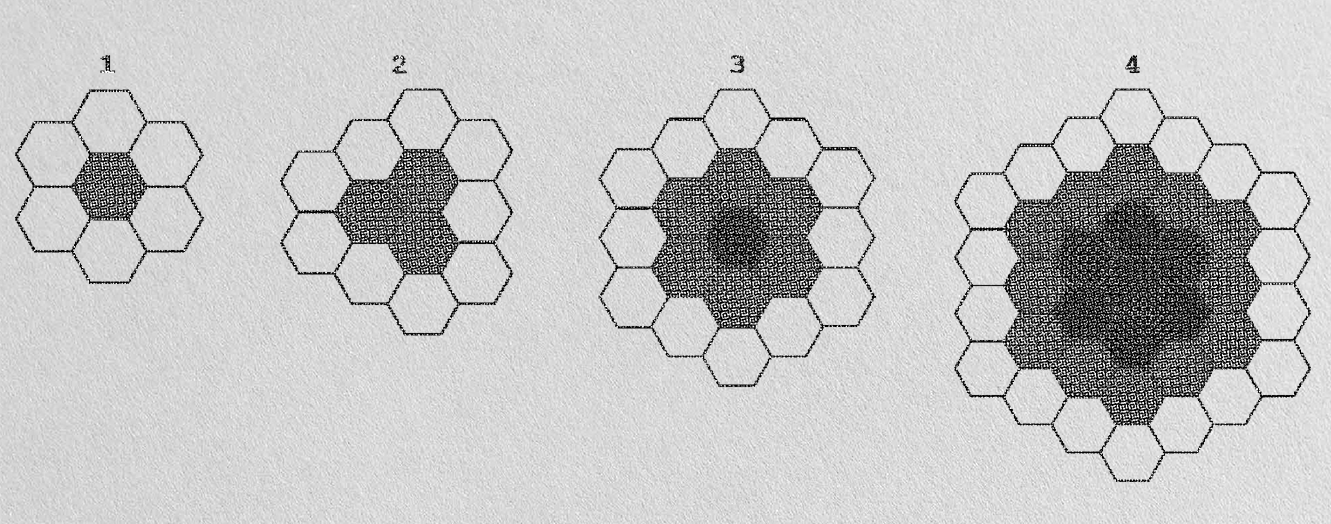
The left image shows the hexes occupied by characters with various Size (x) tags. The colored hexes are occupied by the character, and the darker hexes represent the central hex of characters large enough to have them.
Slow (x)
Characters with the Slow (x) tag reduce their Speed statistic by x, to a minimum of 0. If a character’s speed is reduced to 0 as a result of the Slow (x) tag, they also gain the Stuck tag until the value of their Slow (x) tag is reduced to an amount less than their speed.
The effects of this tag are applied after any effects which increase a character's Speed statistic.
Spirit
Characters with the Spirit tag are intangible beings. They may be psychic imprints of the tormented dead, or they may be otherworldly beings summoned from distant branches of the world tree.
Spirits do not possess a Health stat and are immune to most mundane damage. Spirits may typically only be defeated through Willpower damage, damage with the Holy tag, or banishing rituals. They are unaffected by damage with the Gas tag, and automatically receive the Enchanted tag.
Spirits are unaffected by most terrain features and may even pass through tiles without the Passable tag.
Stuck
Characters with the Stuck tag may not perform any action with the Movement tag, and make all Athletics checks and Saves with +3 Difficulty.
Summon
Actions with the Summon tag create new characters with the Minion tag. Unless otherwise specified, these Minion characters remain active for the duration of the mission (unless killed). An Operative may not perform Actions with the Summon tag which would cause them to go over their Summon Limit.
Temporary (x)
Terrain Features with the Temporary (x) tag are removed from the battlefield when they lose their Temporary (x) tag. At the beginning of each round, the value of all Temporary (x) tags is reduced by 1.
A character which has used an action with the Summon tag to create a Terrain Feature may choose to remove the Temporary (Conjurer’s Level) tag from any such terrain feature as a free action with the Interrupt tag.
Thaumaturgy
Actions with the Thaumaturgy tag may only be performed by Operatives if they have the Thaumaturgy Talent, and require a Backlash Save to be performed in addition to the Check or Attack Roll.
Unconscious
Characters with the Unconscious tag are unable to take any actions, and are valid targets for a Coup De Grace. If an Operative with the Unconscious and Wounded (x) tags takes damage, they increase the value of their Wounded (x) tag by the amount of damage they take, even if that damage has the Non-Lethal tag.
Undead
Characters with the Undead tag are the animated remains of formerly-living beings, returned to a semblance of life by paranatural effects.
Characters with the Undead tag automatically receive the Enchanted tag.
Characters with the Undead tag are immune to damage with the Gas tag.
Unholy
Characters with the Unholy tag are especially vulnerable to Holy effects; see the Holy tag for details.
Warded (x)
Characters with the Warded (x) tag are protected from harm by mystical forces. When a character with Warded (x) takes damage, they reduce incoming damage by 1 for each level of the Warded (x) tag they possess. This reduction is performed before applying the Armor statistic, and applies regardless of the incoming damage’s Ignores Armor or Armor-Piercing (x) tags.
For each point of damage reduced by the Warded (x) tag, reduce the level of the tag by 1. If the tag is removed and there is still remaining damage to apply, it is applied normally.
Wounded (x)
Characters with the Wounded (x) tag suffer +x Difficulty on all attacks, checks, and saves.
Talents
The following section contains lists of all talents available to operatives. Talents are divided into organization talents, archetype talents, and general talents based on their availability.
Organization Talents
Organization talents represent your training, anomalous background, and the ways of your organization. You may only possess organization talents corresponding to your organization.
Ancient Noble Order of Gormogons (Gormogons)
Blastproof
Requires:
Talent: Shaped Charges
You never make a mistake when handling explosives. You cannot be harmed by attacks with the Explosive (X) tag made by yourself or an ally.
Demomaniac
Requires:
Talent: Blastproof
Nothing is more invigorating than the smell of gunpowder. Whenever you are hit by an attack with the Explosive (X) tag, you gain the Prepared (1) tag. If it is your turn, you may opt to instead gain 1 AP. If triggered by your own Attack or Working, you may only gain this benefit once per turn.
Gormogon Arts
Gormogon Base Talent
You have been inducted into the Ancient Noble Order of Gormogons as an Antimason, and have access to their powerful, and often explosive, workings. You gain access to the Gormogon Antimasonry Workings List.
Grand Occident Rites
Requires:
Level: 4+
You have been initiated into the rites of the Grand Occident Wedge, the most secret arts the Gormogons possess. You gain access to the Grand Occident Rites workings list. These rites are considered to be on the Gormogon Antimasonry Workings List for your character.
Gunpowder Mage
Your Gormogon training grants you expertise with mundane as well as mystical explosives. You gain +1 Accuracy on all actions with the Explosive (X) tag.
Keystone
Your Gormogon training lets you identify individual points that, if destroyed, will bring a whole structure crumbling down. You have also learned to apply this to a wider variety of “structures” than merely buildings. You gain access to the following action:
Find Keystone
Cost: 1
Mechanics: Select a character or structure you can see, and make a Combat Engineering check, with +1 Difficulty if the target is a character, unless that character has the Mechanical tag. If the check succeeds, you and your allies gain +2 Accuracy on attacks against the target for a number of rounds equal to your level.
Shaped Charges
You have learned to shape and direct the energy of explosives and explosive workings. When you make an attack with the Explosive (X) tag, you may choose any number of hexes in the blast radius to exclude from the effect, so long as the resulting Area of Effect is still contiguous and contains the center.
Wardbreaker
You are a specialist in breaking wards. When you deal damage to a character with the Warded (X) tag, for each point of damage reduced by the Warded (X) tag, reduce the level of the tag by 2.
British Occult Service (BOS)
Commando Training
You have undergone grueling commando training in the Scottish Highlands, greatly improving your physical fitness and your survival skills. You gain +1 Ballistics, +1 Melee, +1 Navigation, and +1 Stealth.
Dandy
Like most of the officers of the British Empire, you are something of a dandy, and love to be well-dressed and well-groomed. So long as you are in clean, fashionable clothing (including your dress uniform!) you gain +2 Camaraderie and +1 Accuracy on all Camaraderie checks.
Intelligence Officer
Requires:
Level: 5+
Talent: Mincemeat
You have received advanced intelligence officer training at MI666, and can deploy advanced disruption and counterintelligence tactics on your missions. You add the following to the options provided by Mincemeat:
Exploit Distrust: You know that Obskuracorps, and the forces of the Reich as a whole, are led by untrustworthy, self-interested individuals never above backstabbing each other for power. With a little nudge, you can exploit their ambition. Whenever your enemies call for backup during the mission, there is a 1 in 2 chance that none is provided, as the enemy’s commanders use them as pawns. At GM’s discretion, this may not apply to the highest-ranking enemies.
Sever Supply Lines: Though few outside know it, the Reich is constantly on the brink of logistical disaster. You do know, and you know how to exploit it. For the duration of the mission, any enemy with the Human tag who does not have the Elite or Officer tag which rolls a result of 5 or less on the die for an Attack action suffers a weapon malfunction as if they had Critically Failed.
Mincemeat
You are tied into the vast British counterintelligence apparatus, and make use of it to disrupt your enemies ahead of your missions. During the Mission Briefing phase, you may select one of the following:
False Sense of Security: Your opposition in the area is lulled into a false sense of security, believing an attack on their position is impossible. Your GM should reduce the number of enemies you face until they become aware of your presence.
Psychological Warfare: Your foes are on edge, unnerved, and easily broken. Each enemy you encounter with the Human tag which does not possess the Elite or Officer tag has their initial Willpower reduced by 1D3.
If multiple operatives possess Mincemeat, each option can only be applied once.
Oxbridge Occultist
Requires:
Special: This talent may only be selected at character creation.
You attended Oxford or Cambridge, two of the world’s greatest Universities, and were initiated into one of their Veiled secret societies, where you first learned the secrets of the paranatural. You gain +1 Veiled History. Additionally, your mundane education was virtually without equal, and you gain +1 History and +1 Science.
Perfidious Albion
BOS Base Talent
As far as you are concerned, there is no tactic too low to use, so long as it brings Allied victory in the war. You have adapted this philosophy into your fighting style, using all manner of dirty tricks and unfair moves to get an edge over your opponents. You may use the Tradecraft skill in place of the Melee skill for Attack actions.
Poisoner
Requires:
Level: 3+
Talent: Mincemeat
You have access to a variety of tasteless, odorless, scentless poisons, and ways to get them into your enemies’ rations and water supplies ahead of a mission. During the mission planning phase, in addition to your selected Mincemeat option, you may also choose to apply one of the following poisons to all enemies which possess the Human tag within the AO. All such enemies must make a Health save with a target value equal to 10 + your Tradecraft or suffer the effects of your selected poison. At the GM’s discretion, freshly-arrived enemies may not be under the effects of these poisons.
Muscle Relaxant: Enemies affected by this poison reduce their Evasion by 2.
Pyretic: Enemies affected by this poison reduce their Armor by 1, to a minimum of zero.
Emetic: At the start of each turn, enemies affected by this poison must make an additional Health save with a target value equal to 10 + your Tradecraft. If this save is failed, they may only spend 1 AP on their turn.
Hallucinogen: Enemies affected by this poison lose 1D6 Willpower.
If multiple operatives possess Poisoner, each option can only be applied once.
Spot of Tea
You always carry an enchanted flask of tea with you, mystically maintained at the ideal temperature and perfect to settle the nerves. You gain access to the following item of equipment:
Fine Tea
Bulk: 0
Special Rules:
- Tea Break: You may take roughly five minutes to share your tea with your allies. When doing so, you may select a number of characters up to your level. Each selected character makes a Willpower Check with Difficulty equal to your level. Each character who fails this check regains Willpower equal to twice your level. Characters may only be affected by Fine Tea once per non-combat scene.
You may only carry a single Fine Tea at a time.
Holy Order of Knights Templar, Reformed (Templars)
Abjure the Wicked
You have learned to mark the servants of evil wherever they stride, and to denounce them for the monsters they are. You gain access to the following action:
Consecrate
You have learned battlefield benedictions which hallow the very ground beneath your feet. You gain access to the following action:
Consecrate
Cost: 1
Mechanics: Make a Templar Doctrine check. If the check is successful, the hex you are standing on, and all adjacent hexes, gain the Holy tag for the duration of the scene.
Fear No Evil
Requires:
Talent: Consecrate
For a number of rounds equal to your Templar Doctrine level after you manually perform the Consecrate action, you automatically perform the Consecrate action on any hex you enter.
Holy Fire
The strength of your faith is so great, it infuses every step you take and strike you make. You gain the Holy tag, as do any Attack actions you take.
Leap of Faith
Requires:
Level: 3+
You have found that when questioned, your faith surges forth brighter than ever before. When you have 0 Faith Points remaining, you may attempt to regain up to your maximum Faith Points as a Leap of Faith. Once per scene on your turn, you may make a Templar Doctrine check, with added Difficulty equal to the number of Faith Points you are attempting to gain. If successful, you regain the chosen number of Faith Points. If this roll fails, you lose Willpower equal to the number of Faith Points you attempted to gain, as you begin to doubt the strength of your convictions.
Sweeping Denunciation
Requires:
Talent: Abjure the Wicked
Your denunciations condemn whole swathes of the enemy to damnation, so pure is your holy fury. You may select a number of characters up to your Templar Doctrine level as targets for the Denounce the Wicked action.
Templar Faith
Templar Base Talent
Your faith is pure and unquestionable, so strong that it manifests as minor miracles which themselves strengthen your faith. You gain a special pool of Faith Points equal to your Templar Doctrine skill level. At any time, you may spend one or more Faith Points in one of the following ways:
- To gain +1 Accuracy on any attack
- To inflict +1 Difficulty on any attack targeting you
- To gain 1D3 Armor until the start of your next turn
If you spend multiple Faith Points on an option, the effects stack. You regain 1 Faith Point after each of the following:
- You deal damage to an enemy with the Unholy tag
- An attack made with Accuracy targeting you misses
- You are hit by an attack, and your Armor fully negates that attack’s damage
You regain all your Faith Points at the start of a new scene, and may spend any number of Faith Points at one time.
Lay On Hands
Your faith is so strong and your devotion so pure that it can heal the wounded. You gain access to the following action:
Lay On Hands
Cost: 1
Mechanics: Select a character with the Human tag which does not have the Unholy tag and which is within 1 hex of your position, and spend any number of Faith Points. For every 2 Faith Points spent, the target regains 1 Health, or loses 1 level of the Wounded (X) tag.
International Center for the Study of Unified Thaumatology (ICSUT)
Arcane Insight
Requires:
Level: 3+
Talent: Sudden Inspiration
Your insightful nature and expansive knowledge of the paranormal lets you muddle by in fields you should have no knowledge of whatsoever. You may choose to spend 2 Sudden Inspiration points to gain +1 to any skill with the Exceptional tag for one roll, including skills you do not normally have access to.
Battlefield Brilliance
Sometimes you make discoveries of immediate military importance. You may choose to spend your Sudden Inspiration points to add +1 damage each to any Attack action you make.
Broad Insight
Requires:
Talent: Unusual Insight
Your insights and discoveries flow from your every action. Whenever you obtain a result of 20 or higher on any check, or a Critical Success on an Attack Roll, you gain +1 Sudden Inspiration point.
Faculty Mentor
You developed a close relationship with a faculty member while a student at ICSUT, and they continue to advise and mentor you now. Select one of the following skills:
- History
- Science
- Thaumatology
- Veiled History
Whenever you level up, you automatically gain 2 levels in the selected skill. This cannot increase the skill past level 10. Additionally, your mentor may provide advice to you during the Mission Briefing phase.
Restricted Access
Requires:
Level: 3+
You have been given access to ICSUT’s most restricted resources; prototypes, dangerous artifacts, and even more esoteric items. At the start of each mission, you may equip a single item from the Restricted Access section of the ICSUT Equipment List.
Sudden Inspiration
ICSUT Base Talent
You occasionally gain a burst of insight from a Working or discovery which goes particularly well. Whenever you obtain a result of 20 or higher on a Thaumatology or Veiled History check, you gain a Sudden Inspiration point. You may choose to spend your Sudden Inspiration points to add +1 Accuracy each to any Thaumatology or Veiled History check. Your Sudden Inspiration points are reset to 0 at the end of the mission.
Unified Thaumatologist
ICSUT is always working to research traditional thaumaturgical workings, and how they fit into the framework of Unified Thaumatology. With your access to thaumaturges from many other institutions, you’ve taken it upon yourself to try and adapt their workings yourself. Select one working from following lists:
The selected working is added to the Unified Rites Workings List for your character.
Unusual Insight
You draw connections between seemingly-unrelated fields, and discoveries in one can lead to unexpected advances in another. You may choose to spend your Sudden Inspiration points to add +1 Accuracy each to any skill check, except those made with Exceptional skills.
Main Intelligence Directorate, Psychotronics Division (GRU-P)
Commissar
You are a Commissar of the Red Army in addition to, or as cover for, your attachment to the Main Intelligence Directorate. Officially, your responsibilities are to maintain morale and political orthodoxy among the troops, and you apply your training in this field to your work with the AOI. While they can see you, characters with the Faction (Soviet) or Faction (GRU-P) tags can never receive the Broken tag. Additionally, once per non-combat scene, you can give a rousing speech, spiked with your psionic abilities, to restore 1D6 Willpower to all allies who can hear you, excluding yourself.
No Retreat
A true soldier of the Soviet Union never backs down or retreats, even under enemy fire. When you take damage from an enemy, you may choose to regain 1D3 Willpower. You may do this a number of times per mission equal to your Psychotronics level.
Psionic Suggestion
GRU-P Base Talent
You can implant psychic suggestions into a target’s mind, which they will then execute after a predetermined trigger. You gain access to the following action:
Psionic Suggestion
Cost: 1
Mechanics: Select a target character, and one action that character is able to perform. Your target must make a Willpower save with a target value of 8 + your Psychotronics Skill. If the save is failed, then the next time they perform the selected action, they must take an additional action of your choice for free. You may not use this action to force a character to knowingly harm themself or their allies, or to perform a thaumaturgic working.
Psychic Leech
Through a grueling regimen of drugs, hypnotherapy, and training, you have developed your psychic abilities to be able to sap the willpower of your foes and increase that of your allies. You gain access to the following actions:
Bestow Will
Cost: 1
Mechanics: Make a ranged Attack action, using your Psychotronics skill in place of ballistics. If the target is willing, this attack automatically succeeds. If the attack is successful, you may expend any amount of Willpower, and increase the target’s Willpower by one-half the amount of Willpower you expend.
Tags: Indirect Fire, Ignores Cover, Range (4), Psionic
Drain Will
Cost: 1
Mechanics: Make a ranged Attack action, using your Psychotronics skill in place of Ballistics. If the attack is successful, reduce the target’s Willpower by D3, and increase your own Willpower by the same amount.
Tags: Indirect Fire, Ignores Cover, Range (4), Psionic
Psychometry
You are capable of psychometry, a psionic technique for reading the history of an object. Outside of combat, you may touch an item and expend any number of Willpower, then make a Psychotronics check. If successful, for each Willpower expended, you may ask the GM one of the following questions, which they must answer honestly:
- Who owns this object?
- What notable events has this object been a part of?
- When was this object created?
Instead of asking questions, you may instead expend 3 Willpower to receive a vision of one notable event the object was a part of. This vision is from the perspective of whoever was using that object at that event.
Tags: Psionic
Skilled Conditioning
Requires:
Talent: Subconscious Conditioning
You have learned to plant longer-lasting conditioning in your allies’ minds. At the beginning of each mission, for each Operative accompanying you, you may select one skill without the Exceptional tag which you possess to condition that Operative in. They gain levels in that skill equal to half your level in that skill, for the duration of the mission. This may increase skills to a maximum of level 10.
If multiple operatives possess Skilled Conditioning, they must select different skills for each operative.
Tags: Psionic
Subconscious Conditioning
You have been trained to implant knowledge directly into a subject’s subconsciousness, granting them knowledge they did not even know they possessed. At the beginning of each mission, you gain a pool of Subconscious Conditioning points equal to your Psychotronics level. Whenever you or another Operative makes a check or skill save, you may spend 1 Subconscious Conditioning point to grant +1 Accuracy on that check or save.
Additionally, once per non-combat scene, you may spend 10 minutes with your allies reinforcing their conditioning. To do so, make a Psychotronics check. If successful, you regain all spent Subconscious Conditioning points.
Tags: Psionic
Telekinesis
Requires:
Level: 3+
Your psionic abilities manifest as telekinesis, allowing you to manipulate objects at a distance. While you cannot achieve fine enough control of this to operate weapons or complex machinery, outside of combat, you can freely move objects you can see within 10 meters of your position which weigh up to 25 kilograms. You may expend 1 Willpower to gain one of the following benefits for the duration of the scene: increase this weight to 100 kilograms, or become capable of telekinetic fine manipulation such as picking a lock or operating a vehicle. In addition, you gain access to the Telekinetic Lift and Telekinetic Throw actions for use in combat scenes.
Telekinetic Lift
Cost: 1
Mechanics: Select a character you can see of Size (1) or less within 4 hexes of your position, and expend 1 Willpower. The target must make an Athletics save with a target value of 8 + your Psychotronics level, or gain the Lifted tag. The target may choose to fail this save. The target loses the Lifted tag when you choose to remove it, when you take damage, or when you take an Attack action.
Telekinetic Throw
Cost: 1
Mechanics: Select a character you can see of Size (1) or less within 4 hexes of your position and expend 1 Willpower. The target must make an Athletics save with a target value of 10 + your Psychotronics level. The target may choose to fail this save. If the target fails this save, you may remove their Lifted tag, if present, and throw them up to 5 hexes in any direction. The target takes 1D3 damage upon landing; if the target had the Lifted tag, they take 2D3 damage instead.
The Scholomance
Anatomist
Acolytes of the Scholomance are well-educated in the composition and structure of the human body, and the many ways in which a life may end. Though intended to aid in the black arts, this knowledge also makes you an effective field medic. You may use the Necrodynamics skill in place of the First Aid skill for all checks.
Blood of the Dragon
Requires:
Special: This talent may only be selected at character creation.
You are a Dhampir, a child born of an unholy union between a human and a vampire of House Dracul. You can see in all but total darkness, and you are naturally strong and light-footed, giving you +1 Athletics and +1 Stealth. Additionally, once per combat scene, after dealing damage with a weapon which has the Melee tag you may regain 1D6 Health.
Deathly Pallor
Your body has adapted to Thanatic Energy, and you have the chill of the grave about you. You gain immunity to Gas damage. Characters with the Mindless and Undead tags will not attack you unless directly ordered to do so or attacked by you first.
Dimensional Ossuary
You have access to a pocket dimension specially tuned to accept ossified matter. Bone Piles may be stored in the Dimensional Ossuary without limit and retrieved at any time. While stored, their Bulk does not affect you, and you may use them as a target for spells that use Bone Piles. At the end of each mission, the remaining contents of the Dimensional Ossuary vanish, assimilated into the vast spires of the Endless Mausoleum.
Forbidding Air
Your dark knowledge and exposure to unholy forces gives you an intimidating, foreboding air. You gain +2 Accuracy on Camaraderie checks made to intimidate or frighten, except those made against characters with the Spirit or Undead tags.
Gallows Humor
Your blasé attitude towards death, a common trait among Scholomance graduates, has given you a wicked sense of gallows humor. Once per non-combat scene, you may attempt to crack an unexpected, dark joke about the horrors of war. If your fellow operatives deem your joke sufficiently funny, you and all Human characters who hear your joke regain 1D3 Willpower.
Inured to Terror
Years of exposure to vampires, demons, spirits, and the undead has greatly reduced your senses of fear and hopelessness, and replaced them with a burning curiosity. Whenever you would lose Willpower from a hostile effect, you lose 1 fewer, to a minimum of 1 point lost.
Necromancy
Scholomance Base Talent
Every student of the Scholomance is taught the black arts, among them the binding of spirits and raising of the dead. You gain access to the Scholomance Necromancy Workings List. Additionally, you gain access to the following action:
Strip Flesh
Cost: Bonus
Mechanics: For a student of the Scholomance, separating worthless flesh from bone is distressingly simple. Select a Corpse Terrain Feature in an adjacent hex which has a Size (x) of at least 1. Make a Necrodynamics check. If successful, you magically strip the flesh from the corpse, destroying the Corpse Terrain Feature and replacing it with a number of Bone Piles equal to the value of its Size (x) tag. Bone Pile is an item with 1 Bulk that can be used in skeletal rituals.
Solomonari
Requires:
Level: 7+
You are one of the Solomonari, the most honored and powerful of the Scholomance’s graduates, of whom there are only ever 10 members. With this station comes access to the most powerful of arts, taught to you by the Infernal Headmaster of the Scholomance himself. You gain access to the Solomonari Rites Workings List.
Archetype Talents
Archetype talents represent your specialty, niche, and the ways you conduct yourself both on and off the battlefield. You may only possess archetype talents corresponding to your archetype.
Clairvoyant
Autonomous Conditioning
Requires:
Org: GRU-P
You have conditioned your body and nervous system to continue the fight while your mind is elsewhere. While you are under the effects of the Remote Viewing action, you may make one free Attack action originating at your physical body once per turn.
Delphic Oracle
Requires:
Talent: Prophecy
You are a font of prophecies, and can augur the future of your allies as well as yourself. When you take the Prophesy action, you may choose to grant the Prophecy Result to a character you can see instead of yourself. This counts against the number of Prophecy Results you can have at one time, and expires at the end of the mission.
Tags: Prescient
Comforting Prescience
You derive comfort from your knowledge of the future. Whenever an attack affected by Nudge misses you, you hit with an attack affected by Nudge, or a character fails a save while affected by Nudge, you regain 1 Willpower.
Additionally, if you have the Prophecy talent, whenever you use your Prophecy Result, you regain 1 Willpower.
Tags: Prescient
Divine Intent
You are able to divine the intentions of enemies, and adapt your plans accordingly. You gain access to the following action:
Divine Intent
Cost: Bonus
Mechanics: Select a character you are aware of on the battlefield, and make a Willpower check. If successful, the GM must truthfully tell you the next action the target intends to take.
Tags: Prescient
Evil Eye
Scholomance Clairvoyant Base Talent
Add the following effects to the list you can choose from with Nudge:
- Bad Vibes: Select a character you can see. Remove the Ritual tag from the next Thaumaturgy action they take, or increase the difficulty of the Backlash save by +2 if the next Thaumaturgy action they take does not have the Ritual tag.
- Misfire: Select a weapon held by a character you can see. That weapon gains the Dangerous tag until the end of the scene.
- Your Shoe's Untied: Select a character you can see. That character gains the Stuck tag until the end of the round.
Foreseen Faith
Requires:
Org: Templars
You may spend any number of Faith Points when you use Nudge to select one of the following options. In each option, X is equal to the number of Faith Points spent.
- Divine Strike: Select a character you can see. They gain +X Accuracy on their next Attack.
- Divine Intervention: Select a character you can see. The next Attack against them is made with +X Difficulty.
- Divine Durability: Select a character you can see. That character gains XD2 Armor until the start of your next turn.
Holy Visions
Templar Clairvoyant Base Talent
Your clairvoyance manifests as holy visions, light-filled flashes of the future, and the whispers of saints and angels in your ears. Whenever an action or ability with the Prescient tag requires you to expend Willpower, you may instead choose to spend an equivalent amount of Faith Points. Additionally, you may use Templar Doctrine in place of Willpower for Checks and Saves with the Prescient tag.
Intuit
You have the ability to perceive events a few seconds before they happen, often as hunches or subconscious reactions. You gain +1 to your Camaraderie skill, as you can intuit what the exact right thing to say is just in time. Additionally, all attacks targeting you are made with +1 Difficulty.
Tags: Prescient
Nudge
Clairvoyant Base Talent
Using your will and your prescience, you can nudge certain futures into existence. You gain access to the following action:
Nudge
Cost: Bonus
Mechanics: Select one of the following effects and make a Willpower check. If successful, you manifest the effect as described.
- Lucky Shot: Perform a free Take Aim action. Increase the selected weapon’s Armor-Piercing (x) tag by 1 for the duration of the selected attack.
- Near Miss: The next Attack action targeting you is made with +2 Difficulty. This effect fades if no attacks are made targeting you before your next turn.
- Unfortunate Coincidence: Select a character you can see. That character makes all saves with +1 Difficulty for the next round.
Tags: Prescient
Prophecy
Requires:
Level: 3+
Your prescience allows you to grab fleeting glimpses of the future, with significance that is revealed when you need it most. You gain access to the following action:
Prophesy
Cost: 1
Mechanics: Expend 2 Willpower and make a Willpower check. If successful, roll a D20 and record the result. This is your Prophecy Result. You may consume your Prophecy Result to replace the result of any of the following rolls:
- Any roll you make.
- Any roll made for an action targeting you.
The Prophecy Result replaces the D20 roll, but you must still add any relevant modifiers, such as Accuracy, Difficulty, or Skill level. You may only have one Prophecy Result at a time, and Prophecy Results expire at the end of the mission.
Tags: Prescient
Remote Viewing
GRU-P Clairvoyant Base Talent
You can project your mind out of your body to spy on faraway locations. While useful for espionage, your training has focused on a battlefield-appropriate version of this technique, which does not take the time or carry the risks of long-range viewing. You gain access to the following action:
Remote Viewing
Cost: 2
Mechanics: You attempt to project your vision out of your body to another point on the battlefield. Select a hex on the battlefield, then make a Psychotronics check, with +2 Difficulty if you are unable to see the selected hex. If successful, your vision shifts to that point. While your vision is shifted in this way, you are unable to perform actions without the Psionic tag, but draw all sightlines to the selected hex. Your vision remains shifted until you choose to end the Remote Viewing session.
At the GM’s discretion, and with appropriate preparation and equipment, this Talent may be used outside of combat with substantially increased range and/or duration.
Spirit’s Whispers
Requires:
Org: Scholomance
When you call upon the spirits of the dead, you use their insight to gain knowledge of the future. In the next combat scene after you perform the Nekyia working, you gain +1 Accuracy on all actions with the Prescient tag.
Conjurer
Advanced Necromancy
Requires:
Level: 4+
Org: Scholomance
You have studied and trained in more advanced necromantic arts under the personal direction of the professors at the Scholomance. You gain access to the Advanced Necromancy Workings List.
Battlefield Architect
You are a member of the AOI’s Battlefield Thaumatology Working Group, a team working to develop constructs of pure physical force to reshape engagements. Though a young field, it already shows substantial promise, and you and your peers are ready to deploy this new “battlefield architecture” in combat. You gain access to the Battlefield Architecture Working List.
Book of Names
Requires:
Level: 4+
Talent: Demonologist
You have obtained a Book of Names, a collection of aetheric imprints of powerful demons, which you can use to call them forth. You gain access to the Greater Demonology Working List.
Chained Summons
You have mastered the art of recycling the energy of one summoning into other workings. Once per round when you perform a working with the Summon tag, you gain the Channeling (1) tag.
Commanding Presence
You are so used to giving commands to your followers that it is second-nature to you. At the beginning of your turn, you automatically perform the Command basic action for free.
Conjurer’s Inspiration
Requires:
Org: ICSUT
You have found ways to pass insight on to the beings you conjure up, allowing them to be more effective in combat. You may expend Sudden Inspiration points to add accuracy to Ballistics and Melee rolls made by characters with the Controller (you) tag.
Demonologist
ICSUT Conjurer Base Talent
You are trained as a demonologist, practicing the oft-maligned art of summoning and binding anomalous creatures from other regions of the multiverse. You gain access to the Demonology Working List.
Dimensional Armor
When you summon minions under your control, you wrap them in the energy of the multiverse like armor. All Minion characters, and all terrain created by Actions you take with the Summon tag gain +1 Armor.
Experienced Summoner
You have performed countless summonings and conjurations, and have your own unique and highly effective methods of performing them, along with muscle memory. You gain +1 Accuracy on all actions with the Summon tag.
Reap Essence
When a Minion character you summoned dies or is otherwise dismissed, you may choose to regain 1 Willpower. You may do this a number of times each mission equal to your level.
Raised Hordes
Scholomance Conjurer Base Talent
You have developed your necromantic rituals to allow them to raise multiple servants simultaneously, and deepened your control over them. All of your Scholomance Necromancy and Advanced Necromancy Workings with the Summon tag raise twice as many Minions. In the case of Workings which require a physical source of material, they can target twice as many such sources at once.
When calculating the impact of Minions affected by this talent on your Summon Limit, each such minion counts as one half.
Studied Constructs
Requires:
Org:** ICSUT
Talent: Battlefield Architect
The constructs you bring forth are exceptionally durable thanks to your deep understanding of the principles of Unified Thaumatology. All Terrain Features you create with the Temporary (x) tag are created with double the listed value.
Swarming Summons
Conjurer Base Talent
Your capacity for controlling the bindings on summoned creatures is far greater than an ordinary thaumaturge’s. Your Summon Limit is equal to your level + 1, instead of half your level.
Evoker
Ablative Insight
Requires:
Org: ICSUT
You have developed mental focusing techniques that allow you to blunt backlash. Whenever you would lose Health as a result of a failed Backlash Save, you may choose to spend Sudden Inspiration points to reduce the loss. For each point you spend, you reduce the amount of Health you would lose by 1.
Backlash Buffer
Requires:
Level: 3+
You’ve suffered a substantial amount of backlash in your day, and have come up with various methods of mitigating it; you might have a colloidal silver tattoo, crystal fetishes, or just an exceptionally high tolerance for pain. Whenever you suffer Backlash, instead of the GM choosing an effect, you may instead choose to lose 1 Health or 1 Willpower.
Brutish Workings
Sometimes, it’s worth discarding safety and efficiency to get the job done. In your case, that means dumping immense cosmic power into your workings, and damn the consequences. Whenever you perform a working, you may choose to automatically succeed on the Thaumatology check to do so. If you do, you automatically fail the Backlash Save for that working.
Channel Backlash
Evoker Base Talent
You've learned to use backlash to your advantage, channeling it on the fly into improvised cantrips. A number of times per scene equal to your level, if you fail a Backlash save, you may choose one of the following effects instead of taking Backlash:
- Force Dagger: You channel the backlash into a blade of pure magic. Make a free Attack with the Melee tag using your Thaumatology skill. It deals 1D3 damage if it hits.
- Magic Missile: You channel the backlash into a dart of pure magic. Make a free Attack with the Range (2) tag using your Thaumatology skill. It deals 1D3-1 damage if it hits.
- Shocking Burst: You emit a blast of uncontrolled electricity. All characters within 1 hex of your position must make an Athletics Save or take 1D2 damage with the Ignores Armor tag.
Additionally, once per round when you perform a working which does not have the Ritual tag, you gain the Channeling (1) tag.
Cordite Backlash
Requires:
Org: Gormogons
For some reason, your workings love to backfire in explosive ways. Whenever you suffer Backlash, you may elect to have it instead come in the form of an Explosive (1) attack targeting yourself which deals damage equal to half your level. This counts as an Attack made by you.
If your Combat Engineering skill is 6 or greater, increase the tag to Explosive (2), or to Explosive (3) if the skill is at 10.
Energetic Overspill
You have learned to channel backlash into your workings directly, rather than suffer it yourself. Add the following options to those provided by the Channel Backlash talent:
- Blazing Energies: Your Working burns with intense heat. All characters which take damage from the working gain the Burning (1) tag.
- Crackling Energies: Your Working is infused with lightning. All characters within 1 hex of a target of the working take 1D2 damage.
- Pressurized Energies: Your Working comes like a powerful gust of wind. All targets of the working must succeed at an Athletics Save with a target number of 12 or be moved 1 hex away from you.
Evoker’s Insight
Requires:
Org: ICSUT
Inspiration comes to you in the flash of lightning and the crackle of backlash. Whenever you fail a Backlash Save, you gain 1 Sudden Inspiration point.
Explosive Evocations
Gormogon Evoker Base Talent
You have a particular affinity for dangerous, explosive workings, as do most evokers of your order. You may increase the damage of any Explosive (x) attacks caused by your workings by 1D6.
Greater Channeling
Requires:
Level: 3+
You can channel and withstand a much greater amount of backlash without ill-effects. You may use the Channel Backlash talent a number of times per scene equal to twice your level.
Reshape Working
Working without ritual safeguards gives you much more control over your workings, allowing you to reshape them on the fly. Whenever you perform a Working, you may choose to apply +2 Difficulty to the Backlash Save and choose one of the following benefits:
- Reduce the AP cost of the Working by 1. If this would reduce the AP cost of the Working to 0, the cost becomes 1 Bonus Action. If the cost of the Working was already 1 Bonus Action, it becomes None.
- Double the range of the Working.
- Increase the damage of the Working by 1D6.
- Another appropriate benefit, with GM approval.
Unified Evocations
ICSUT Evoker Base Talent
While you may prefer to shape magic in your own way, you can’t deny that having access to other evokers' work is a big boost. Fortunately, your AOI membership gets you access to their library of evocations, built around the framework of Unified Thaumatology. You gain access to the Unified Evocations Workings List.
Willpower Reclamation
When your workings go off as intended, you can take a moment to breathe and recover. Whenever you succeed at a Backlash Save, you regain 1 Willpower.
Guardian
Avalanche
Requires:
Talent: Mountain Stance
Even when you plant yourself immobile, you are still watching for allies who need you, and despite your roots you can move quickly to guard the innocent. While you have the Stuck tag, you may still perform the Interpose action once per round. If you have the Rapid Reposition talent, this limit is increased to twice per round.
Bone Shield
Scholomance Guardian Base Talent
You protect yourself from attack behind heavy shields of necromantically-reinforced bone. You gain access to the following item of equipment:
Bone Shield
Other Armor
Bulk: 2
Tags: Armor (2)
Special Rules:
- Ablative Armor: Whenever you take damage while having this item equipped, roll a D6. If the result of this roll is a 1, reduce the value of this item’s Armor (x) tag by 1 for the duration of the scene.
- Shield: You may not make attacks using weapons with the Heavy tag while you have this item equipped.
You may only select one Bone Shield as equipment at the start of a Mission.
Blast Shielding
Requires:
Org: Gormogons
You have constructed a special suit of heavy, blast-resistant, sealed armor. You gain access to the following item of equipment:
Blast Armor
Full-Body Armor
Bulk: 3
Tags: Armor (3)
Special Rules:
- Blast Shield: While wearing this armor, you halve all damage you take with the Explosive (x) tag. Additionally, you may never gain the Burning (x) tag.
Draw Fire
Sometimes, the best way to protect your allies is to be the only one the enemy dares to attack. You’ve mastered this risky discipline. You gain access to the following action:
Draw Fire
Cost: Bonus
Mechanics: You gain the Draw Fire tag. While you have this tag, enemies will prioritize attacking you over attacking your allies, unless one of those allies is an immediate threat to an enemy’s life. You may remove this tag at any time on your turn.
Distant Protector
Requires:
Level: 3+
You have trained yourself to move rapidly across the battlefield, appearing wherever and whenever your charges need you. You may use the Interpose action targeting any character within your Speed in hexes of your position, rather than 1 hex.
Front Toward Enemy
Gormogon Guardian Base Talent
Having covered your armor in directional explosives, you make the prospect of approaching you a dicey one indeed. A number of times per combat scene equal to your Combat Engineering level, you may perform the following action:
Detonate Proximity Explosive
Cost: 1
Mechanics: Select 3 contiguous hexes, each adjacent to your position. Each character in a selected hex must make an Athletics save with a target value of 8 + your Combat Engineering level or take 2D6 damage with the Explosive (1) tag, or half damage on a successful save. This damage does not create an additional blast radius.
Graveyard Guardian
Requires:
Org: Scholomance
You have learned a handful of combat spells designed specifically for your unique combination of necromantic and martial arts. You gain access to the Scholomance Wards Workings List.
Guardian Angel
Templar Guardian Base Talent
You strive to emulate the guardian angels of the heavenly host, who watch over you just as you watch over your teammates. You may select a character within 3 hexes of your position as a target for the Interpose action instead of 1 hex. Additionally, you regain 1 Faith Point when performing the Interpose action.
Interpose
Guardian Base Talent
You have trained on how to interpose yourself between an ally and an incoming attack, and gain access to the following action:
Living Wall
Requires:
Talent: Mountain Stance
You make your body a living wall to protect your allies from harm, giving them cover with your armor-plated body. While you have the Stuck tag, your allies treat you as a Terrain Feature with the Cover (2) tag.
Mountain Stance
When you stand immobile at the center of a firefight, you become as indestructible as a mountain. You gain access to the following action:
Rapid Reposition
You have trained yourself to move quickly in your heavy armor, allowing you to arrive wherever your charges need you. You may use the Interpose action a number of times per round equal to your Speed.
Sanctified Armor
Requires:
Level: 5+
Org: Templars
You have been granted a custom-made suit of Sanctified Steel Plate. Forged from iron mined on Mount Sinai mixed with the ashes of martyrs, quenched in holy water, and wrought in exaltation of the Father, the Son, and the Holy Spirit, Sanctified Steel Plate is miraculously protective, durable, and flexible. You will wear it in battle until the day you die, and then be interred along with it in the Order’s undercroft. You gain access to the following item of equipment:
Sanctified Steel Plate
Full-Body Armor
Bulk: 3
Tags: Armor (4)
Special Rules:
- Miraculously Durable: At the beginning of each of your turns, if you have a Shredded (x) tag, reduce the value of that tag by 1.
You can never willingly give up your Sanctified Steel Plate to anyone, and should you lose it you are sworn to spend your life attempting to recover it.
Vengeful Strike
When an enemy strikes at one of your charges, you swiftly remind them that they are protected. After you perform the Interpose action, you may make an Attack against the character which attacked you as a result of your Interpose action. If their attack successfully hits you, you gain +1 Accuracy on your Attack.
Infiltrator
Assassinate
Requires:
Level: 4+
Talent: Play Dead, or Master of Disguise
You can perform assassination strikes upon those who do not know you are a threat. While you have the Disguised (x) tag from Master of Disguise or the Infiltrating and Hidden tags, you gain access to the following action:
Assassinate
Cost: 1
Mechanics: Select a Size (2) or smaller target within 1 hex of your position, and make a Tradecraft Attack against that target with the Ignores Armor tag. If the attack is successful, the target takes xD6 damage, where x is equal to your level. You then lose all Disguised (x), Infiltrating, and Hidden tags.
Deep Cover
Requires:
Talent: Master of Disguise
Your disguise allows you to walk unquestioned among the enemy as if you were one of them. Whenever you start a combat scene, you may choose to start adjacent to any character with a Faction (x) tag that corresponds to a Disguised (x) tag you possess.
Die Another Day
Requires:
Talent: Play Dead
Once per mission, if you would die as a result of a failed Fatality Check, you may choose to fake your own death. You may return at a dramatically appropriate time in a subsequent scene with a new scar and an outlandish story to tell. You may choose the time and manner of your reappearance, as well as the exact details of how you evaded your demise, subject to GM approval.
Double-Agents
Requires:
Level: 3+
You have been given top-secret clearance to know the identity of deep-cover infiltrators and double-agents within the AO, and arrange for them to be exactly where you need them. Once per mission, you may perform the following action:
Signal Double Agent
Cost: Bonus
Mechanics: Select an enemy character with the Human tag which does not have the Elite or Officer tags and which has a line of sight to you. That character immediately loses all Faction (x) tags they possess and gains the Faction (BOS) tag. The character is aware of the orders they have been given by the opposition, but nothing of substantial tactical value. They exfiltrate with you.
The GM may deny a use of this ability if it would derail their plans for the mission. If they do, you may either use it again at another time, or select a different target.
Effective Double-Agents
Using this ability can be a great way to turn the tide of a disastrous encounter, but it can also do substantial damage to your GM’s plans. Make sure your GM is aware of this when you purchase the ability, and if they ask you to hold off on using it on specific enemies, understand that in doing so they might be setting you up for an even cooler moment down the road! GMs of players who purchase this talent should be aware that an infiltrator player who selects it likely wants to create dramatic moments where a single agent in the right place makes all the difference, and should work to make those moments possible without derailing the action.
Improbable Acrobatics
Your infiltrator training means you are able to perform improbable stunts of acrobatics and dexterity. You are able to climb sheer walls like a spider, keep your balance on top of speeding cars, and aim a rifle while dangling upside-down from a rope, along with other impressive feats. Additionally, you may use Tradecraft in place of Athletics for all Athletics rolls.
Licence to Kill
Requires:
Org: BOS
Your distinguished service has granted you access to the Quartermaster Division's finest protoypes. You may add the following options to the devices provided by the Quartermaster Division talent:
- Miniature Bomb: A highly miniaturized explosive device (Athletics weapon) with the Range (4), Explosive (1), and Limited (1) tags, dealing 1D6 damage.
- Grapnel Launcher: A grappling hook launched by pressurized air. You may use the Grapnel Launcher to automatically succeed on a single check to climb an obstacle, cross a gap, or other suitable tasks by GM discretion.
- Bolas: Two weights connected by a cord, perfect for tripping foes. Choose a character of up to Size (2) within 3 hexes to make an Athletics save. If they fail, they gain the Stuck tag until the end of your next turn.
- Slingshot: A slingshot (Tradecraft weapon) loaded with a rune-inscribed stone primed to shock the first creature it touches, with the Range (3) and Limited (1)** tags. Upon a hit, the target takes 1D3 damage and starts their next turn with 1 fewer AP.
Master Of Disguise
You are a master of disguise, using a mix of enchanted trinkets, makeup, and acting to appear as someone you are not. You gain a pool of Disguise Points equal to your Tradecraft level. This pool is restored to full at the start of every mission. Additionally, in any non-combat scene, you may take ten minutes to construct a disguise for yourself, changing your appearance to that of any character you have seen which has the Human tag and granting yourself the Disguised (x) tag, with a value equal to the faction of the character you are disguising yourself as.
This disguise is effective at a distance, but may possess subtle inaccuracies. When an enemy questions your disguise, you must make a Tradecraft save with a target of 10 + the enemy’s Camaraderie level. If this save is failed, you remove the Disguised (x) tag.
While you possess the Disguised (x) tag, you may spend Disguise Points to improve your disguise as follows:
- Mimicry (2 Points): You may only select this option if you have heard the character you are imitating speak. You can do a near-perfect impression of the target’s voice. Enemies do not question your disguise based upon your speech pattern.
- Indignation (1 Point): You become irate whenever your disguise is questioned and holds up. Whenever you pass the Tradecraft save caused by an opponent questioning your disguise, that opponent loses 1D3 Willpower as you berate them for their incompetence.
- Attention to Detail (Variable): You spend extra time perfecting the details of your disguise. For each point spent on Attention to Detail, you gain a +1 bonus to Tradecraft saves made to maintain the disguise.
Mental Puppeteer
Requires:
Org: GRU-P
Talent: Mind Control
Your mind-control abilities have been honed to the extent that they are essentially autonomous. You may have a number of characters under the effects of your Mind Control talent equal to your level.
Mind Control
GRU-P Infiltrator Base Talent
You have developed your psionic abilities to such a point that you can completely override the will of another, forcing them to obey your commands. Whenever a character with an unresolved suggestion from your Psionic Suggestion Action is reduced to 0 Willpower, you may make a Psychotronics check with +2 Difficulty. If successful, the character gains the Minion and Controller (you) tags for a number of rounds equal to your Psychotronics level. While they have these tags, they are immune to the effects of the Broken tag.
Only one character may be under the effects of your Mind Control at a time.
Play Dead
You have learned to fake your own death to lull your enemies into a false sense of security. You gain access to the following action:
Play Dead
Cost: None
Mechanics: Whenever you are the target of an attack, you may take this action. Resolve the attack as normal. After it resolves, you appear to have been killed as a result of the attack. So long as you do not take any actions, except for Master Infiltrator, you are treated as having the Hidden tag. All characters not aware of your ability to perform this action treat you as being a normal corpse.
Tags: Interrupt
Saboteur
Gormogon Infiltrator Base Talent
Subtlety is not exactly something your order is well known for, but you are among the exceptions, and you combine stealth and high explosives to great effect. You especially love to plant time- or motion-triggered explosives in places your enemies think secure. You gain access to the following action:
Plant Explosive Device
Cost: 1
Mechanics: You may only take this action if no enemies have a line of sight to you. Select an adjacent hex and make a Combat Engineering check. If successful, you create a Planted Explosive Terrain Feature on the selected hex. You may only have a number of active Planted Explosives equal to twice your level. If you plant a new explosive device while at your limit, you must choose an active Planted Explosive to become inert.
Planted Explosive
Special: This Terrain Feature can only be seen by characters actively aware of its existence, or who are actively searching for such features. After a character occupies the same hex as this Terrain Feature, it is removed.
Tags: Damaging (2D6), Explosive (2), Passable
Stealth Engineer
Requires:
Org: Gormogons
You have learned to apply lessons from your infiltrator training to your demolitions work. You may use Tradecraft in place of Combat Engineering.
Ungentlemanly Warfare
Infiltrator Base Talent
You are an expert in underhanded and covert tactics, colloquially known as “Ungentlemanly Warfare”. You gain +1 Tradecraft, which may increase your Tradecraft above the +3 limit at character creation. Additionally, you gain access to the following actions:
Sneak Attack
Cost: 2
Mechanics: Make a Melee Attack action, using your Tradecraft skill in place of your Melee skill. If the Attack hits, select one of the following additional effects:
- Backstab: The attack deals its maximum possible damage.
- Kidney Shot: The attack gains the Ignores Armor tag.
- Setup Strike: You gain the Prepared (1) tag.
- Unseen Attack: You do not lose the Hidden tag as a result of making this attack.
The cost of this action is reduced to 1 if no enemies have Line of Sight to you, or the target has a Faction (x) tag corresponding to a Disguised (x) tag you have.
Master Infiltrator
Cost: 1
Mechanics: Make a Stealth skill check. For each enemy with Line of Sight to you, this check gains +1 Difficulty. If the check is successful, you gain the Hidden and Infiltrating tags.
Quartermaster Division
BOS Infiltrator Base Talent
You've been equipped for your mission by the boffins down at MI666's Quartermaster Division, producers of the best covert paratechnology this side of the pond. A number of times per mission equal to your level, you may declare that some piece of kit on your person has a hidden function, selected from the list below:
- Hidden Blade: A cleverly concealed folding knife (Melee weapon) which deals 1D3 damage; attacks with this knife are at +1 Difficulty.
- Dart Gun: A small airgun built into an item such as a pen or umbrella handle which fires a poisoned dart (Ballistics Weapon) with Range (2). When you declare a Dart Gun, choose one poison from the options in the Poisoner talent. On a hit, the dart gun deals 1 damage and applies the chosen poison. A target may only be affected by the same poison once per scene.
- Lockpicks: A set of picks that can be used to unlock any mundane lock with a successful Tradecraft check.
- Smoke Pellet: As Smoke Grenades, but with Limited (1).
Knight
Blinding Assault
Requires:
Level: 5+
Your unparalleled control of your weapons allows you to charge faster than the eye can see. Once per turn, you may Charge with a non-Heavy weapon as a Bonus Action.
This talent is mutually exclusive with Heavy Arms Specialist.
Charge
Knight Base Talent
You are an expert in closing the gap to faraway enemies while using your own momentum to strike at them. You gain access to the following action:
Charge
Cost: 1
Mechanics: Select a character at least 2 hexes away, and a weapon you are equipped with which has the Melee tag. If you select a weapon with the Heavy tag, Charge costs 1 additional AP. You make a free Run action, which must put you within range to strike the selected target with the selected weapon, and then make a free Attack action with +1 Accuracy with the selected weapon against the selected target. You then gain the Slow (1) tag for the rest of the round.
Commando Crusade
BOS Knight Base Talent
You have drunk too much liquid courage and heard too many tales of Arthurian chivalry, resulting in a level of callous disregard for your own life which scares the daylights out of everyone else. Attacks made as part of a Charge action also deal 1D3 Willpower damage. Additionally, after making a Charge action, all Attacks targeting you are made with +1 Difficulty until your next turn. This effect stacks.
Devastating Blow
Putting the weight of your massive weapon behind your blows and throwing precision to the wind, you shear clear through armor and flesh alike. Whenever you make an attack with a weapon with the Melee tag, you may choose to increase the Difficulty of that attack by up to half your level. For each added difficulty, you may choose one of the following benefits:
- Add the Armor-Shredding (1) tag to the attack.
- Increase the attack’s damage by 1D3.
- If the attack hits, add the Jammed or Dulled (1) tag to a weapon carried by the target.
- If the attack hits, apply the Slow (1) tag to the target. This tag lasts for a number of rounds equal to half your level.
Heavy Arms Specialist
Requires:
Level: 5+
You have trained and conditioned yourself to the point that you can manage the heaviest of weapons with relative ease. You ignore the effects of the Heavy tag on weapons with the Melee tag. Note that these weapons are still considered to have the Heavy tag for you.
This talent is mutually exclusive with Blinding Assault.
Holy Wrath
Requires:
Org: Templars
Yours is the wrath of God himself, and you feel His presence when you lay low His foes. Whenever you deal damage to a target with the Unholy tag using your Sainted Blade, you regain 1 Faith Point. If you kill such a target, you regain all missing Faith Points.
Knight’s Blade
Requires:
Org: BOS
Through inheritance, award, or underhanded means, you have obtained the sword of a knight who served England (or one of its colonies) in centuries past. You gain access to the following item of equipment:
Enchanted Blade
Melee Weapon
Bulk: 1
Damage: 1D6+1
Tags: Melee
Special Rules:
- Legendary Blade: All attacks made with this weapon are made with +1 Accuracy.
Knightly Courage
Requires:
Level: 3+
When all is against you, and you face the greatest of foes, your courage drives your weapons forth just as much as your skill at arms. Whenever you make an Attack using a weapon with the Melee tag, increase your Melee skill by the Difficulty of the roll, for the duration of that attack. This is applied after calculating the net Accuracy or Difficulty for the attack, and can increase your Melee skill above 10.
Lance Tactics
Drawing inspiration from the heavy cavalry knights of the past, you add the momentum of your charge to the tips of your weapons. You add the Armor-Piercing (2) tag to Attacks made as part of your Charge actions.
Oathbow
Requires:
Org: BOS
Some particularly unhinged knights eschew firearms entirely in favor of adopting the weapons of their forebears. You gain access to the following item of equipment:
Yeoman's Longbow
Athletics Weapon
Bulk: 2
Damage: 1D3
Tags: Range (6)
Special Rules:
- Bewildering: All attacks made with this weapon deal 1D3 Willpower damage.
- Marked for Ruin: Characters hit by this weapon take +1 Health damage from all Attacks until the end of your next turn. This effect does not stack.
Sainted Blade
Templar Knight Base Talent
You have been granted one of the rare and precious Sainted Blades, crafted from iron mined on Mount Sinai in the lost forge of Saint Maurice. It is heavy as the Lord’s judgement. You gain access to the following item of equipment:
Sainted Blade
Melee Weapon
Bulk: 2
Damage: 2D6
Tags: Heavy, Holy, Melee
Special Rules:
- Instrument of Wrath: Whenever you make an Attack action using your Sainted Blade, you may spend any number of Faith Points. For each Faith Point spent in this way, increase the damage done by the Attack by 1D3.
- Miraculous Edge: At the start of each of your turns, the value of this weapon’s Dulled (x) tag is reduced by 1.
You can never willingly give up your Sainted Blade to anyone, and should you lose it you are sworn to spend your life attempting to recover it.
Seize the Moment
You make good use of the chaos incited by your charge to strike your enemies at their most vulnerable. You may increase the cost of your charge action by any number of AP. For each AP spent on the charge action as a result of this ability, make an additional free attack as part of your Charge action, which benefits from the Charge’s increase to Accuracy.
Swift as Wind
A knight lives and dies by the speed of their charge. You know this well, and make sure to do all you can to increase your own speed. Once per round, before you take the Charge action, you may double your Speed for the duration of the round. You may do this a number of times per combat scene equal to half your level.
The Long Cut
Requires:
Level: 3+
When you summon all your strength, you may attempt a powerful charge that cleaves through whole crowds of enemies. You gain access to the following action:
Warpath
Cost: 1
Mechanics: Once per scene, select a weapon you are equipped with which has the Melee tag. If you select a weapon with the Heavy tag, Warpath costs 1 additional AP. You make a free Run action, moving in a straight line. You may pass through hexes containing characters as if they had the Passable tag, but you must end your movement in a Passable hex. Then, you may make a free Attack action with the selected weapon against each enemy within melee range of your path. You then gain the Slow (1) tag for the rest of the round.
Ritualist
Cantrips
You are skilled at using minor workings to solve a variety of problems. A number of times per mission equal to your level, you may make any Check using your Thaumatology Skill in place of another Skill.
Circle Workings
You have trained to support your fellow Thaumatologists in performing their workings, and can add your energy to theirs. You gain access to the following Action:
Circle Working
Cost: Special
Mechanics: Select a character you can see within 2 hexes of your position who has the Thaumaturgy talent. Expend any number of AP. If you possess the Channeling (x) tag, you may also expend any number of its levels. The selected character gains the Channeling (x) tag, where x is equal to the combined amount of AP and levels of the Channeling (x) tag that were expended in the working.
Dark Rituals
Scholomance Ritualist Base Talent
As a graduate of the Scholomance, you are able to channel dark powers to aid your casting, though it comes at a cost to your sanity. Whenever you would fail a Thaumatology check to perform a working, you may opt to spend 1D3 Willpower to succeed instead.
Detonation Field
Requires:
Org: Gormogons
You have come up with a new working not yet added to the Gormogon canon, a derivation of probability fields with an explosive bent. The following working is added to the Gormogon Antimasonry Workings List for your character, and does not count against the number of workings you may have memorized at one time:
Conjure Detonation Field
Action: Conjure Detonation Field
Cost: 2
Mechanics: Select a hex you can see, and make a Thaumatology check. If successful, that hex, and all adjacent hexes, gain a Detonation Field Terrain Feature (see below).
Tags: Ritual, Thaumaturgy
Detonation Field
Special Rules: Characters within this terrain feature treat all failures on actions with the Dangerous tag as critical failures.
Tags: Passable, Temporary (Conjurer’s Level)
High-Energy Rituals
Requires:
Level: 4+
Org: ICSUT
You are trained and qualified to perform High-Energy Rituals, the most advanced and dangerous rituals ICSUT has access to. You gain access to the High-Energy Rituals Workings Lists. These workings are considered to be on the Unified Rites Workings List for you.
Improvised Geometry
The principles of unified thaumatology allow you to improvise new ritual workings in the field. Once per scene, you may cast a single Working with the Ritual tag from a Working List to which you have access which you do not have memorized.
Inspired Memory
ICSUT Ritualist Base Talent
When pressed, your memory is a deep well of rituals and formulae you thought forgotten. You may expend 3 Sudden Inspiration points to gain access to any Working with the Ritual tag you have access to, even if it is not currently memorized. You may do this a number of times per mission equal to one-third of your level. You retain access to this Working for the duration of the mission.
Precision Demolitions
Gormogon Ritualist Base Talent
Your explosive, destructive magics are nonetheless carefully controlled and planned. Whenever you perform a Working from the Gormogon Antimasonry or Grand Occident Rites Workings Lists, you may choose to increase its cost by 1 and add the Ritual tag to the action.
Quick Circle
You have mastered the process of constructing ritual geometry quickly, allowing you to accelerate your workings in the pitch of battle. You gain access to the following action:
Quick Circle
Cost: Bonus
Mechanics: The next working with the Ritual tag that you perform has its AP cost reduced by 1.
Recursive Meditation
Through reciting mantras, focusing on enchanted trinkets, or simple focus, you can restore spent strength. Once per non-combat scene, you may spend ten minutes in quiet focus and contemplation. Make a Thaumatology check. On a success, regain 1D6+1 Willpower, or half that on a failure.
Risky Rituals
Sometimes, it’s worth taking a risk on a ritual. You’re an expert at judging exactly when that is. Whenever you choose to forgo the Ritual tag on a Working, you may choose two of the benefits of doing so instead of one.
Ritual Factorization
Requires:
Level: 5+
You've discovered innovative ways to collapse immense, complicated rituals into permutations of simple rites. All Workings now cost a maximum of 1 Willpower to perform, regardless of their AP cost.
Thirsting Blade
Requires:
Org: Scholomance
Talent: Athame
The Scholomance has many cursed and powerful weapons on hand, and makes them available to its graduates. The Thirsting Blade is one such weapon, an ancient equivalent of an Athame with a predatory hunger, barely tamed and made subservient to your will. You gain access to the following item of equipment:
Thirsting Blade
Melee Weapon
Bulk: 1
Damage: 1D6
Tags: Enchanted, Melee
Special Rules:
- Ritual Blade: Whenever you inflict damage using this weapon, you gain 1 AP, which may only be spent on actions with the Thaumaturgy tag.
- Vampiric Edge: Whenever you inflict damage using this weapon, you may opt to regain 1D3 Health instead of regaining 1 AP as specified by the Ritual Blade rule.
Speckmann Rebound
You have learned to channel the backlash of your workings into useful effects, in a process formally known as a Speckmann Rebound. When performing an action with the Ritual tag, you may opt to make a Backlash Save. If the save is successful, you gain 1 AP, which may only be spent on actions with the Thaumaturgy tag.
Steady Hand
You have developed a steady hand that would make a surgeon jealous, and a precise eye for ritual geometry. You gain +1 Accuracy on all actions with the Ritual tag.
Unified Rites
Ritualist Base Talent
While your education may have had its own unique flavor, at your core you are a Unified Thaumatologist specializing in ritual magic. Your AOI membership gives you access to their standardized list of combat rituals and rites. You gain access to the Unified Rites Workings List.
Additionally, once per round when you perform a working which has the Ritual tag, you gain the Channeling (1) tag.
Soldier
Big Guns
Requires:
Level: 3+
You have trained and qualified on the AOI’s most destructive firearms, and you are allowed to take them into the field. You may select equipment from Heavy Munitions Lists.
Divine Munitions
Templar Soldier Base Talent
You have gained access to a supply of sanctified ammunition and munitions, which allows you to channel your holy wrath at a range. You gain access to the following item of equipment:
Sanctified Grenades
Athletics Weapon
Sanctified steel engineered to release crucifix-shaped shrapnel, surrounding a core of blessed gunpowder, these explosives detonate with the sound of the Horn of Jericho.
Bulk: 1
Damage: 1D6
Tags: Limited (3), Range (3), Holy, Explosive (2)
Dual-Wield
Usually, shooting two weapons at once is a great way to miss both shots, but not for you. You ignore attacks made with weapons which do not have the Heavy tag for the purposes of the Multi-Weapon Penalty rule.
Grit
Soldier Base Talent
You are simply too stubborn to let pain slow you down. Where other operatives would bleed out or collapse, you just keep on fighting. You gain access to the following action:
Power Through
Cost: Bonus
Mechanics: Expend a Willpower point. You regain 1D6 Health.
Heavy Weapons Specialist
Requires:
Level: 5+
You have trained and conditioned yourself to the point that you can manage the heaviest of weapons with relative ease. You ignore the effects of the Heavy tag on weapons with the Range (x) tag.
This talent is mutually exclusive with Lead Storm.
Knock 'em Down
Requires:
Level: 3+
When your shots strike true, the enemies fall like dominoes. When you inflict a critical hit or reduce an enemy to zero Health, you gain 1 AP.
Lead Storm
Requires:
Level: 5+
Your deftness with light weapons allows for unprecedented speed. Once per turn, you may attack with a non-Heavy weapon as a Bonus Action.
This talent is mutually exclusive with Heavy Weapons Specialist.
Pack Mule
You excel at the most thankless of all infantry jobs, humping a heavy pack around for hundreds of miles without complaint. You increase your Encumbrance stat by 5, and add 5 to your Encumbrance modifier for Checks and Saves.
Psionic Barrage
GRU-P Soldier Base Talent
By focusing, you can unleash bursts of coherent psionic energy that shred enemies just as well as any bullet. You are always equipped with the following weapon, which is unaffected by the multi-weapon penalty:
Psychic Bombard
Requires:
Org: GRU-P
Your mental firearms are strengthened by training and conditioning, allowing you to stretch their powers in terrifying ways. Once per turn, you may make a Psychotronics check. If successful, select one of the following effects to apply to your Psionic Barrage weapon until the start of your next turn:
- Increase the damage to 2D6.
- Add the Ignores Cover and Indirect Fire tags.
- Increase the value of its Range (6) tag to Range (12).
Saint Michael’s Chosen
Requires:
Level: 4+
Org: Templars
You have been anointed in the name of the Prince of the Heavenly Host, Saint Michael, first among the Angels and Archangels. Like the Guardian of Heaven, you will not suffer the devil to live. Whenever you make an Attack targeting an enemy with the Unholy tag, you always inflict your selected weapon's maximum damage.
Sniper
Your hours at the AOI’s range have paid off, and you are now an expert at making extremely precise shots at long range. Whenever you select a character more than 6 hexes away as a target for an Attack action, you gain +2 Accuracy on the attack roll. If you are at a substantially higher elevation than the target, you gain an additional +1 Accuracy on this attack roll.
Additionally, in non-combat scenes you never miss a target you have a reasonable chance of hitting unless you choose to.
Specialty Ammunition
You know the value of having the right ammo for the job, and you’ve made friends with the quartermasters so you always have it on hand. A number of times per mission equal to your Camaraderie, you may select one of your equipped weapons with the Range (x) tag and grant it one of the following effects. These effects last until the end of your turn. A weapon may only receive one Specialty Ammunition effect at a time.
- Extra Powder: Increase the value of the weapon’s Range (x) tag by 2.
- Flechette Rounds: The weapon gains the Armor-Shredding (1) tag.
- Full Metal Jacket: The weapon gains the Armor-Piercing (2) tag.
- Incendiary Rounds: The weapon gains the Burning (2) tag.
- Spellbreaker Rounds: For each point of damage done by this weapon reduced by the Warded (x) tag, reduce the level of the tag by 2.
Spray 'n Pray
Who needs accuracy when you have raw rate of fire? If you put enough bullets downrange, some of them are guaranteed to hit. When you make an Attack with a weapon with the Range (x) tag, you may choose to spray and pray, adding +2 Difficulty to the roll. If you hit, deal damage as normal, but if you miss, deal half damage anyway, so long as you do not critically fail.
Suppressive Fire
Requires:
Org: BOS
Your tactical fire interferes with the enemy's ability to aim. When you Attack an enemy, as long as you do not critically fail, they gain +1 Difficulty on all Attacks until your next turn. This effect stacks.
Tommy
BOS Soldier Base Talent
You don’t quite fit in in the BOS. You don’t have noble blood or enormous wealth, you didn’t go to an elite Public School, and you don’t have a manservant. What you do have is an immense drive, a drive so strong you managed to break into the old boy’s club. Compared to the British class divide, what are bullets? Whenever you would regain Health with Grit, you regain twice as much.
General Talents
General talents represent your interests, backstory, and your quirks. General talents may be selected by any character who meets their listed requirements.
Academic Expertise
Requires:
Org: ICSUT
or
Skill: History 3+ or Science 3+ or Veiled History 3+
You're a world-class expert in an academic discipline, in both Veiled and Unveiled contexts. Choose a field of study narrow enough for a Master's degree program (e.g. Palaeontology, Chinese History, Russian Literature) and an area of expertise within that field narrow enough to write a doctoral thesis on (e.g. Spinosaurid dinosaurs, the Taiping Rebellion, the works of Leo Tolstoy). You gain +1 Accuracy on History, Science, and Veiled History checks about your field of study, or +2 Accuracy if the check relates to your area of expertise.
Amateur Pilot
Requires:
Skill: Piloting 0
You have learned how to pilot planes and other flying machines in your spare time or as cross-training. Though you’re no ace yet, you have a good grasp of the fundamentals. You gain +1 Piloting.
Artful Dodger
You have learned to dance and weave around the battlefield. You increase your Evasion by 2.
Athame
Requires:
Talent: Blood Sacrifice
You have forged an Athame, a ritual dagger used for drawing blood. With it, you can channel energy from your strikes into your rituals. You gain access to the following item of equipment:
Athame
Melee Weapon
Bulk: 1
Damage: 1D3
Tags: Enchanted, Melee
Special Rules:
- Ritual Blade: Whenever you inflict damage using this weapon, you gain 1 AP, which may only be spent on actions with the Thaumaturgy tag.
Blood Sacrifice
Requires:
Skill: Thaumatology 1+
You carry ritual implements for sanguimancy, the practice of using the Elan-Vital Energy in your own blood as fuel for workings. You gain access to the following action:
Blood Sacrifice
Cost: Bonus
Mechanics: Lose an amount of health equal to or less than your Thaumatology skill. You gain that many AP, which may only be spent on actions with the Thaumaturgy tag.
Chainsmoker
Everyone enjoys a good cigarette, but your appreciation goes much further. You may smoke Cigarettes multiple times per non-combat scene. If a non-combat scene ends and you have not smoked, lose 1 Willpower.
Fast
Requires:
Skill: Athletics 4+
You’ve spent substantial time and effort on cardiovascular conditioning, and it’s begun to pay off. You increase your Speed Statistic by 1.
Familiar
Requires:
Archetype: Ritualist or Conjurer
You have created a familiar, a fragment of pure intelligence given physical form, which aids you in your studies and on your missions. The familiar cannot speak, but can psychically transmit images and emotions to its Controller. If killed, it is resummoned prior to the start of the next mission. At the start of each mission, you are accompanied by your familiar, which has the following stats:
Fists of Fury
Requires:
Skill: Melee 2+
You've got training in an unarmed martial art — probably boxing, savate, or jujutsu, but maybe something more exotic if you've spent time in the Far East. Your fists and feet are a Melee weapon that deal 1D3 damage, and you gain +1 Accuracy on Melee Attacks against opponents who are unarmed or only wielding a Ballistics weapon.
Great War Veteran
Requires:
Special: This talent may only be selected at character creation.
This is not the first “war to end all wars” you’ve fought in. You remember the trenches of the Somme, the terror of going over the top, the introduction of tanks and planes. You gain +2 Ballistics, +1 Melee, and +1 Military Science. Additionally, you gain +1 Accuracy on all Willpower saves.
Grimoire
Requires:
Archetype: Conjurer, Ritualist
You have compiled, inherited, or otherwise gained access to a grimoire, a tome containing numerous thaumaturgical formulae which you can reference in the field. At the beginning of a mission, you may select a number of thaumaturgical workings which you have access to equal to your level to inscribe in the grimoire. At any time outside of combat, you may elect to spend ten minutes reading and replace any number of your memorized workings with those inscribed within the grimoire. This does not store the replaced workings in the grimoire.
ICSUT Educated
Requires:
Org: Gormogons, ICSUT
You attended ICSUT, where you received a world-class education on the unified magical theory of Thaumatology. You gain 1 level in the Thaumatology skill. Additionally, you gain +1 Accuracy on Thaumatology checks to understand or decipher magical knowledge, formulas, or spells.
Late Awakening
Requires:
Level: 2+
Willpower: 14+
Special: Does not have the Thaumaturgy talent.
Something changed inside you recently, unlocking previously-latent thaumaturgic potential. While you are a fairly weak and untrained thaumaturge, you can manage a few basic workings. You gain access to the Thaumatology Skill, though it starts at +0. Additionally, at the beginning of each mission, you may memorize 1 Working from the Unified Evocations Working List.
Additionally, you are considered to have the Thaumaturgy talent for the purposes of rules which reference it.
Morphine-Based Lifeform
Overdoses are for pansies. You may be affected by Morphine multiple times per non-combat scene, and never suffer ill effects for doing so. If a non-combat scene ends and you have not been injected with morphine, lose 1 Health.
Noblesse Oblige
Requires:
Org: Any, excluding GRU-P
Special: This talent may only be selected at character creation.
You have or are the heir to a title of nobility in the peerage of your home country, with all the rights and responsibilities that entails. You were groomed for leadership from a young age, and gain +1 Camaraderie, +1 History and +1 Melee. Additionally, you gain +1 Accuracy on Camaraderie checks to mingle with the upper crust.
Overcharge
Requires:
Talent: Thaumaturgy
You are able to hold on to the energies that slip through others' fingers. The Channeling (x) tag is no longer converted to AP automatically at the start of your turn. Instead, at any time on your turn, you may choose to convert all or a portion of your Channeling (x) tag to AP that may only be spent on actions with the Thaumaturgy tag, reducing the value of your Channeling (x) tag by the amount of AP you gained. The value of your Channeling (x) tag may not exceed 5, and resets to zero at the end of each scene.
Perfect Memory
You have developed a perfect memory, which allows you to recall information and details almost effortlessly. You can always remember any detail your character would have observed, which the GM should provide you with upon request. Additionally, if you possess the Thaumaturgy talent, you may memorize one additional Working from any list you have access to, and if you have the Psychotronics skill, you increase it by 1.
Resistance Supplies
Requires:
Skill: Camaraderie 4+
You coordinate between local resistance groups and the AOI, and your contacts try to help you out on your operations by leaving you supply drops in convenient locations. Once per mission in a non-combat scene, you may use this ability to find a resistance supply drop. This drop contains a number of items of equipment from the AOI Equipment List of your choice equal to half your Camaraderie level.
Scrounger
You've learned to stretch your limited supplies as far as they can possibly go. Once per scene and a number of times per mission equal to a third of your level, you may use an item with the Limited (x) tag without consuming a use.
Speed Demon
You have a need for speed. You may take multiple doses of Amphetamines in a scene, and their effects stack.
Thaumaturgy
Gormogon/ICSUT/Scholomance Base Talent
You are a thaumaturge, also known as an enlightened observer, a mage, or a wizard. For poorly-understood reasons, you are able to perceive and manipulate Elan-Vital Energy to create magical workings, unleashing powerful forces and reshaping reality to your will. You are able to perform actions with the Thaumaturgy tag; for full details see the Thaumaturgy section. Additionally, you gain access to the following actions:
Channel
Cost: 1
Mechanics: Channel your energy to prepare for an imminent Working. You gain the Channeling (1) tag.
Observe
Cost: Bonus
Mechanics: You gain the Observing tag. You may remove this tag at any time.
Warfighter
The higher-ups like to go on about wizards, demons, and ghosts, but you know this war will be won the same way as any other: by striking the enemy until they die. Your aptitude in mundane warfare allows you to deal +2 damage to targets with the Human tag.
Wayfinder
You have a natural affinity for finding Ways, occult portals between different branches of the world tree. You are automatically aware of the existence of any Way within x hexes of your location, where x is the value of your Navigation skill. Additionally, you gain access to the following action:
Knock Knock
Cost: Bonus
Mechanics: Select a known Way, and make a Navigation check. If you succeed, you successfully guess the Knock required to open the Way.
Willful
Your will is exceptionally strong, even by the standards of Allied Occult Initiative operatives. You increase your Willpower statistic by 5.
Equipment
The following section contains lists of equipment available to operatives on missions. Operatives may only select equipment from the lists of Organizations of which they are members.
NOTES
- Equipment issued by the Allied Occult Initiative is available for selection by all operatives. It is an eclectic mix of proven military equipment, artisanal handcrafts, and prototypes pushed into service.
- Unless otherwise stated, items on the Other Equipment List have purely narrative use, with effects determined by the GM.
Armor
Allied Occult Initiative (AOI)
Flak Jacket
Chest Armor
Based upon the newly-developed vests worn to protect against flying shrapnel and debris, AOI flak jackets make use of experimental ballistic fibers developed by Prometheus Labs, theoretically allowing them to stop bullets.
Bulk: 1
Tags: Armor (1)
Helmet
Head Armor
Standard-issue helmets provide protection against shrapnel and falling debris, though they are less effective against direct hits. The AOI’s variant includes several luck charms which encourage bullets to miss the unprotected face and instead strike the most heavily-reinforced sections of the helmet.
Bulk: ½
Tags: Armor (1)
Plated Armor
Chest Armor
Heavy, and not especially effective, plated armor uses thick steel plates sewn into a vest to provide some level of ballistic defense. Their weight and discomfort makes them uncommon sights on the battlefield.
Bulk: 2
Tags: Armor (2)
Ancient Noble Order of Gormogons (Gormogons)
Blast Armor
Full-Body Armor
Bulk: 3
Tags: Armor (3)
Special Rules:
- Blast Shield: While wearing this armor, you halve all damage you take with the Explosive (x) tag. Additionally, you may never gain the Burning (x) tag.
- Requires: Blast Shielding (Talent)
Holy Order of Knights Templar, Reformed (Templars)
Sanctified Steel Plate
Full-Body Armor
Bulk: 3
Tags: Armor (4)
Special Rules:
- Miraculously Durable: At the beginning of each of your turns, if you have a Shredded (x) tag, reduce the value of that tag by 1.
- Requires: Sanctified Armor (Talent)
You can never willingly give up your Sanctified Steel Plate to anyone, and should you lose it you are sworn to spend your life attempting to recover it.
The Scholomance
Bone Shield
Other Armor
Bulk: 2
Tags: Armor (2)
Special Rules:
- Ablative Armor: Whenever you take damage while having this item equipped, roll a D6. If the result of this roll is a 1, reduce the value of this item’s Armor (x) tag by 1 for the duration of the scene.
- Shield: You may not make attacks using weapons with the Heavy tag while you have this item equipped.
- Requires: Bone Shield (Talent)
You may only select one Bone Shield as equipment at the start of a Mission.
Melee Weapons
Allied Occult Initiative (AOI)
Athame
Melee Weapon
Bulk: 1
Damage: 1D3
Tags: Enchanted, Melee
Special Rules:
- Ritual Blade: Whenever you inflict damage using this weapon, you gain 1 AP, which may only be spent on actions with the Thaumaturgy tag.
- Requires: Athame (Talent)
Combat Knife
Melee Weapon
Issued as a last-resort weapon for virtually every soldier, the Combat Knife also serves a myriad of non-combat uses from opening cans to making booby-traps. With the aid of a mounting ring, many Combat Knives can be attached to rifles as Bayonets.
Bulk: ½
Damage: 1D3
Tags: Melee
Entrenchment Tool
Melee Weapon
Ruggedized, collapsible shovels, Entrenchment Tools can be pressed into service as weapons in a pinch, though their real utility is in digging foxholes and other fortifications.
Bulk: 1
Damage: 1D3
Tags: Melee
Special Rules:
- Entrenchment: Characters equipped with an Entrenchment Tool gain access to the following action:
Entrench
Cost: 4
Mechanics: Select a hex you are standing on or adjacent to which has soil or other terrain which can be manually excavated. You create a foxhole Terrain Feature on that hex (see below).
Foxhole
Special Rules: Characters occupying the same hex as this Terrain Feature treat all adjacent hexes as having the Cover (2) tag.
Tags: Difficult, Passable
Machete
Melee Weapon
Longer than a Combat Knife and less flexible, the Machete offers its user superior melee performance in exchange for greater bulk. In densely wooded areas, they are virtually essential for bushwhacking.
Bulk: 1
Damage: 1D6
Tags: Melee
British Occult Service (BOS)
Enchanted Blade
Melee Weapon
Bulk: 1
Damage: 1D6+1
Tags: Melee
Special Rules:
- Legendary Blade: All attacks made with this weapon are made with +1 Accuracy.
- Requires: Knight's Blade (Talent)
English Greatsword
Melee Weapon
Though rare, a handful of examples of two-handed greatswords can be found in private collections and museums around England. Based on their design, the BOS has commissioned a small number of blades to outfit their members.
Bulk: 2
Damage: 2D6
Tags: Heavy, Melee
Flail
Melee Weapon
A heavy, spiked steel weight on a length of chain, attached to the end of a quarterstaff, flails are ostensibly a peasant weapon, derived from a common threshing tool. Some Knights choose them over a more traditional blade for their greater impact against lightly-armored enemies.
Bulk: 3
Damage: 2D6
Tags: Heavy, Melee
Special Rule:
- Bashing Weapon: If this weapon is used to make an attack against a character with 1 or less Armor, it deals 4D3+2 Damage instead of 2D6.
Garotte
Melee Weapon
A length of steel wire or silk rope secured to two handles, used to strangle an opponent. The BOS favors them as a means of assassination for their silent operation and ease of concealment.
Bulk: ½
Damage: 1D3
Tags: Melee
Special Rules:
- Assassination Weapon: If this weapon is used to make an attack as part of an Assassinate action, it deals 2xD3 Damage instead of xD6.
Shortsword
Melee Weapon
A general term for blades intended for use with a single hand, shortswords range from fencing rapiers to cavalry sabers to family heirlooms. The BOS generally does not issue their membership with such blades, instead assuming that any member who wishes to bring one to the field will have a few rattling around one of their family estates.
Bulk: 1
Damage: 1D6
Tags: Melee
Holy Order of Knights Templar, Reformed (Templars)
Greathammer
Melee Weapon
Used to smash aside fortifications and pulp bone, the Holy Order’s Greathammers are works of art as much as they are weapons, lovingly inscribed with devotions to Eligius, Patron Saint of Smiths.
Bulk: 3
Damage: 5D3
Tags: Heavy, Melee
Sainted Blade
Melee Weapon
Bulk: 2
Damage: 2D6
Tags: Heavy, Holy, Melee
Special Rules:
- Instrument of Wrath: Whenever you make an Attack action using your Sainted Blade, you may spend any number of Faith Points. For each Faith Point spent in this way, increase the damage done by the Attack by 1D3.
- Miraculous Edge: At the start of each of your turns, the value of this weapon’s Dulled (x) tag is reduced by 1.
- Requires: Sainted Blade (Talent)
You can never willingly give up your Sainted Blade to anyone, and should you lose it you are sworn to spend your life attempting to recover it.
Shortsword
Melee Weapon
Templar Shortswords are not generally as richly ornamented as their other weapons. They are instead smithed in large quantities as training exercises, intended to allow apprentice smiths to hone their skills before moving on to larger and more ornate weapons.
Bulk: 1
Damage: 1D6
Tags: Melee
The Scholomance
Thirsting Blade
Melee Weapon
Bulk: 1
Damage: 1D6
Tags: Enchanted, Melee
Special Rules:
- Ritual Blade: Whenever you inflict damage using this weapon, you gain 1 AP, which may only be spent on actions with the Thaumaturgy tag.
- Vampiric Edge: Whenever you inflict damage using this weapon, you may opt to regain 1D3 Health instead of regaining 1 AP as specified by the Ritual Blade rule.
- Requires: Thirsting Blade (Talent)
Warden Mace
Melee Weapon
The traditional weapon of the Scholomance’s shield-carrying defenders, the Warden Mace is specifically enchanted to crumble the undead, perfect for putting down uncontrollable creations and enemy necromancers’ legions.
Bulk: 2
Damage: 1D6
Tags: Melee
Special Rules:
Warden Sword
Melee Weapon
A less popular weapon among Wardens than the Mace, the serrated shortsword is used on targets which are capable of bleeding out.
Bulk: 2
Damage: 1D6
Tags: Melee
Special Rules:
- Serrated Blade: This weapon deals 2D3 Damage to enemies which do not have the Construct, Mechanical, or Undead tags.
- Requires: Guardian (Archetype)
Ranged Weapons
Allied Occult Initiative (AOI)
Carbine
Ballistics Weapon
A modification of the service rifle which sacrifices shorter range for reduced bulk, superior for close-quarters engagements.
Bulk: 1
Damage: 1D6
Tags: Range (6)
Combat Shotgun
Ballistics Weapon
Loaded with a variety of different types of shot, shotguns are highly adaptable weapons prized by the AOI less for their room-clearing ability than their flexibility.
Bulk: 2
Damage: 2D3
Tags: Range (4)
Special Rules:
- Specialist Ammo: If you choose to equip a Combat Shotgun during the Briefing Phase of the mission, you may elect to equip it with any number of the Specialist Ammo types listed below. Each Specialist Ammo type selected increases the Bulk of the item by 1/2. When firing a Combat Shotgun equipped with Specialist Ammo, you may elect to make the Attack with or without the benefit of that Specialist Ammo.
- Beanbag Rounds: The weapon gains the Non-Lethal tag.
- Shredder: Targets hit by the weapon gain the Shredded (1) tag.
- Silvershot: The weapon inflicts damage to characters with the Spirit tag as Willpower Reduction.
- Slugs: Increase the value of the weapon’s Range (x) tag by 2.
Flare Gun
Ballistics Weapon
Useful for signalling, AOI flare guns are pistol-sized, and come packaged with a mixture of white, green, and red shells. In a pinch, they can be used as a dangerous incendiary weapon.
Bulk: 1
Damage: 1D3
Tags: Burning (3), Dangerous, Range (6), Limited (12)
Special Rules:
- Signal Flare: You may fire signal flares from your Flare Gun. In combat, this is treated as a Use action, and consumes 1 use of the Flare Gun. The signal flares persist for 10 seconds (roughly 2 rounds).
Grenades
Athletics Weapon
Fragmentation-type grenades see widespread use among all forces engaged in the 7th Occult and 2nd World Wars. The AOI furnishes its operatives with American Mk 2 Grenades, as their pin-and-spoon design allows them to be used to create booby traps along with their more traditional use.
Bulk: 1
Damage: 1D6
Tags: Dangerous, Explosive (2), Limited (3), Range (3)
Special Rules:
- Booby Trap: You may spend 1 AP and expend a use of Grenades to create a Frag Trap Terrain Feature in an adjacent hex with the tags Damaging (1D6), Explosive (2), and Passable. After a character occupies the same hex as this Terrain Feature, it is destroyed.
This Terrain Feature can only be seen by characters actively aware of its existence, or who are actively searching for such features.
Pistol
Ballistics Weapon
Semi-automatic pistols are widely issued to AOI operatives for use as a last-resort weapon. Though less effective at range than a larger weapon, their light weight and surprising lethality has saved many lives in tight situations.
Bulk: ½
Damage: 1D6
Tags: Range (2)
Service Rifle
Ballistics Weapon
The standard-issue service rifles of the Allied powers are widespread among AOI operatives. Initiative quartermasters engrave each rifle with a silver hexagram that breaks contagion links between batches, after a disastrous incident in which ten thousand rifles had their firing pins melted by a single Kriegsmagier.
Bulk: 2
Damage: 1D6
Tags: Range (9)
Smoke Grenades
Athletics Weapon
Unlike the smoke grenades issued by mundane forces, which are primarily used for signalling, AOI smoke grenades produce dense, long-lasting clouds of smoke which are perfect for providing cover.
Bulk: 1
Damage: 0
Tags: Range (2), Limited (3)
Special Rules:
- Obscuring Smoke: Smoke grenades can be thrown targeting a hex rather than a character. On a successful Attack roll against a set Evasion of 11, the targeted hex and all adjacent hexes become occupied by a Thick Smoke terrain feature (see below).
Thick Smoke
Tags: Blocks Vision, Passable, Temporary (1D3)
Sniper Rifle
Ballistics Weapon
Designed for use at extreme range, sniper rifles are widely used to eliminate priority targets before they even realize they are under attack. The AOI issues a mixture of Soviet, British, and American rifles to its operatives, largely based upon availability.
Bulk: 3
Damage: 2D6
Tags: Armor-Piercing (3), Range (12)
Special Rules:
- Unwieldy: Attacks made with this weapon suffer +2 Difficulty unless you have performed the Take Aim basic action against the attack’s target on this turn.
Submachine Gun
Ballistics Weapon
Automatic firearms which bridge the gap between carbines and full machine guns, submachine guns are widely used for close-quarters suppressive fire, having originally been designed for trench warfare.
Bulk: 2
Damage: 2D3
Tags: Range (6)
Ancient Noble Order of Gormogons (Gormogons)
Gormogon Grenade Launcher
Combat Engineering Weapon
An unwieldy and dangerous prototype weapon that more closely resembles plumbing than a firearm, Gormogon Grenade Launchers provide substantially improved range and rate of fire over traditional rifle-mounted launchers. They have a tendency to explosively misfire when not handled properly, however.
Bulk: 3
Damage: 2D6
Tags: Heavy, Dangerous, Explosive (2), Range (5)
Requires: Level: 4+
Satchel Charges
Combat Engineering Weapon
Explosives specifically designed for sabotage and the destruction of buildings and infrastructure, used by the Gormogons in their role as sappers and combat engineers. Unlike mundane equivalents, the Gormogon variety is light and compact enough to be thrown like a grenade without sacrificing destructive power.
Bulk: 2
Damage: 2D6
Tags: Dangerous, Explosive (2), Limited (3), Range (3)
Special Rules:
- Sapper Charges: This weapon always deals its maximum Damage to Terrain Features.
Holy Order of Knights Templar, Reformed (Templars)
Sanctified Grenades
Athletics Weapon
Sanctified steel engineered to release crucifix-shaped shrapnel, surrounding a core of blessed gunpowder, these explosives detonate with the sound of the Horn of Jericho.
Bulk: 1
Damage: 1D6
Tags: Limited (3), Range (3), Holy, Explosive (2)
Special Rules:
- Requires: Divine Munitions (Talent)
International Center for the Study of Unified Thaumatology (ICSUT)
Demonic Grenades
Athletics Weapon
Experimental grenades which make use of electrodemonics to generate their detonations, rather than traditional explosives. While their reusable nature is highly appealing, concerns over the potential of accidental possession have prevented their widespread issue.
Bulk: 1
Damage: 1D6
Tags: Dangerous, Explosive (2), Limited (3), Range (3)
Special Rules:
- Rechargeable Explosives: At the start of each scene, Demonic Grenades regain the Limited (3) tag if they did not already have it.
- Requires: Restricted Access (Talent)
Other Equipment
Allied Occult Initiative (AOI)
Adrenaline
Injectors filled with synthetic adrenaline can be used to wake an unconscious soldier for a time, letting them push through for a few moments. The side effects, however, can be more dangerous than no medicine at all.
Bulk: ½
Special Rules:
- Adrenaline Surge: A character equipped with Adrenaline may perform a Use action to inject it into any Operative within 1 hex which has the Unconscious tag. The selected Operative loses the Unconscious tag for 1D3 rounds. After they regain the Unconscious tag at the end of these rounds, they double the value of their Wounded (x) tag.
Amphetamines
Often called “pep pills”, amphetamines offer soldiers increased energy and aggression, along with a greater risk of friendly-fire incidents.
Bulk: ½
Tags: Limited (1)
Special Rules:
- Stimulants: At any time, you may choose to expend your Amphetamines. If you do so, you gain the Accelerated (1) tag for the duration of the scene. You may not benefit from more than one dose of Amphetamines at a time.
Bane Powder
Ectoplasm-disrupting powder originally developed by Wardens of the Scholomance, Bane Powder is now manufactured on a near-industrial scale by the adepts of that school for the AOI's use. Its precise ingredients are a closely-guarded secret.
Bulk: 1
Tags: Enchanted, Limited (3)
Special Rules:
Scatter Bane Powder: With a Use action, you may select a character within an adjacent hex which has the Spirit tag and expend a use of this item. The selected character must make a Willpower check or lose 1D3 Willpower.
Binoculars
Precision-made binoculars allow the observation of details from afar. AOI-issue models come equipped with an anti-glare coating developed by Prometheus Labs that limits the “shine” that can give away an observer’s position.
Bulk: 1
Chocolate
Rare and difficult to come by on the warfront, chocolate is almost universally loved and highly valued in barter with just about anyone.
Bulk: ½
Cigarettes
Though not included in standard AOI rations, cigarettes are distributed by the AOI’s quartermasters in enormous quantities, for use in calming the nerves, trading with locals, or simply managing nicotine addiction
Bulk: ½
Tags: Limited (3)
Special Rules:
- Smoke Break: Once per non-combat scene, you may choose to expend a use of Cigarettes (equivalent to one pack) to smoke them and steady your nerves. When you do so, you regain 1D3 Willpower.
Flashlight
Also called a torch or a moonbeam, the AOI issues angle-headed flashlights able to be used while clipped onto a uniform. While externally identical to mundane equivalents, the AOI’s flashlights come equipped with paratechnological batteries which last for thousands of hours on a charge.
Bulk: ½
Special Rules:
- Light Switch: You may toggle a Flashlight on or off at any time with a Use action. While the Flashlight is on, it illuminates a cone of hexes 4 long starting at its position.
Gas Mask
Though Hitler has forbidden his armies from using gas weapons, the Obskuracorps regularly ignores this edict, necessitating the issuance of gas masks.
Bulk: ½
Special Rules:
Maps
Created by a mixture of aerial surveillance, espionage, and scrying, AOI maps detail not just the terrain but structures, fortifications, and known points of interest.
Bulk: 1
Special Rules:
- Orienteering: While you have Maps in your inventory, you gain +1 Accuracy on all Navigation checks. Additionally, you may consult the maps for geographical information at the GM’s discretion.
Medical Kit
Bandages, sulfa tablets, penicillin, and stitching supplies, provided to aid in the treatment of battlefield wounds. Though not a substitute for a hospital visit, properly-trained medics with such supplies have saved countless lives.
Bulk: 1
Tags: Limited (3)
Special Rules:
- Emergency Surgery: You may expend a use of the Medical Kit to perform a Battlefield Medicine check on a character which would normally not be eligible for that check.
- Field Medicine: While you have a Medical Kit in your inventory, you gain +1 Accuracy on all First Aid checks, and checks to stabilize an operative with the Dying (x) tag are automatically successful.
Morphine
Liquid morphine and syringes are distributed to AOI strike teams to allow wounded soldiers to continue the fight despite the pain from injuries. The risk of overdose is largely mitigated by limiting enchantments on the injectors, though such enchantments do little for the risk of addiction.
Bulk: ½
Tags: Limited (3)
Special Rules:
- Painkiller: In any non-combat scene, you may choose to expend a use of Morphine to inject it into yourself or an ally. When you do so, the injected character regains 1D3 Health. AOI guidelines mandate that morphine may not be used on any person more than once per scene, or serious medical consequences may follow.
- Lifesaver: In a combat scene, you may spend 1 AP to expend a use of Morphine to restore 1D3 Health to an adjacent target with the Dying (x) tag.
Radio
Compared to the mundane radios which require a heavy backpack, the AOI’s radios are compact and lightweight, making use of cutting-edge thaumaturgy and technology to allow for genuine handheld communications technology.
Bulk: 1
Special Rules:
- Wireless Communication: A radio may communicate with any other radios within a 10 kilometer radius.
Reichsmarks
Counterfeited, stolen, or obtained via AOI sympathizers, bags full of Reichsmarks are distributed to AOI teams expected to trade with locals. Though not as highly valued as gold or more stable currencies, they can be used to purchase items on the open market behind enemy lines, rather than requiring barter.
Bulk: 1
Rope
A coil of rope 20 meters long, strong enough to lift 150 kilograms.
Bulk: ½
British Occult Service (BOS)
Fine Tea
Bulk: 0
Special Rules:
Fine Tea
Bulk: 0
Special Rules:
- Tea Break: You may take roughly five minutes to share your tea with your allies. When doing so, you may select a number of characters up to your level. Each selected character makes a Willpower Check with Difficulty equal to your level. Each character who fails this check regains Willpower equal to twice your level. Characters may only be affected by Fine Tea once per non-combat scene.
- Requires: Spot of Tea (Talent)
You may only carry a single Fine Tea at a time.
Holy Order of Knights Templar, Reformed (Templars)
Raphaelite Holy Water
Every Templar is taught to bless water, but the potency of such blessing pales in comparison to the water that seeps from the Font of Raphael. The Font’s location is a closely-guarded secret revealed only to the leaders of the Order, the Holy Father, and the twelve knights charged with its protection, but reinforced crystal decanters of the water are sometimes entrusted to Templars on particularly dangerous missions.
Bulk: ½
Tags: Limited (1)
Special Rules:
- Miraculous Healing: With a Use action, you may pour the Holy Water on a character in melee range’s wounds. When you do so, the target regains 1D6 Health and 1D6 Willpower. If the target has the Templar Doctrine skill, they instead gain 2D3 Health and 2D3 Willpower. If the target has the Unholy tag, they do not gain or regain Health or Willpower, and instead lose 2D6 Health and 2D6 Willpower.
You may only carry a single Raphaelite Holy Water at a time.
International Center for the Study of Unified Thaumatology (ICSUT)
Everhart Battery
A dangerously-unstable container of pure Elan-Vital Energy, charged off of the experimental Everhart Resonators at ICSUT Zürich.
Bulk: 1
Tags: Limited (3)
Special Rules:
- Unstable Power Source: A character equipped with an Everhart Battery may choose to expend one use of the battery to automatically succeed on a Thaumatology Check to perform a Working. If they do so, they automatically fail its Backlash Save.
- Requires: Restricted Access (Talent)
Personal Probability Field
Prototype charms designed to ensure favorable outcomes for AOI troops, which never saw widespread use due to the increase in seemingly-random fatalities they caused.
Bulk: 1
Special Rules:
- Extreme Luck: A character equipped with an Active Personal Probability Field treats all successful Attacks and Checks as having rolled a result of 20, and all failed Attacks and Checks as having rolled a result of 1. The Field can be toggled on or off with a Use action.
- Requires: Restricted Access (Talent)
Profane Tome
Some books and grimoires are kept under lock and key by ICSUT’s librarians for the danger that they, or the knowledge within them, represents. Those allowed out into the battlefield are usually filled with potent thaumaturgical formulae, though such power comes with risks.
Bulk: 1
Special Rules:
- Dangerous Knowledge: A character equipped with a Profane Tome may choose to expend 1 Willpower to add +1 Accuracy to any Thaumatology check they make.
- Requires: Restricted Access (Talent)
Main Intelligence Directorate, Psychotronics Division (GRU-P)
Trance Inducers
Psychoactive drugs designed to induce a fugue state that increases psychic potential, Trance Inducers are rarely used on the battlefield due to the loss of body control they cause.
Bulk: ½
Tags: Limited (1)
Special Rules:
- Induced Trance: At any time, you may choose to expend your Trance Inducers. If you do so, for the remainder of the scene, you are unable to take any actions without the Psionic tag, and increase your Psychotronics by 2, which may increase it above 10.
Heavy Munitions
Allied Occult Initiative (AOI)
Anti-Tank Rifle
Ballistics Weapon
Enormous guns firing high-velocity, high-caliber rounds designed for penetrating thick armor plating. The AOI’s “standard” Anti-Tank Rifle is based on the Polish karabin przeciwpancerny wz. 35, delivered to the AOI after the country’s fall by remnants of its Flying University.
Bulk: 3
Damage: 3D3
Tags: Armor-Piercing (6), Heavy, Range (8)
Requires: Big Guns (Talent)
Heavy Machine Gun
Ballistics Weapon
Heavy Machine Guns are large, belt-fed weapons with a terrifying rate of fire and poor accuracy. The AOI’s model is slightly lighter than the ones fielded by Obskuracorps, and is theoretically single-man operable, though it is still an unwieldy beast.
Bulk: 3
Damage: 2D6
Tags: Heavy, Range (5)
Requires: Big Guns (Talent)
Rocket-Propelled Grenade
Ballistics Weapon
A Gormogon improvement on a failed Soviet prototype provided by GRU-P, the AOI’s Rocket-Propelled Grenade is the first weapon of its kind, capable of delivering shaped charges that detonate on impact over very long ranges. After running out of rounds, the launcher is intended to be discarded and scuttled using a built-in entropy sigil to prevent German reverse-engineering.
Bulk: 2
Damage: 2D6
Tags: Dangerous, Explosive (2), Limited (3), Range (6)
Requires: Big Guns (Talent)
Thaumaturgy
This section contains the rules regarding spell-casting, a powerful, fundamental part of many playstyles and Archetypes. The spells and rites cast by player characters and NPCs differ, but all obey the same general rules as listed below.
Overview
Thaumaturgy is broadly divided into two categories: Ritual and Spontaneous. Ritual thaumaturgy uses careful planning, focusing items or geometry, and preparation to mitigate and control backlash, resulting in precise, powerful, but less flexible workings, while spontaneous thaumaturgy risks backlash and its consequences for substantially greater flexibility. This split is represented by the presence or absence of the Ritual tag on an action with the Thaumaturgy tag.
At the beginning of a mission, Thaumaturges memorize a number of workings equal to 2 + their Thaumatology level from the Working Lists available to them. At the end of a mission, Thaumaturges reset their memorized workings.
Basic Workings
Many workings provide an action, which is available to be used by any character which has the working memorized. In addition to other Working Lists, all Thaumaturges have access to the Universal Workings List.
All workings require an expenditure of Willpower as part of their casting. The Willpower cost of a working is equal to half of its base AP cost rounded up, from a minimum of 1 to a maximum of 3. This is determined by its base AP cost before modifiers; reducing the AP cost of a working does not reduce its Willpower cost. Workings that cost a bonus action or are exclusively performed out of combat cost 1 Willpower.
Actions with the Thaumaturgy tag always specify the skill required to perform them. In the case of attack actions, this skill is used just like the Melee or Ballistics skills in an attack action, and unless otherwise specified works exactly like any other attack. However, unlike other actions, Thaumaturgy actions risk backlash when performed, unless they have the Ritual tag. This is represented by the Backlash save. This save is performed after the working is performed, regardless of if was successful, and is made by rolling a D20 with no modifiers against a target number of 11. If you succeed, then you suffer no ill effects; the backlash manifests in some harmless way. If you fail, however, you suffer one of the following effects, determined by your GM:
- You suffer 1D3 Damage with the Ignores Armor tag, as backlash manifests in harmful energy.
- If the attempted working possesses the Summon tag, the summoned creature(s) appear, but lose the Controller (you) and Minion tags, becoming either neutral or hostile to you and your allies, at the GM's discretion.
- A narratively-appropriate negative effect of the GM’s choosing.
Optionally, you may forgo the strict structure of a Ritual working to speed up or stretch a working. If you so choose, you may remove the Ritual tag from any Thaumaturgy action you have access to, and choose one of the following:
- Reduce the AP cost of the action by 1. If this would reduce the AP cost of the action to 0, the cost becomes 1 Bonus Action. If the cost of the action was already 1 Bonus Action, it becomes None.
- Double the Range of the action.
- Increase the Damage of the action by 1D6.
High-AP Workings
Many workings have an AP cost of greater than 2, representing thaumaturgical actions which take substantial amounts of time to perform. These cannot be performed over multiple turns; instead, the primary way to perform them is to use the Channel action on previous turns to gain the Channeling (x) tag, which gives them extra AP they may spend exclusively on workings.
Many thaumaturges also possess alternative ways to gain the Channeling (x) tag. Combining those methods with removing the Ritual tag from a working, it is possible to perform up to a 4 AP working in a single turn without needing to take the Channel action.
Non-Combat Workings
Some workings do not provide an action. These workings cannot be performed in combat, and instead require a Thaumatology skill check to be used. Additionally, workings which do provide an Action may be performed outside of combat with a Thaumatology skill check, at the GM’s discretion. Performing workings outside of combat requires a Backlash save, unless the working or action has the Ritual tag.
Working Lists
Universal Workings
Curse
With a simple charm, you twist luck against a foe.
Action: Curse
Cost: 1 AP, 1 Willpower
Mechanics: Select a character within your line of sight or whom you know the location of as your target. Make a Thaumatology check with +1 Difficulty. If the check is successful, select a type of roll; Attacks, Checks, or Saves. The target gains +1 Difficulty on the selected type of roll for a number of rounds equal to your Thaumatology level.
Tags: Thaumaturgy
Locate
At its core, all magic is scrying, and locating objects is one of the most basic drills used to teach this fundamental discipline.
Action: Locate
Cost: 2 AP, 1 Willpower
Mechanics: Select an object, place, or character as your target to locate and make a Thaumatology check with +3 Difficulty. You gain +1 Accuracy on this roll for each of the following factors which applies:
- You are personally familiar with the target.
- You know the rough location of the target.
- You have an item identical to, or formerly part of the target.
If the check is successful, you learn the current position of the target. If the target is nearby, you can determine which hex it occupies. If it is farther away, you know the exact direction and distance to it.
Tags: Ritual, Thaumaturgy
Magelight
With a small expenditure of EVE, you can create a persistent ball of smokeless fire to light your way.
Action: Magelight
Cost: Bonus, 1 Willpower
Mechanics: Select a target within 2 hexes of your position, which may be a character, a piece of terrain, or a point in space, then make a Thaumatology check. On a success, you conjure a magelight, a small, intangible orb which emits light but not heat. The light remains anchored to the selected target, providing light in a 3 hex radius, for the duration of the scene.
Tags: Ritual, Thaumaturgy
Open Way
You attempt to force open a Way for which you do not know the Knock.
Action: Force Way
Cost: 4 AP, 2 Willpower
Mechanics: Select a Way which you are aware of and for which you do not know the Knock. Make a Thaumatology check with +4 Difficulty. If successful, you force open the Way. The Way remains open for a number of rounds equal to your Thaumatology level, then closes.
Tags: Thaumaturgy
Battlefield Architecture
Neutron Spikes
In some worlds of the multiverse, all matter is created of solid neutrons, which like to organize themselves into sharp, nigh-indestructible spikes. You have learned the location of one such world, and can pull some of those spikes through.
Action: Scatter Neutron Spikes
Cost: 2 AP, 1 Willpower
Mechanics: Select a number of contiguous, unoccupied hexes with the Passable tag you can see up to your level, and make a Thaumatology check with +1 Difficulty. If successful, each hex gains a Neutron Spikes Terrain Feature (see below).
Tags: Ritual, Summon, Thaumaturgy
Neutron Spikes
Tags: Damaging (1D6, Armor-Piercing 1), Passable, Temporary (Conjurer’s Level)
Plumbomagnetic Mire
By ripping open countless micro-portals to an electromagnetically-active region of a reality where lead is magnetic, you create a zone across which bullets have impossible difficulty travelling.
Action: Create Plumbomagnetic Mire
Cost: 2 AP, 1 Willpower
Mechanics: Select a hex you can see, and make a Thaumatology check. If successful, that hex, and all adjacent hexes gain the Plumbomagnetic Mire Terrain Feature (see below).
Tags: Ritual, Summon, Thaumaturgy
Plumbomagnetic Mire
Special Rules: The hex containing this Terrain Feature counts as two hexes for determining the distance to a target for attacks with the Range (x) tag.
Tags: Enchanted, Passable, Temporary (Conjurer’s Level)
Van Der Waals Barrier
By manipulating the probability of electrons’ positions, you can create long lasting, invisible, impassible walls of pure force. Much like apportation, such manipulation of probability is always chaotic and unpredictable, however.
Action: Conjure Van Der Waals Barrier
Cost: 2 AP, 1 Willpower
Mechanics: Select a straight line of contiguous, unoccupied hexes you can see up to half your level, and make a Thaumatology check with +2 Difficulty. If successful, each selected hex gains a Van Der Waals Barrier Terrain Feature (see below).
Tags: Summon, Thaumaturgy
Van Der Waals Barrier
Special Rules: Attacks with the Range (x) tag cannot be made along sightlines which cross this terrain feature.
Tags: Enchanted, Temporary (2 * Conjurer’s Level)
Demonology
Beckon Imps
You can call forth a stabbing of imps, vile, chaotic creatures which infest much of the multiversal world tree like aphids. They do not so much obey your commands as they do take them as suggestions, but they have other uses…
Action: Summon Imps
Cost: 2 AP, 1 Willpower
Mechanics: Select an unoccupied hex you can see within 6 hexes of your position and make a Thaumatology check. If successful, you summon 1D3+1 Imps (see below) at that location. The Imps are not hostile to you or your allies unless attacked first, and always attempt to stay within 6 hexes of you, but are otherwise under the GM’s command.
Tags: Thaumaturgy, Summon
Imp
Health: 5
Willpower: 10
Armor: 0
Speed: 4
Evasion: 13
Tags: Demonic, Enchanted, Grunt, Size (¼)
Special Rules:
- Chaotic Whimsy: At the start of each Imp’s turn, the GM rolls 1D6. The Imp performs the following action based on the result of this roll:
- 1-3: Mad Cackling - The imp moves to stay within 6 hexes of its Conjurer, but takes no other action.
- 4-5: Help the Boss! - The imp attempts to attack a character it can see within 6 hexes of its Conjurer which it considers an enemy.
- 6: Murder - The imp attempts to kill another imp within 6 hexes of its Conjurer. If the other imp survives, it will attempt to kill this imp on its turns.
- Living Buffer: Whenever a character with the same Faction (x) tag as the Imp’s Conjurer suffers backlash within 3 hexes of an Imp, they may instead choose to project the backlash onto the Imp. If they do so, the Imp detonates in an Explosive (1) attack centered on its position which deals 1D3 Damage.
Attacks:
Call Tartarean
Tartareans were among the first demons ever summoned. Vaguely humanoid, they are believed to be native to a relatively nearby reality, possibly one branched off from our own. Many of them appear to relish being summoned to war in our reality, and follow a curious code of martial honor.
Action: Call Tartarean
Cost: 4 AP, 2 Willpower
Mechanics: Select an unoccupied hex you can see within 6 hexes and make a Thaumatology check with +2 Difficulty. If successful, you summon 1 Tartarean (see below).
Tags: Ritual, Summon, Thaumaturgy
Tartarean
Health: 15
Willpower: 10
Armor: 3
Speed: 2
Evasion: 8
Skills: Melee +2
Tags: Controller (Conjurer), Demonic, Enchanted, Minion
Attacks:
Sulphur-Alloy Blade
Melee Attack
Damage: 1D6
Tags: Melee
Exorcize Demon
By tracing the multiversal residue on a Demon and using it to guide a reversed summoning, you are able to forcibly return it to its home reality.
Action: Exorcize Demon
Cost: 2 AP, 1 Willpower
Mechanics: Select a character you can see which has the Demonic tag and does not have the Elite tag, and make a Thaumatology check. If successful, the target must make a Willpower save or be returned to its home reality, effectively killing it but leaving behind no corpse.
Tags: Thaumaturgy
Fortify Demon
Coming as they do from a variety of home realities, what heals one demon often hurts another. There are a few tricks which always work, however.
Action: Fortify Demon
Cost: 2 AP, 1 Willpower
Mechanics: Select a character with the Demonic and Minion tags, and make a Thaumatology check. If successful, the target gains the Warded (2) tag.
Tags: Ritual, Thaumaturgy
Imp-Plosion
The chaotic energy within Imps can be released easily and explosively. Their surviving fellows seem to find the process hilarious.
Action: Imp-Plosion
Cost: 1 AP, 1 Willpower
Mechanics: Select an Imp with a Controller (you) tag and make a Thaumatology check. If successful, the Imp detonates in an Explosive (2) attack centered on its position which deals 2D6 Damage.
Tags: Thaumaturgy
Multiversal Knowledge
The same techniques which allow Demons to be summoned from across realities also allow you to summon fragments of lore and information from other realms of existence. Many are banal, some useful, and most dangerous.
Action: Channel Multiversal Knowledge
Cost: 2 AP, 1 Willpower
Mechanics: Select a skill you have access to and make a Thaumatology check. If successful, you gain +1D3 levels in that skill for the duration of the scene, to the normal maximum of 10. You may only boost one skill in this way at a time, and a skill may only receive this boost once per scene.
Tags: Thaumaturgy
Summon Flame Elemental
Pulling open a portal to a reality of living fire, you drag forth a Flame Elemental, a serpentine creature of solidified flame which wishes only to burn.
Action: Summon Flame Elemental
Cost: 3 AP, 2 Willpower
Mechanics: Select an unoccupied hex you can see within 6 hexes and make a Thaumatology check with +1 Difficulty. If successful, you summon 1 Flame Elemental (see below).
Tags: Ritual, Summon, Thaumaturgy
Flame Elemental
Health: 12
Willpower: 10
Armor: 1
Speed: 4
Evasion: 12
Skills: Melee +1
Tags: Controller (Conjurer), Demonic, Enchanted, Minion, Size (1)
Special Rules:
- Burning Aura: At the start of their turn, all characters within 1 hex of the Flame Elemental gain the Burning (1) tag.
- Living Flame: The Flame Elemental can never gain the Burning (x) tag, and is immune to damage with the Burning (x) tag. If the Flame Elemental ever enters a hex with conditions which would extinguish it, such as water deeper than a puddle, extremely powerful wind, or a complete lack of oxygen, it immediately dies.
Attacks:
Burning Bite
Melee Attack
Damage: 1D6
Tags: Burning (2), Melee
Greater Demonology
Bind Demon
By divining their True Name, an encoded reference to their exact reality of origin and identity, it is possible to semi-permanantly bind a demon into service. Such an act is always risky, for no creature enjoys servitude to another, and a bound demon always seeks freedom from its master.
Action: Bind Demon
Cost: 3 AP, 2 Willpower
Mechanics: Select a character with the Demonic tag which you can see within 6 hexes, and make a Thaumaturgy save with a target value equal to the selected character’s Willpower. If the target has the Controller (x) tag referencing a character on the battlefield, add Difficulty equal to the controlling character’s Thaumatology level. If successful, the target loses all Controller (x) tags it currently possesses and gains the Controller (you) and Minion tags.
Tags: Ritual, Thaumaturgy
Open Hellgate
With enough effort, you can wrench open a gateway to a hellish realm populated by demons and utterly hostile to Earthly life. The connection is tenuous, but the effects are devastating.
Action: Open Hellgate
Cost: 5 AP, 3 Willpower
Mechanics: Select an unoccupied hex you can see within 6 hexes and make a Thaumatology check with +6 Difficulty. Regardless of success, you manifest a Hellgate Terrain Feature (see below) on the selected tile. If you succeed, creatures which arrive through the Hellgate may not attack you or characters you select as allies unless attacked by them first.
Tags: Ritual, Summon, Thaumaturgy
Hellgate
Special Rules:
- Demonic Incursion: At the start of each round, the GM randomly selects an unoccupied hex adjacent to the Hellgate and rolls a D6. Based upon the result of this roll, the following creature appears in the selected hex (See Bestiary). When the Hellgate is removed from the battlefield, all creatures created by this rule are removed along with it. All creatures created by the Hellgate are hostile to all characters save those with the Demonic tag, and will attempt to inflict as much destruction as possible. When created, they lose any Controller (x), Faction (x), or Minion tags they may have.
- 1-3: Imp
- 4: Flame Elemental
- 5: Hellhound
- 6: Tartarean
- Exorcizable: The Hellgate may be targeted by the Exorcize Demon Working. If the Working is a success, it reduces the value of its Temporary (x) tag by 1D6.
- Two-Way Gate: If any character enters the hex containing the Hellgate, they pass through it and into the demonic realm it links to. They are removed from the battlefield, and may return at GM discretion in future missions.
Tags: Enchanted, Passable, Temporary (6D6)
Summon Tartarean Knight
The martial caste of their civilization, Tartarean Knights tower over their fellows. They appear to relish the opportunity to slay members of Obskuracorps.
Action: Summon Tartarean Knight
Cost: 4 AP, 2 Willpower
Mechanics: Select an unoccupied hex you can see within 6 hexes and make a Thaumatology check with +3 Difficulty. If successful, you summon 1 Tartarean Knight (see below).
Tags: Ritual, Summon, Thaumaturgy
Gormogon Antimasonry
Break Ward
The breaking of wards is one of the Gormogon’s great specialties. By understanding how they are constructed, you can take advantage of flaws in their design to collapse them with ease.
Action: Break Ward
Cost: 1 AP, 1 Willpower
Mechanics: Select a character or object with the Warded (x) tag within your line of sight. Make a Thaumatology check. If it is successful, remove a number of levels of the Warded (x) tag from your target equal to twice your Combat Engineering skill.
Tags: Ritual, Thaumaturgy
Charm Ammunition
A recently-developed working, which saw its inventor promoted to leadership of the Milan Wedge, this simple charm makes any weapon fire explosive ammunition.
Action: Charm Ammo
Cost: 1 AP, 1 Willpower
Mechanics: Select a weapon with the Range (x) tag within your line of sight. Make a Thaumatology check. If you succeed, apply the Enchanted and Explosive (1) tags to the weapon for a number of rounds equal to your level. This action cannot be used on weapons that already have the Enchanted tag.
Tags: Ritual, Thaumaturgy
Curse Ammunition
The fouling of weapons is a thaumaturgical technique as old as gunpowder. Your variation simply adds explosive flair.
Action: Curse Ammo
Cost: 1 AP, 1 Willpower
Mechanics: Select a weapon with the Range (x) tag within your line of sight. Make a Thaumatology check. If you succeed, apply the Enchanted tag to the weapon. The next time any character attempts to make an attack with the weapon, it explodes as an Explosive (1) attack, destroying the weapon. This attack does damage equal to your level. This action cannot be used on weapons that already have the Enchanted tag.
Tags: Ritual, Thaumaturgy
Entrench
No Gormogon worth her salt carries an entrenchment tool, for what need have you of shovels when you can conjure an explosion instead.
Action: Entrench
Cost: 1 AP, 1 Willpower
Mechanics: Select an unoccupied target hex within your line of sight. Make a Thaumatology check. If you succeed, a controlled demolition creates a Trench Terrain Feature on the target hex (see below).
Tags: Thaumaturgy
Trench
Explode
The Gormogon stereotype of the explosive-obsessed pyromaniac has some basis in reality, especially given that this is the first technique taught to all Antimasons.
Action: Explode
Cost: 1 AP, 1 Willpower
Mechanics: Select a target creature or hex within your line of sight. Make a Thaumatology check. If you succeed, make an Explosive (1) attack centered on the target creature or hex, dealing 1D6 Damage. If your Combat Engineering skill is 6 or greater, increase the tag to Explosive (2), or to Explosive (3) if the skill is at 10.
Tags: Thaumaturgy
Fireproof
Learning to protect yourself from the results of your workings is an important lesson for any Gormogon who wishes to make it to old age.
Action: Fireproof
Cost: 2 AP, 1 Willpower
Mechanics: Select a character to target and make a Thaumatology check. If you succeed, your target becomes immune to the Burning (x) tag and damage with the Explosive (x) or Burning (x) tags for a number of rounds equal to your level.
Tags: Ritual, Thaumaturgy
Magic Mine
With careful preparation and great understanding of mechanics, you can conjure up mystical explosives as potent as any anti-personnel mine.
Action: Magic Mine
Cost: 2 AP, 1 Willpower
Mechanics: Select an unoccupied target hex within your line of sight. Make a Thaumatology check. If it is successful, you place a Magic Mine Terrain Feature on the selected hex (see below).
Tags: Ritual, Summon, Thaumaturgy
Magic Mine
Special Rules:
After a character enters the hex containing this terrain feature, it performs an Explosive (1) attack centered on itself, dealing damage equal to its conjurer’s level. It is then removed from the battlefield. If your Combat Engineering skill is 6 or greater, increase the tag to Explosive (2), or to Explosive (3) if the skill is at 10.
This Terrain Feature can only be seen by characters actively aware of its existence, or who are actively searching for such features.
Tags: Enchanted, Passable
Grand Occident Rites
Collapse Way
Ways are portals between branches of the world tree, mighty, mysterious, and nigh-indestructible. Nigh-indestructible is not the same thing as truly indestructible, however.
Action: Collapse Way
Cost: 5 AP, 3 Willpower
Mechanics: Select a Way within your line of sight and which you know the location of. Make a Thaumatology check. If it is successful, the target Way is destroyed.
Tags: Ritual, Thaumaturgy
Erode
By accelerating entropy, you can convert any structure into little more than dust in the wind.
Action: Erode
Cost: 3 AP, 2 Willpower
Mechanics: Select a target hex within your line of sight that is occupied by a terrain feature. Make a Thaumatology check. If successful, the terrain silently crumbles away to dust, leaving the target hex vacant.
Tags: Ritual, Thaumaturgy
Firestorm
Constructing carefully-layered ritual geometry, you cause a self-sustaining series of explosions, powered by their own backlash.
Action: Conjure Firestorm
Cost: 3 AP, 2 Willpower
Mechanics: Select a number of contiguous hexes you can see equal to your Combat Engineering level, and make a Thaumatology check. If successful, each hex gains a Conjured Firestorm Terrain Feature (see below).
Tags: Ritual, Summon, Thaumaturgy
Conjured Firestorm
Tags: Damaging (2D6), Enchanted, Passable, Temporary (Conjurer’s Level)
Implode
Sometimes, destroying a thing can be done in such a way as to create something new. A wall, for example, can be turned into a handsome pile of rubble.
Action: Implode
Cost: 3 AP, 2 Willpower
Mechanics: Select a number of contiguous hexes up to your level, and make a Thaumatology check with difficulty equal to the number of hexes selected. You must be able to see at least one of the selected hexes. If successful, all structures on the selected hexes are destroyed, and all characters within the selected hexes must make an Athletics save with a target equal to 10 + your Combat Engineering level or suffer 3D6 Damage. Then, choose one of the selected hexes and create a new terrain feature with the Cover (x) tag, where x is equal to the number of hexes you selected.
Tags: Thaumaturgy
Unified Rites
Alter Mass
Altering the mass of ordinary matter is a useful technique, one that shows great promise for materials science.
Action: Alter Mass
Cost: 2 AP, 1 Willpower
Mechanics: Select an object within your line of sight that is not being worn or carried, then make a Thaumatology check. If successful, you can increase or decrease the Bulk of the object by an amount equal to (or less than) your Thaumatology skill. This may not reduce the Bulk of an object below zero. This alteration lasts until the end of the scene.
Tags: Ritual, Thaumaturgy
Backlash Reconstruction
With patience and determination, it is possible to use the backlash of a working to understand the working itself.
Cost: 1 Willpower
Mechanics: Select a location within your line of sight where a Working was performed within the last month, and make a Thaumatology check with +3 Difficulty. If the Working performed at the selected location did not have the Ritual tag, make this check with +1 Difficulty instead. If the check is successful, you learn the following:
- The rough type of Working performed (Summoning, Evocation, Enchantment, et cetera).
- The approximate length of time since the Working was performed.
- The position and number of targets of the Working.
- Additional information at the GM’s discretion.
Tags: Ritual, Thaumaturgy
Control Weather
True control of the weather is beyond the capabilities of a single thaumaturge, but with practice, you are able to create localized phenomena to aid your allies and mire your enemies.
Action: Control Weather
Cost: 3 AP, 2 Willpower
Mechanics: Select a number of contiguous hexes with the Passable tag you can see up to your Thaumatology level, and make a Thaumatology check with +3 Difficulty. If successful, you conjure one of the Terrain Features listed below.
Tags: Ritual, Thaumaturgy
Hail
Tags: Damaging (1D6), Passable, Temporary (Conjurer’s Level)
Thick Fog
Tags: Blocks Vision, Passable, Temporary (Conjurer’s Level)
Torrential Rain
Special Rules: Remove the Burning (x) tag on all hexes with this terrain feature, and on all characters within such hexes. Ballistics Attacks originating within or passing through this terrain feature suffer +1 Difficulty. This effect only applies to any attack once.
Tags: Passable, Temporary (Conjurer’s Level)
Create Door
A complex application of transmutative principles can be used to turn base matter into a more complex and useful form. The cost of doing so is the only thing stopping this from becoming a revolution in construction.
Cost: 1 Willpower
Mechanics: You spend roughly a minute drawing ritual geometry on a wall or other vertical surface up to 50 cm thick. After the geometry is complete, make a Thaumatology check, with +1 Difficulty for every 10 cm of thickness of the surface. If successful, you create a doorway on the surface. The door can be opened and closed normally, and is made out of the same material as the original surface. The created door is permanent and entirely mundane.
Invisibility
True invisibility is believed to be physically impossible. However, with a bit of thaumaturgy, it is possible to bend the light around an object, rendering it practically invisible. A careful illusion is used to disguise the pinholes left so that those thus cloaked can see.
Action: Bestow Invisibility
Cost: 3 AP, 2 Willpower
Mechanics: Select a number of characters up to half your Thaumatology level, and make a Thaumatology check with +2 Difficulty. If successful, each selected character gains the Hidden and Infiltrating tags. These tags are removed at the end of the scene.
Tags: Ritual, Thaumaturgy
Raise Ward
The construction of mystical defenses against harm is a critical function of AOI thaumaturges, and while the precise methods may vary, the results are much the same.
Action: Raise Ward
Cost: 2 AP, 1 Willpower
Mechanics: Select a character within 3 hexes as your target, then make a Thaumatology check. If successful, that character gains the Warded (x) tag, with x equal to half your Thaumatology level. This tag is removed at the end of the scene. Raise Ward may not increase the value of a Warded (x) tag to more than 10.
Tags: Ritual, Thaumaturgy
Transmogrify
Permanent transfiguration of matter requires a substantial expenditure of time and energy, but a temporary transformation is much easier. Such principles are carefully guarded, however, for their potential use in forgeries and counterfeiting.
Action: Transmogrify
Cost: 3 AP, 2 Willpower
Mechanics: Select an item with up to 2 Bulk in your inventory or within 1 hex of your position that you can see as your target, then make a Thaumatology check with +2 Difficulty. Add an additional +1 Difficulty if the target item is held or worn by an opponent. If this check is successful, you may transform the target item into any other item of equal Bulk with which you are familiar. The transformed item is a fully functional, if unremarkable, example of its kind. This transformation lasts until the end of the scene, at which time the item returns to its original form.
Tags: Ritual, Thaumaturgy
High-Energy Rituals
Modify Velocity
Modifying the intensity of friction beneath a target’s feet is an effective way to aid them in moving, or bog them down.
Action: Modify Velocity
Cost: 3 AP, 2 Willpower
Mechanics: Select a target character within 3 hexes of your position, and make a Thaumatology check with +2 Difficulty. This Difficulty is removed if the target is willing. If the check is successful, you may grant the target a number of levels of the Accelerated (x) or Slow (x) tags equal to half your Thaumatology level. These tags remain for a number of rounds equal to your Thaumatology level.
Tags: Ritual, Thaumaturgy
Probability Beacon
Apportation is never completely safe or reliable, but having a Probability Beacon at the destination makes it just barely consistent enough to use for minor resupplies and reinforcements.
Action: Probability Beacon
Cost: 4 AP, 2 Willpower
Mechanics: Select an adjacent passable hex and make a Thaumatology check. If the check is successful, you place a Probability Beacon Terrain Feature with the Passable and Temporary (2) tags on the target hex. When you perform this working, you may choose to request either a Reinforcement Trooper or a number of items of equipment you have access to equal to half your Thaumatology level, encoding your choice into the ritual circle as you make it. When the Temporary (2) tag expires, your chosen resupply appears on the hex.
If a character or any impassable terrain features are on the same hex as the Probability Beacon Terrain Feature when the resupply appears, both them and the resupply are annihilated. You may use this working once per mission, or twice per mission if you are level 8 or greater.
Tags: Ritual, Thaumaturgy
Reactive Ward
By modifying your wards to release backlash when damaged, you can punish those who attack what you have protected.
Action: Reactive Ward
Cost: 2 AP, 1 Willpower
Mechanics: Select a character within 3 hexes as your target, then make a Thaumatology check. If successful, that character gains the Warded (x) tag, with x equal to your Thaumatology level. Whenever this character loses a level of the Warded (x) tag as a result of an Attack action, the character which made the Attack Action suffers 1D3 Damage. This tag is removed at the end of the scene.
Tags: Ritual, Thaumaturgy
Unified Evocations
Chain Lightning
Crackling electricity arcs from your fingers, leaping from target to target before finally earthing.
Action: Chain Lightning
Cost: 2 AP, 1 Willpower
Mechanics: Select a character you can see within 6 hexes, and make a Thaumatology check. If successful, that character takes 1D6 Damage. Then, select another character within 6 hexes of the target and make another Thaumatology check, adding +1 Difficulty. If successful, that character suffers 1D6 Damage. Continue selecting new targets in this manner, increasing the difficulty by 1 each time, until you fail a Thaumatology check or you have succeeded a total of four times. You may select the same character as a target for this repetition more than once, but not twice in a row.
Tags: Thaumaturgy
Fireball
Summoning burning energy, you flick forth an ember which grows to a roaring inferno.
Action: Fireball
Cost: 2 AP, 1 Willpower
Mechanics: Select a point you can see within 6 hexes and make a Thaumatology check. If successful, perform an attack with the Burning (2) and Explosive (2) tags centered on the selected point, dealing 2D6 Damage.
Tags: Thaumaturgy
Ice Shard
Manipulating entropy, you create a spike of iron-hard ice the size of your forearm and cast it forth at your enemies.
Action: Ice Shard
Cost: 1 AP, 1 Willpower
Mechanics: Select a target within 8 hexes, and make a Thaumatology check. If successful, the target suffers 1D6 Damage with the Armor-Piercing (1) tag.
Tags: Thaumaturgy
Incinerate
A gout of flame surges forth from your hands, burning all in its path.
Action: Incinerate
Cost: 1 AP, 1 Willpower
Mechanics: Select a point you can see within 3 hexes of your position, and make a Thaumatology check. If successful, all characters which occupy hexes on the line between you and the selected point take 1D6 Damage with the Burning (2) tag.
Tags: Thaumaturgy
Tremor
Stomping your feet into the ground, you cause a minor earthquake, knocking those around you off their feet.
Action: Tremor
Cost: 1 AP, 1 Willpower
Mechanics: Make a Thaumatology check. If successful, all characters within 3 hexes of your position must make an Athletics save with a target value of 8 + your Thaumatology level or gain the Prone tag, and the Stuck tag for 1 round.
Tags: Thaumaturgy
Scholomance Necromancy
Banish Spirit
Dissolving a spirit back into its constituent energies is an important ability for any who would conjure them to possess.
Action: Banish Spirit
Cost: 2 AP, 1 Willpower
Mechanics: Select a target character with the Spirit tag within 2 hexes of yourself, and make a Necrodynamics check. If this check succeeds, increase the target’s Banished (x) tag by an amount equal to half your Necrodynamics skill.
Tags: Ritual, Thaumaturgy
Bind Spirit
Spirits are creatures of will and energy without form, but it is possible to bind them such that they have no choice but to obey you. Few take kindly to this.
Action: Bind Spirit
Cost: 3 AP, 2 Willpower
Mechanics: Select a target character with the Spirit tag within 2 hexes of yourself. The target must make a Willpower save with a target number equal to 8 + your Necrodynamics skill. If it fails, it gains the Minion tag and the Controller (you) tag for a number of rounds equal to your necrodynamics level.
Tags: Ritual, Thaumaturgy
Cleanse Wound
If you understand the processes of death and decay, you can reverse them, staving off the end for your allies.
Action: Cleanse Wound
Cost: 2 AP, 1 Willpower
Mechanics: Select a character with the Wounded (x) tag within 1 hex of yourself. Make a Thaumatology check. If successful, reduce the target’s Wounded (x) tag by 1D3.
Tags: Ritual, Thaumaturgy
Fortify Undead
Unliving flesh and bone has no natural way of repairing itself. You have never cared much for the natural order, however.
Action: Fortify Undead
Cost: 2 AP, 1 Willpower
Mechanics: Select a character with the Undead tag within 2 hexes of your position, and make a Thaumatology check. If successful, the selected character gains the Warded (x) tag, where x is equal to half your Necrodynamics level.
Tags: Ritual, Thaumaturgy
Nekyia
With carefully-constructed geometry, ritual offerings, and an impulse of Elan-Vital Energy, you can summon forth thanatic impressions of the dead and ply them for information.
Cost: 1 Willpower
Mechanics: Spend roughly fifteen minutes inscribing precise ritual geometry around the corpse whose spirit you wish to converse with. Once the geometry is complete, make a Thaumatology check. If successful, you may converse with an impression of the deceased left behind at the moment of their demise. Depending on the condition of the corpse, the impression may have greater or lesser fidelity; more recent and more intact corpses remember more details, while corpses decayed to bones have no usable impressions whatsoever.
The summoned impression is not a true spirit, and cannot leave the ritual geometry constructed. It knows anything it did in life, though at the GM’s discretion its memories may be hazy or incomplete. It is not compelled to answer you truthfully, and any Camaraderie checks to determine if it is lying are made with +1 Difficulty, or +2 Difficulty if it believes you are an enemy.
The impression lasts for roughly five minutes, after which it crumbles away. Subsequent attempts to summon forth the same impression are made with +1 Difficulty per attempt, regardless of success.
Tags: Ritual, Thaumaturgy
Raise Skeleton
The raising of skeletal constructs is an ancient technique. Such constructs are brittle, but nimble.
Action: Raise Skeleton
Cost: 2X AP, X Willpower
Mechanics: Select up to 3 Bone Piles within 2 hexes of yourself. Make a Thaumatology check. If successful, you create a Raised Skeleton under your control on a hex adjacent to you, and remove the bones used from the battlefield or your inventory. For the cost of this spell, X is equal to the number of targeted Bone Piles. The Raised Skeleton has different Health and Armor statistics based on the number of bone piles used to summon it:
- 1 Bone Pile: 6 Health, 0 Armor
- 2 Bone Piles: 10 Health, 0 Armor
- 3 Bone Piles: 14 Health, 1 Armor
Tags: Ritual, Summon, Thaumaturgy
Raised Skeleton
Health: Variable
Willpower: N/A
Armor: Variable
Speed: 3
Evasion: 10
Special Rules: This skeleton dissolves into useless, thaumically-exhausted bones when slain.
Tags: Controller (Conjurer), Enchanted, Minion, Mindless, Size (1), Undead
Attacks:
Bony Strike
Melee Attack
Damage: 1D6
Tags: Melee
Raise Wight
Puppeteering recently-dead flesh, you return it to a semblance of life: a Wight, a rotting, shambling corpse with unnatural strength.
Action: Raise Wight
Cost: 2 AP, 1 Willpower
Mechanics: Select a Corpse Terrain Feature within 2 hexes of yourself which which has a Size (x) of at least 1, and which does not have the Construct, Mechanical, or Undead tags. Make a Thaumatology check. If successful, you raise a Wight under your control, and destroy the terrain feature. The Wight gains the Armor statistic of the Corpse Terrain Feature from which it was created.
Tags: Ritual, Summon, Thaumaturgy
Restore Spirit
With an understanding of the nature of spirits it is possible to restore them, granting them energy and making them more “whole”.
Action: Restore Spirit
Cost: 1 AP, 1 Willpower
Mechanics: Select a character within 3 hex of your position which has the Spirit tag and make a Thaumatology check. If successful, restore the target’s Willpower by an amount equal to your Necrodynamics skill.
Tags: Ritual, Thaumaturgy
Advanced Necromancy
Bone Wall
After sprinkling prepared bone powder on the ground, you channel magical energy into it, causing a femur-hard wall to form.
Action: Raise Bone Wall
Cost: 2 AP, 1 Willpower
Mechanics: Select up to 3 contiguous hexes with the Passable tag within 3 hexes of your position, and make a Thaumatology check. If successful, you conjure a Bone Wall Terrain Feature on each selected hex (see below).
Tags: Ritual, Summon, Thaumaturgy
Bone Wall
Health: 10
Armor: 2
Special Rules: This Terrain Feature may be treated as a bone pile by the Raise Skeleton working.
Tags: Blocks Vision, Enchanted, Temporary (Conjurer’s Necrodynamics Level), Undead
Raise Greater Wight
Action: Raise Greater Wight
Cost: 3 AP, 2 Willpower
Mechanics: Select a Corpse Terrain Feature within 2 hexes of yourself which which has a Size (x) of at least 1, and which does not have the Construct, Mechanical, or Undead tags. Make a Thaumatology check. If successful, you raise a Greater Wight under your control, and destroy the terrain feature. The Wight gains the Armor statistic of the Corpse Terrain Feature from which it was created, can make attacks using any weapons the corpse was equipped with, and has base statistics as follows:
Tags: Ritual, Summon, Thaumaturgy
Skeletal Construct
By carefully selecting the choicest bones and moulding them with your magic, you are able to animate a construct with the best attributes of many creatures rolled into one.
Mechanics: With access at least three Bone Piles, you may create an Inert Construct character over the course of an hour. You may incorporate as many additional bone piles as you wish. The Inert Construct character has the Mindless and Size (2) tags. You gain access to the following action:
Raise Skeletal Construct
Cost: 6 AP, 3 Willpower
Mechanics: Select an Inert Construct character within 1 hex of your position, and make a Thaumatology check. If successful, you raise a Skeletal Construct under your control. For each bone pile you incorporated into the Inert Construct, you may increase the Skeletal Construct's statistics in one of the following ways:
- Increase the Skeletal Construct’s Health Statistic by 2.
- Increase the Skeletal Construct’s Armor Statistic by 1.
- Increase the Skeletal Construct’s Speed Statistic by 1.
- Increase the Skeletal Construct’s Melee Skill by 1.
- Increase the Skeletal Construct’s Evasion Statistic by 1.
- (2 piles) Increase the Damage of the Skeletal Construct’s Osseous Blow by 1D6.
Each option may be purchased any number of times. Each Skeletal Construct counts as 2 summons for the purposes of your Summon Limit, and is unaffected by the Raised Hordes talent.
Tags: Ritual, Summon, Thaumaturgy
Scholomance Wards
Regrow Shield
Channeling the energy of the battlefield, you regrow and repair the unliving bone of your shield.
Action: Regrow Shield
Cost: 1 AP, 1 Willpower
Mechanics: Select a Bone Shield item you are equipped with, and make a Thaumatology check. If successful, increase the value of the selected Bone Shield’s Armor (x) tag by 1D3, to a maximum of 4.
Tags: Ritual, Thaumaturgy
Bone Rampart
A derivation of the powerful Bone Wall spell, this spell creates a low rampart for use as cover.
Action: Raise Bone Rampart
Cost: 2 AP, 1 Willpower
Mechanics: Select up to 3 contiguous hexes with the Passable tag within 3 hexes of your position, and make a Thaumatology check. If successful, you conjure a Bone Rampart Terrain Feature on each selected hex (see below).
Tags: Ritual, Summon, Thaumaturgy
Bone Rampart
Health: 6
Armor: 2
Tags: Cover (2), Enchanted, Temporary (Conjurer’s Necrodynamics Level), Undead
Raise Skeletal Defender
By imbuing bones with defensive magic, you may create a more durable, if still expendable, skeleton. One day, this'll be you.
Action: Raise Skeletal Defender
Cost: 2X AP, X Willpower
Mechanics: Select up to 3 Bone Piles within 2 hexes of yourself. Make a Thaumatology check. If successful, you create a Skeletal Defender under your control on a hex adjacent to you, and remove the bones used from the battlefield or your inventory. For the cost of this spell, X is equal to the number of targeted Bone Piles. The Skeletal Defender has different Health and Armor statistics based on the number of bone piles used to summon it:
- 1 Bone Pile: 6 Health, 0 Armor
- 2 Bone Piles: 10 Health, 1 Armor
- 3 Bone Piles: 14 Health, 2 Armor
When a Skeletal Defender is summoned, you may designate a creature for it to protect. On its turn, the Skeletal Defender may move to attempt to stay adjacent to its designated target. Otherwise, the Skeletal Defender will not act unless commanded.
Tags: Ritual, Summon, Thaumaturgy
Skeletal Defender
Health: Variable
Willpower: N/A
Armor: Variable
Speed: 3
Evasion: 10
Special Rules:
- The skeletal defender may perform the Interpose action once per round, at its conjurer's behest.
- This skeleton dissolves into useless, thaumically-exhausted bones when slain.
Tags: Controller (Conjurer), Enchanted, Minion, Mindless, Size (1), Undead
Attacks:
Bone Bash
Melee Attack
Damage: 1D3
Tags: Melee
Spine Whip
Sympathetically duplicating an ossified vertebra you carry as a handle, you cast forth a bony whip to drag your opponents to you.
Action: Spine Whip
Cost: 1 AP, 1 Willpower
Mechanics: Select a target you can see within 3 hexes, and make a Thaumatology check. If successful, the selected target must make an Athletics save with a target value of 8 + your Necrodynamics level or be moved 1D3 hexes towards you.
Tags: Ritual, Thaumaturgy
Solomonari Rites
Animate Skeleton
With understanding of life and death comes the realization that nothing separates them. Using this insight, you animate the skeleton of a living being just as you would a pile of inanimate bones. Such displays of necromantic mastery are ineffective on those strong enough to overpower your bindings, however.
Action: Animate Skeleton
Cost: 3 AP, 2 Willpower
Mechanics: Select a target you can see with the Beast or Human tags and a Size (x) of less than 3, then make a Thaumatology check with +2 Difficulty. If successful, the target must make an Athletics save with a target value of 8 + your Necrodynamics level or gain the Controller (you) and Minion tags. While it has these tags, at the start of each of its turns, the target takes 1D3 Damage and repeats this save, with a success removing these tags.
Tags: Thaumaturgy
Beasts’ Speech
Beasts have no true sapience or language, but their minds are keen and their memories sharp. With this rite, you may peer into the past through an animal’s eyes, for any purpose you can imagine.
Action: Beasts’ Speech
Cost: 2 AP, 1 Willpower
Mechanics: Select a target you can see with the Beast tag, and make a Thaumatology check. If successful, you gain the ability to peer into the target’s recent memories, and may ask the GM a number of questions about things it has seen or experienced equal to your Thaumatology level.
Tags: Ritual, Thaumaturgy
Dragon’s Flight
True dragons have not been seen in centuries, but you have personally met one of a different sort, who has taught you to grow scaly wings alike those of the ancient wyrms. Moulding your flesh on the battlefield, you gain incredible freedom of movement, all the better to bring victory.
Action: Dragon’s Flight
Cost: 3 AP, 2 Willpower
Mechanics: You may not perform this working while equipped with Chest Armor. Make a Thaumatology check with +1 Difficulty. If successful, draconic wings sprout from your back, granting you the Accelerated (2) and Fly tags. These wings remain until the end of the scene. You may choose to dismiss them at any time as a free action.
Tags: Ritual, Thaumaturgy
Organizations
The following section provides an overview of the various different organizations which are parties to the Seventh Occult War, including non-combatants and neutral powers.
Allied Occult Initiative
Ancient Noble Order of the Gormogons
Founded in the 18th-century to oppose the Freemasons, the Gormogons have since evolved into an elite corps of demolitions experts, utilizing methods both mundane and mystical. They are the undisputed experts in ward-breaking and the controlled demolition of occult structures. During the Sixth Occult War, Gormogon antimasons were employed by multiple sides, bringing the order much renown beneath the Veil.
Gormogons are organized into local chapters, called Wedges, underneath the ultimate authority of the Grand Occident Wedge in London. The leader of the Grand Occident Wedge, and of the whole order, is the Oecumenicus Volgi, currently Vincenzo Santini, a.k.a. Diomedes Masonbane.
The Gormogons were one of the first organizations to join the Allied Occult Initiative, despite the inclusion of several Masonic organizations within its ranks — the grave threat of the Obskuracorps has led to an unprecedented truce between the Gormogons and the Freemasons. With the Nazi occupation of Europe, most Gormogon Wedges across the continent have been shuttered and their members dispersed — some have joined up with local resistance cells, while many more have evacuated to the Grand Occident Wedge or the Great Alpine Wedge in Basel, Switzerland.
British Occult Service
The Occult Service of the British Empire is the premier paranormal agency of the United Kingdom and her colonies. Although only formally organized after the Sixth Occult War — which it played an instrumental role in concealing — the Service traces its origins to the various sorcerers and alchemists who have served in the royal retinue over the centuries. The chief of the Service is known only as "D" — a nom de guerre which pays homage to Elizabethan magician John Dee, an antecedent to the modern Service. The Service itself is sometimes referred to as MI666, although this is usually done derisively.
The British Occult Service has been opposed to the Obskuracorps and the Thule Society long before the war started. It was the BOS that first identified the extensive archeological efforts undertaken by Nazi occultists, and it was the BOS that first moved to thwart them. British operatives have spent nearly a decade contesting their fascist counterparts for control of archeological sites and recovered artifacts.
It was the BOS that laid the foundations of the Allied Occult Initiative, enlisting allies such as the Knights Templar to create a coalition to oppose the Obskuracorps. With the outbreak of open hostilities following the Battle of Prague, the BOS now serves as the main coordinator of the Initiative and its primary link to the Allied governments.
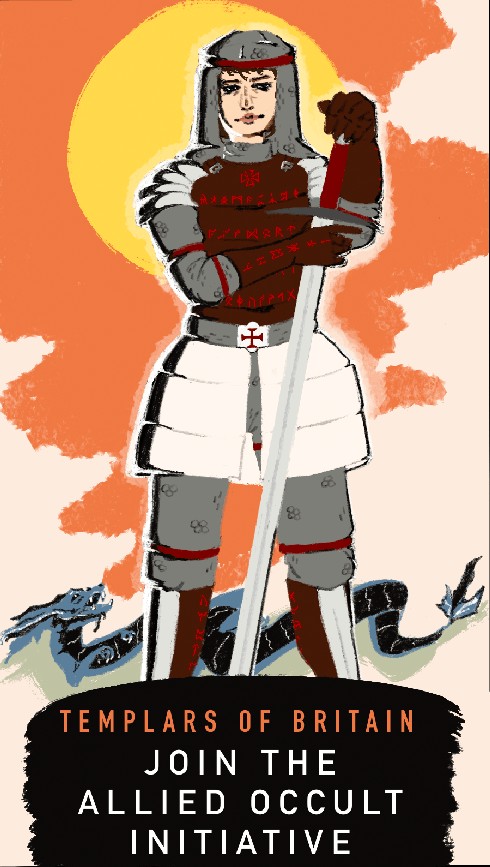
Holy Order of Knights Templar, Reformed
Founded in 1118 AD as the Poor Fellow-Soldiers of Christ and of the Temple of Solomon, the Knights Templar were formally suppressed and officially disbanded in 1312, by order of Pope Clement V under pressure from King Philip IV of France. However, parts of the organization persisted in secret, without support from the Papacy, for over six hundred years.
The Knights Templar emerged from hiding and officially reformed, behind the Veil, following the theft of the Spear of Destiny from Vienna by the Obskuracorps in 1938. Continuing their historical mission to protect Christendom, the Knights Templar oppose the efforts of the Obskuracorps to loot and pillage the sacred artifacts of Europe.
The Knights Templar were one of the founders of the Allied Occult Initiative, and have played a pivotal role in its earliest engagements. Heavily armored, warded by faith, and experienced in combatting mystical and mundane foes, the Knights Templar provide the primary shock troops of the Initiative.
International Center for the Study of Unified Thaumatology
Following the formulation of the theory of Unified Thaumatology by J.S. Carver, in 1913 the remnants of the Rosicrucian occult society the Hermetic Order of the Golden Dawn reorganized into a formal research center dedicated to the study and teaching of thaumatology. The resulting International Center for the Study of Unified Thaumatology has rapidly grown into the world's premier occult college, with campuses in London and Zürich.
ICSUT is one of the AOI's primary research partners, working around the clock on new spellcraft and paratechnology to tip the balance of the war. ICSUT is responsible for the development of the Everhart Resonator, and operates the prototypes to support AOI strike operations. ICSUT is also the source of most of the Initiative's battlemages.
The ICSUT London campus has been heavily targeted by the Luftwaffe during the Blitz, forcing its temporary closure and the relocation of students and classes to the newly opened ICSUT campus in Three Portlands. ICSUT Zürich continues to operate mostly as normal, albeit with the addition of a contingent of AOI troops using the campus as a forward operating base on the continent.
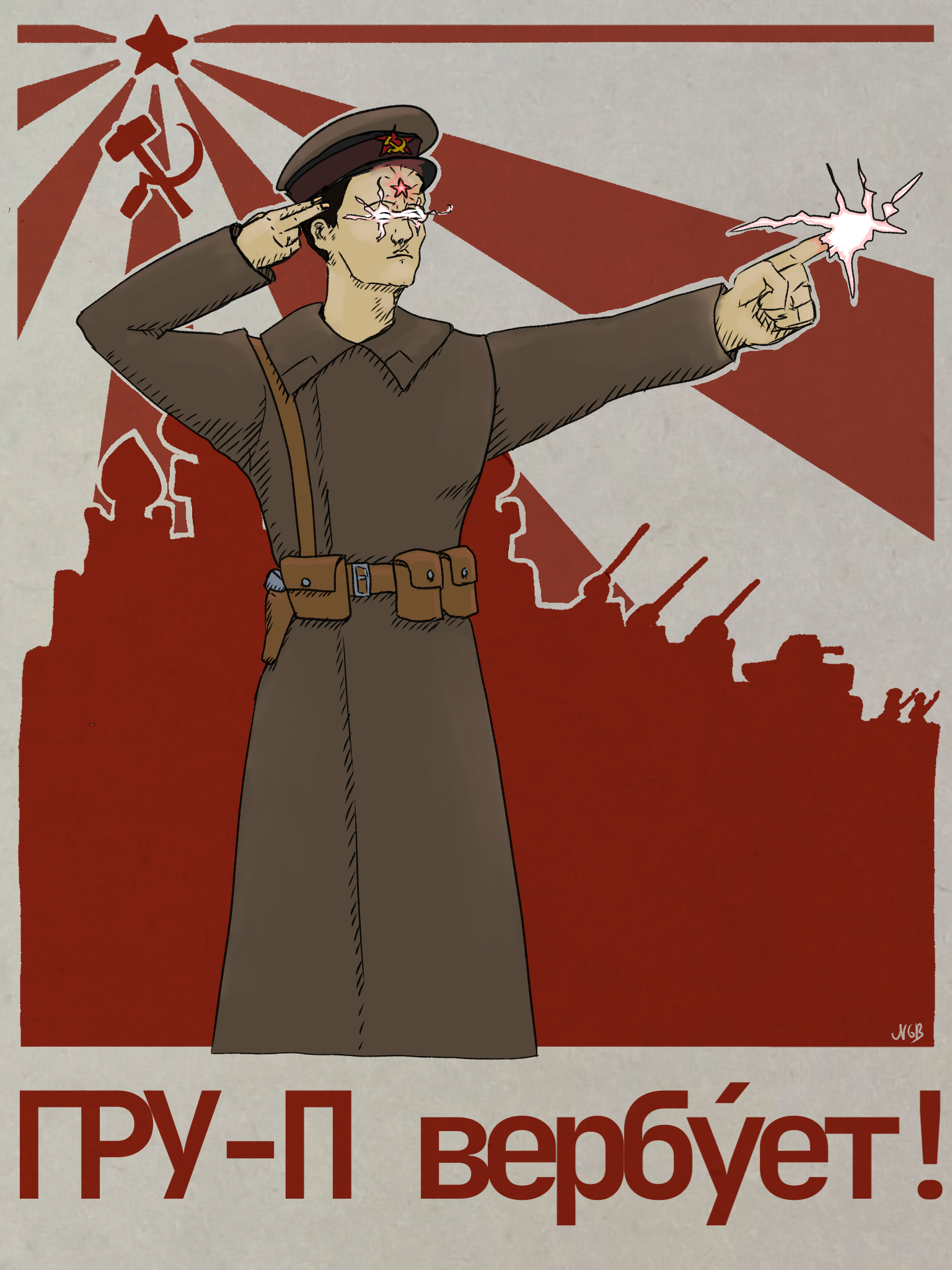
Main Intelligence Directorate, Psychotronics Division
The nascent Psychotronics Division of the GRU is — along with the NKVD Special Detention Brigade — one of two paranormal defense agencies of the Soviet Union. Created in 1937 in response to Obskuracorps involvement in the Spanish Civil War, the purpose of the GRU-P is to research and weaponize paranormal phenomena to defend the Union against occult threats. In this capacity, it has been opposed to the Obskuracorps since its inception — even while the Soviet Union was officially neutral following the Molotov-Ribbentrop Pact.
As a result of Stalin's purges, the GRU-P does not have ready access to skilled thaumaturges and mystics. This, in turn, has spurred a focus on the new parascience of psionics, and the GRU-P has rapidly become the leading expert in psychic abilities and phenomena.
Based on intelligence gathered via telepathy and precognition, the GRU-P has long been convinced that war with Nazi Germany is inevitable — a belief that has turned out to be well-founded. The GRU-P has therefore participated in the Allied Occult Initiative since the Battle of Prague, although this support was largely covert until the Nazi invasion of the Soviet Union.
The Scholomance
Located in Transylvania, the Scholomance is one of the oldest schools of sorcery in the world, and the subject of numerous legends and rumors — most wildly inaccurate, but some with a grain of truth. According to legend, the school was founded by King Solomon, is run by the Devil, and instructed Dracula. Only one of these is true.
In truth, the Scholomance is run by Vice-Headmaster Laszlo Sarkany, a powerful wizard known to be centuries old. Pupils of the Scholomance are instructed in necromancy and other so-called "black arts", giving rise to the school's poor reputation — an undeserved reputation, as Scholomance necromancers are frequently the ones responsible for dealing with wild undead and rogue necromancers.
Despite Romania's fall to fascism, the Scholomance stands in opposition to the Obskuracorps and Nazi Germany. This may be attributed in large part to the personal sympathies of the Vice-Headmaster: fascists leave a bad taste in his mouth, and he doesn't care for their politics either.
Neutral Powers
The Reinz Economic Concern
The Reinz Economic Concern is a collection of European financial firms with ties to the paranormal world beneath the Veil. Reinz was originally founded after the Sixth Occult War through mergers of preexisting companies owned by alchemists, financiers, and long-lived paranormal entities with vested interests in the industrializing world. Reinz and its wholly owned subsidiaries act as the primary method of banking, loaning, and financial exchange for sub-Veil individuals and organizations. As such, Reinz represents the single largest private source of investment for occult and paratechnological research.
While outwardly neutral, the members of Reinz have proven to be ready business partners for paranormal ventures on both sides of the war. The money that developed weapons in Prometheus Laboratories and Krupp Dämonik can be traced to members of Reinz, while Reinz accounts in Switzerland hold both cursed Nazi gold and Avalonian heirlooms. The Concern plays both sides, so that they are well-positioned to flourish, no matter who prevails on the Western Front.
The SCP Foundation
A private paranormal defense agency, formed from the merger of a number of like-minded groups in Europe and North America. The Foundation focuses on the containment of impossible anomalies, nominally for the good of humanity, and sells these services to national governments. As a result, the Foundation has acquired one of the largest stockpiles of paranormal artifacts in the world.
Officially neutral in the Occult War, the Foundation has long been preparing for it. They have undertaken a massive program to relocate anomalies from sites in Europe to secure locations in North America, and have been working to recruit and train more combat task forces. In secret, they have also agreed to safeguard certain artifacts previously held by the AOI, although this arrangement is only temporary.
Axis Forces
Ahnenerbe Obskuracorps
Formed in 1935 as part of the Ahnenerbe — the research and propaganda institute of the Schutzstaffel, the paramilitary vanguard of the Nazi Party — the Obskuracorps is the primary paranormal agency of Nazi Germany. Since their inception, they have been on a quest to recover occult artifacts by any means, a task which frequently brought them into conflict with other organizations. This pre-war archeological arms race culminated in the Battle of Prague and the outbreak of the Seventh Occult War, when the Obskuracorps attempted to recover and destroy the Golem of Prague.
The Obskuracorps is mostly composed of non-paranormal personnel armed with paranormal weaponry, derived from pilfered artifacts and stolen secrets. As part of the SS, it answers directly to Heinrich Himmler, and its members are chosen as much for their adherence to Himmler's esoteric fascist ideology as they are for their competence and experience with the paranormal.
The average Obskuracorps soldier is an evil bastard, either completely beholden to the darkest depths of Nazi thought or a self-serving sociopath with no regard for human life. They have been ordered to show no mercy to any Allied operatives, and none should be expected from them.
Krupp Dämonik
Krupp as a company has dominated the field of German weapons manufacturing since 1903, in vehicles, artillery, munitions, and scores of other products. It is no surprise, then, that Krupp created a subsidiary specifically dealing in the intersection of occultism and weapons development. Krupp Dämonik utilizes syncretic Pan-European demonological techniques to summon, bind, enchant, curse, and otherwise use demons and demonic byproducts in the process of weapon manufacturing. Depending on the caliber or variant, Krupp Dämonik products may contain hexed ammunition, theobiological components, or even entire demons bound to the internal workings of the weapon to allow for greater precision in aiming, as well as more explosive payloads. Krupp Dämonik is responsible for an estimated three-quarters of the Obskuracorps arsenal, either directly or indirectly.
Subject to aggressive vertical integration, Krupp Dämonik's production process is fueled entirely through slave labor, from mining and refinement, to human sacrifice and final assembly. The death rates at many of Krupp's plants are astronomically high, causing the factories to be drenched in thanatic energy and dread. Employees are known to have dropped dead on the assembly line, only for their bodies to pick themselves up and resume the work. These factories represent the beating heart of the Obskuracorps war effort, as without these weapons, Obskuracorps' rank-and-file would be defenseless and powerless against AOI strike teams.
Order of the New Templars
Founded by mad philosopher Jörg Lanz von Liebenfels in 1900, this militant proto-fascist religious order derives much of its ideology from the discredited theory of theozoology. They believe that the Aryan race descends from a species of electricity-based interstellar life, and that their cosmic heritage grants them the right to rule all of Europe as the master race, to one day ascend and take their rightful place among the stars.
The Neutemplar-Orden and its hierarchy is modeled off of the Templars of old, a perversion which angers the Reformed Templars to no end. They believe that God has bestowed upon them paranormal powers through their much diluted ancestry, which may be awakened through meditation, trepanation, and selective Aryan breeding. Many of their cohort have been accidentally lobotomized through ritualized electroshock therapy, but the Order has experienced success in replicating the secular psychic and electrokinetic abilities of GRU-P clairvoyants and ICSUT evokers, creating soldiers with untamed power, wielded with the zeal of fanatics.
The Order's focus on Christian heresy and anti-dogmatic theories has made it unpopular with much of the Thule Society and the Reich, which views the Order as, at most, a useful supply of incurious reactionaries and shock troops. However, the electric spectacle of the Order's occult demonstrations has made them popular with certain elements of the Obskuracorps, especially among the anti-intellectual element that disapproves of the Thule Society's focus on theory and history.
Thule Society
The Thule Society is a group of German ethno-nationalist occultists that formed in 1918. It sponsored one of the political forerunners of the Nazi Party, and many early Nazis were originally members of the Thule Society. Although officially dissolved in 1925, the Society persisted in secret and continued to provide occult support to the Nazi Party from the shadows.
Although the creation of the Obskuracorps has diminished the prestige of the Thule, they are still the primary source of mystics and battlemages for Nazi Germany. High-ranking Thule are part of the Obskuracorps high command, and the Thule have played a central role in the planning and execution of the Occult War. This has generated tensions with the leadership of the Obskuracorps — Himmler in particular is displeased by the role played by the Thule in masterminding the War's strategy.
Locations
The following section provides an overview of notable locations that are involved in the Seventh Occult War.
Allied Occult Initiative
Grand Occident Wedge
The first and preeminent Wedge, the Grand Occident Wedge is the heart and headquarters of the Gormogons, and temporarily serves as the home of the AOI High Command. The Oecumenicus Volgi resides here and presides over the affairs of the order. As befits the Gormogons, the building is heavily fortified against both mystic and mundane intrusion — it is said that only a Gormogon could bypass the wards that protect the Wedge. It is also said that the entire structure is rigged to explode should a Freemason ever step foot inside without permission.
Because of these fortifications, the Oecumenicus Volgi has volunteered the Wedge to house the AOI High Command. The normally closed and cloistered Wedge has been opened to the other members of the AOI — even Masonic organizations — and their representatives can be found throughout the halls.
The Wedge contains many secrets and oddities, mostly explosive in nature. Of particular note to visitors is the Hall of Boom, a museum of explosives and explosions that houses the trophies of the Gormogons and chronicles great feats of antimasonry through the ages.
ICSUT Zürich
The second ICSUT campus, ICSUT Zürich is a teaching and research university with a special focus on theoretical and high-energy thaumatology. It is here where Dr. John Everhart built the first Everhart Resonator, and of the ten extant prototypes, all but three are located on the campus.
Unlike ICSUT London, ICSUT Zürich has remained open for enrollment and instruction, albeit with a heavily modified and condensed curriculum designed to produce more battlemages for the Allied Occult Initiative. The ongoing classes also serve as a cover for the AOI's use of the campus as a forward operating base for Allied strike teams — a fact which must be concealed from the Swiss authorities, as ICSUT has pledged to respect and maintain Swiss neutrality in the conflict.
Under the guise of conducting apportation experiments, the campus' High-Energy Experimental Thaumatology Lab has been converted into a staging ground for AOI strike teams; the use of ICSUT Zürich as a base reduces the real-space distance translocated by strike teams apportated into Occupied Europe, which in turn allows for much more precise apportations. Without the campus and its Everhart Resonators, it is doubtful that apportation could be used at all.
Three Portlands
Three Portlands is an extradimensional city-state connected by Way to Portland, Oregon; Portland, Maine; and the Isle of Portland in the UK. The entire city is concealed by the Veil of Normalcy, and is policed by the American Unusual Incidents Unit. Its connections to the United Kingdom and both coasts of the United States make Three Portlands a valuable strategic location for the AOI.
Significant wartime traffic and materiel flows through the city, which serves as a logistics and transportation hub. The AOI also operates a prisoner of war internment camp on the outskirts of the city, which houses enemy combatants captured during the Occult War. The city is also home to the newly-opened ICSUT Portlands campus, where the classes and students of ICSUT London have relocated.
The AOI's presence in the city is also felt in the numerous off-duty personnel who make frequent use of Three Portlands as a rest and relaxation destination. Between the various AOI activities and R&R, the city has experienced an enormous economic boom. There are some in Three Portlands who are grateful for this newfound economic prosperity, while there are others who resent the rapid changes their city is undergoing. Certainly, no one is very happy about the large groups of armed men wandering about…
Neutral Powers
Bahnhofstrasse 26, 8001 Zürich, Switzerland
Bahnhofstrasse 26 is the main headquarters of the Reinz Economic Concern, and has been ever since the REC's founding. Located on the Paradeplatz, among many other prestigious banks, Bahnhofstrasse 26 looks drab and mundane. A plain brownstone with modest decoration, it provides the perfect front for the REC to receive clients from above the Veil. Given the population of the Veil and the Concern's financial ties, it is important for firms such as Reinz to maintain foothold in the mundane world, both to stay within the Swiss government's good graces, and to maintain a stable cashflow to support its more fantastical operations.
Bahnhofstrasse 26 possesses few paranormal qualities, beyond some of its employees. Mundane clients may expect services much like any other firm, with vaults that rank among the most secure on the continent. However, for more auspicious clientele, service at the Reinz is altogether different. A secure Way network within the second subbasement guarantees access to a series of seven arcane vaults, embedded in the cores of the Alps' seven tallest mountains. These vaults are sealed with wards derived from techniques purchased from a turncoat Gormogon; they are guarded by four Egyptian sphinxes, two tamed cockatrix, and a host of other occult defenses designed to protect the riches of Occult Europe from man, god, and monster.
These defenses have never been penetrated in the half-century that they have been active. But with advances in paratechnology and occult techniques, it is only a matter of time before the seal is cracked…
Site-138
The Foundation's administrative headquarters in Europe and North Africa, located in Schwyz, Switzerland. From here, the Foundation coordinates the mass relocation of artifacts from Europe to secure facilities in North America. It is also the home of Mobile Task Force Alpha-61 ("Death's-Headhunters"), the Foundation's primary wartime defense task force.
Despite its presence in neutral Switzerland, the Seventh Occult War has made its presence felt at Site-138. Security has been tightened, and new fortifications have been erected to fend off any possible attack. Given the high volume of paranormal artifacts that pass through the site, it is considered a potential high-value target for both the Obskuracorps and the AOI…
Wanderer's Library
The domain of the World Serpent, the Wanderer's Library is a vast nexus intertwined with the branches of the world tree. It is said to be connected to every library in existence, and to house every work of literature that has ever existed. These sayings are probably exaggerations, but it is true that the Library can be accessed via Ways from other libraries, and that its collection is too vast to be fully catalogued.
The Wanderer's Library is maintained as a neutral and apolitical center of learning, open to anyone willing to abide by its rules — no violence against other patrons, no damaging the books, and no removing books without a Library Card. Violations are followed by swift punitive action by the Librarians. The Library's official neutrality has led many enemies of the Obskuracorps to take-up semi-permanent residence in the Library, turning it into a sort of refugee camp for those displaced by the Occult War.
Negotiations with the Serpent's intermediaries, carried out by the Golem of Prague, have given the Allied Occult Initiative permission to travel through the Library on missions, provided that they carry no weapons and launch no offensives from within its halls. This same grace is not afforded to the Obskuracorps, who frequently find themselves ejected from the Library after testing the patience of the Librarians.
Axis Forces
Castle Werfenstein
Set on a cliff overlooking the banks of the Danube, Burg Werfenstein was constructed in the 13th century to exert control over shipping on the river, with the capability of raising chains across the river to block traffic entirely. A series of unfortunate events struck Werfenstein's owners, one after another. Over time the castle fell into disrepair, caught fire, and was eventually torn down in 1780, leading to rumors spreading of a five-hundred-year-old curse that lay upon the castle grounds. In 1907, Jörg Lanz von Liebenfels purchased and restored the inauspicious site, turning it into his personal Ordensburg for the heretical New Templars, where they train and practice their occult rites in secret.
Now, Castle Werfenstein is a place shrouded in perpetual rain, its tallest tower subject to a near-endless barrage of lightning as the New Templars hone their psuedo-theopsychism. The cliff under Castle Werfenstein is riddled with secret tunnels, within which the Order pursues even more forbidden secrets, constructing eigenweapons and theological weapons of mass destruction for the Reich. Its castle walls have become warded against intruders to a degree matched only by AOI and Obskuracorps' most secure facilities. The nature of the necromantic monsters that patrol the nearby Danube's turgid depths have never been described, as AOI agents that stray too close to the water's edge never return. Castle Werfenstein represents a precious target for the AOI, a strategically critical target that would cripple the Order's morale and war-making capabilities, if only someone were to bring down its walls…
Kriegskontrollzentrum
The Kriegskontrollzentrum is an Obskuracorps stronghold, nestled within and underneath the NSDAP Administrative Building in Munich, due to the symbolic and psychic strength the building draws from. The Kriegskontrollzentrum doubles as the administrative and strategic headquarters for the Obskuracorps, the nerve center through which Obskuracorps officers formulate strategy, issue directives, and plan the ascent of Germany as an occult power. For increased efficiency, the Kriegskontrollzentrum also contains the official Obskuracorps archives, which document the names and abilities of every Obskuracorps agent in the field.
As such a valuable target of espionage, the Kriegskontrollzentrum boasts powerful anti-scrying wards, and allows only high-ranking officers within its walls. As such, the facility's defenses, countermeasures, and wards are almost entirely unknown, and only general aspects of their nature can be deduced.
LZ-137 Horst Wessel
In September of 1938, the German rigid airship LZ-130 Graf Zeppelin II finished construction to minimal applause. Helium was scarce, hydrogen was avoided, and demand for another airship was low in the aftermath of the Hindenberg disaster. Any further plans to build more airships were halted, as there was no mundane need for such large, imposing, awkward vehicles. However, the day the stop-work order was issued, the half-built frame of LZ-131 was found to have been stolen. On Himmler's orders, the LZ-131 had been stolen by Obskuracorps agents and transported by magic to a hidden valley of the German Alps, where they continued to work on it in secret.
Now, despite the setbacks of four self-immolations, two uncontrolled crashes, and one catastrophic act of espionage by an Italian Gormogon antimason, the LZ-137 Horst Wessel is about to embark on its maiden voyage. Its cells inflated by enslaved helium elementals, its furnace powered by Tartarean demons, the Wessel's armory has been thaumaturgically improved, its superstructure alchemically enhanced, and the airship has been turned into a deadly eigenweapon showcasing the Obskuracorps occult might. Its rigid body has been lightened to such a degree that it is unable to land, rendering it a permanently floating air fortress, accessible only by high-flying Luftplattes or apportation. It acts as a mobile base of operations, laboratory, and wizard tower for the Obskuracorps. Shrouded in a cloak of magical mist, the Wessel is capable of flying to any theater unseen and undetected, anywhere, at any time. Should it reach within targeting distance of any Allied city, the Wessel would be primed to rain down the type of occult destruction not seen since Sodom and Gomorrah.
Spezialakademie 5
Modeled on the mundane SS-Junkerschlen at Bad Tölz, Spezialakademie 5 is Obskuracorps' primary training facility for combat thaumaturges. Originally established on the orders of Heinrich Himmler to "train the gifted men of Germany in the Aryan Magics", its curriculum is almost entirely based upon the fringe theories of Hyperborean sorcery espoused by the Thule Society. Consequentially, its graduates are unfamiliar with the theories of Unified Thaumatology, and often do not understand even the basic principles of backlash.
Non-thaumaturgic education at the Spezialakademie largely revolves around adherence to Nazi doctrine, and students are rewarded by their teachers for reporting violations and deviances among their fellows. The faculty, along with many high-ranking Obskuracorps officers, operate an unofficial patronage system at the school, with favor from high-ranking officers leading to rapid graduation, better treatment and accommodations, and choice postings. Backstabbing, false accusations of heterodoxy, and outright assassinations are commonplace, with the instructors largely turning a blind eye, so long as their personal favorites are left unharmed.
Characters
The following section contains descriptions of several prominent individuals who have participated in the Seventh Occult War.
Allied Occult Initiative
Sir Robert Durant, GCVO
A famed British adventurer and archeologist, Sir Robert Durant is one of the most highly-decorated agents of the Occult Service. A veteran of the Great War, he has spent much of the interwar period on missions for the Crown, suppressing any supernatural forces that might threaten the safety of the Empire. Among his greatest accomplishments was the infiltration of the Thule Society, which provided critical intelligence that allowed the AOI to recover the Golem of Prague before it could be destroyed by the Obskuracorps.
Since his return to London, Durant has been deemed too valuable to risk in combat or further undercover ventures, and he has been moved into a supervisory role away from the front lines. He now serves as a liason between the AOI High Command and the Combined Chiefs of Staff, keeping the Allied governments apprised of developments in the Occult War. In this role, he frequently briefs AOI strike teams on the political contexts and ramifications of their missions.
Dr. John Everhart

A student of J.S. Carver — the founder of unified thaumatology — Dr. Everhart is considered one of the leading thaumatologists of the era. His work has focused on understanding the nature of Elan-Vital Energy, which has led to the development of the Everhart Resonator: a device for converting electricity into Elan-Vital Energy. This new device has immediately become one of the greatest wartime assets of the AOI, as it has enabled the widespread use of apportation.
Dr. Everhart currently serves as the Dean of ICSUT Zürich, and is closely involved in AOI operations on the campus. While he has little time for research these days, he continues to oversee the High-Energy Experimental Thaumatology Lab, where he and his student assistants continue to work on new developments in applied thaumatology for the war effort.
Josef, the Golem of Prague
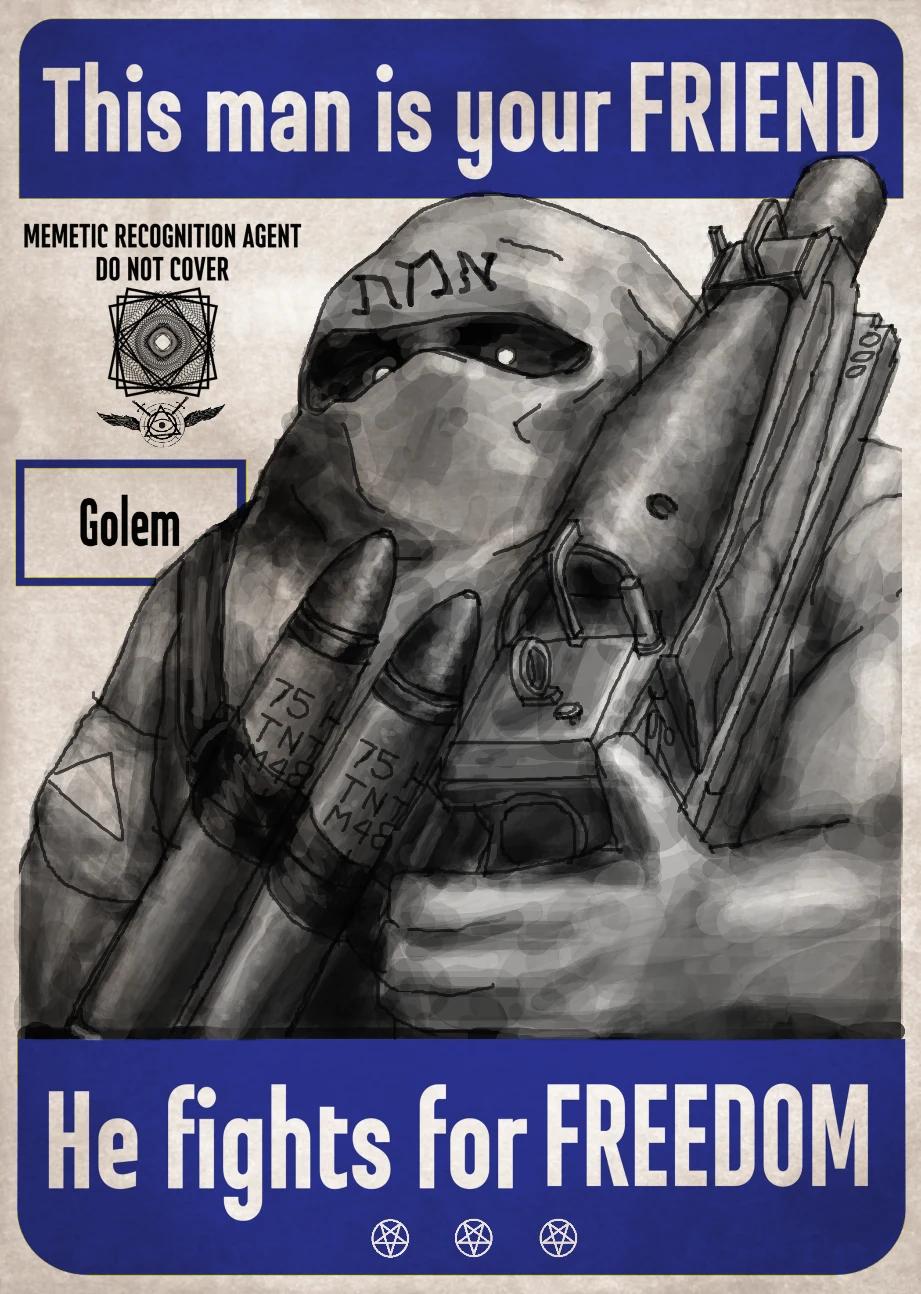
The Golem of Prague is a construct of medieval Kabbalah, created by the Maharal to protect the Jewish citizens of Prague. For reasons unknown, he was deactivated and placed into storage in the attic of Prague's Old New Synagogue. This was where he was found by the Obskuracorps in March of 1939, when they attempted to destroy the Golem. This proved to be a disastrous decision.
Inadvertently reactivated by the Obskuracorps, the Golem proceeded to battle Nazi forces throughout Prague until the timely arrival of the first AOI strike team. With the assistance of the strike team, the Golem escaped from the city, and has since joined the AOI as a special operative. Wise beyond years and skilled in necromancy, the Golem has quickly become one of the AOI's greatest weapons against the Obskuracorps.
Knight-Commander Isabel Johanna-Michaela Habsburg
Knight-Commander Isabel Johanna-Michaela Habsburg is a minor member of the House of Habsburg, the former rulers of the Austro-Hungarian Empire. With no chance of ever seeing the Imperial throne, she dedicated herself to becoming a holy warrior, joining the Templars-in-Hiding at the age of 14. Her personal patron saint is Joan of Arc, whose sword she carries — it is even rumored that the saint speaks to her through it.
Isabel Habsburg was part of the Templar-in-Hiding contingent tasked with protecting the Spear of Destiny. While she and her comrades were unable to stop the Obskuracorps from seizing the Spear and killing the commander of the guard, her heroism and leadership saved the remaining Templars and allowed them to escape Vienna alive. She has sworn an oath to see the Spear recovered, and there are none who doubt her conviction.
Isabel Habsburg is now a Knight-Commander tasked with supervising all Templar operations in Central Europe (roughly corresponding to the former territory of the Holy Roman Empire). Her devotion to the Templar cause, and defense of their independence from Vatican oversight, has caused substantial friction between her and Pope Pius XII.
Oecumenicus Volgi Vincenzo Santini
Under the nome de magie Diomedes Masonbane, Vincenzo Santini has served as Oecumenicus Volgi of the Ancient and Most Noble Order of Gormogons since 1928. An avowed anti-fascist effectively exiled from his home country for his opposition to the Mussolini regime, Oecumenicus Santini sees occult fascism as such a threat that he has declared an unprecedented truce with the Freemasons, and made common cause against the Nazis with former rivals like the Bavarian Illuminati and the Knights Templar. This has earned him a number of enemies among the Gormogons, and several prominent members have resigned in protest.
Vincenzo himself is a cautious man — it's why he's lasted over a decade as Oecumenicus Volgi, after the last three men in his position held the title for less than two years before accidentally blowing themselves up. He spends most of his days inside the Grand Occident Wedge, the AOI's de facto headquarters, working to keep the Initiative united, but he occasionally still takes to the field, where his skill in wardbreaking and high-energy thaumaturgy is unrivaled.
Vice-Headmaster Laszlo Sarkany
Laszlo Sarkany is a man of mystery, and he likes to keep it that way. It is known that he is at least a century old, that he is among the most powerful living thaumaturges, and that he does not drink wine; it is rumored that never sleeps, that he has seven wives, and that he was the inspiration for Bram Stoker's Dracula. At least one of these rumors is true.
Despite his title, Sarkany is the true head of the Scholomance, supervising the day-to-day operations of the school — the office of the Headmaster is kept vacant, in case the Devil wants it back. Since the outbreak of the war, he has been appointed the head of the AOI Council of War Engineering, an ad hoc working group charged with overseeing AOI weapons research and development. His mind, though ancient, is particularly well-suited to such a task, and he applies his vast knowledge of weapons and warfare towards a singular goal: to kill as many Nazis as possible.
Captain Sofya Voronina
The highest-ranking GRU-P "talent" the Allied Occult Initiative is aware of, Captain Voronina is the official liaison between AOI High Command and Moscow. Her service history and real name are secret even from the psychics reporting to her, as is how she received the Lichtenberg-figure scars which cover the majority of her exposed body. Much of her time is spent in telepathic communion, both with her agents in the field, and (it is presumed), with GRU-P's main command in Russia, and on occasion she has been known to perform "telepathic conferences", acting as a channel for her superiors to speak to AOI leadership directly.
Voronina's unreadable mask — classified name, classified history, classified emotions — drops only at the mention of the Order of the New Templars. Whenever GRU-P agents have even the slightest chance to eliminate their agents, she will insist that they take it, even at the cost of wider tactical goals. Whether this is a reflection of official GRU-P policy or a personal vendetta remains, like everything else about Voronina, classified.
Neutral Powers
Lieutenant Julian Corwin
Julian Corwin is the young second-in-command of Mobile Task Force Alpha-61 ("Death's-Headhunters"), the Foundation's primary wartime defense task force. Stationed at Site-138 in Switzerland, he is responsible for monitoring the status of the war and Obskuracorps' operations throughout Europe and North Africa. His position frequently requires him to liaise with both the Obskuracorps and the AOI, although he has a marked preference for the Allies.
Corwin is young and idealistic, and chafes at the Foundation's neutrality in the Seventh Occult War. He knows that it is only a matter of time before the Obskuracorps turns its attention towards the Foundation's vast hoard of artifacts, and he believes that the Foundation should take the offensive first. He may even be willing to provide some covert assistance to the AOI, should he be called upon…
C. Goldbaker
C. Goldbaker is a member of the Reinz Group's board of directors, and head of their investment division. Information about his younger years is scarce, but it is believed that Goldbaker hails from Egypt, and may have obtained a degree in economics and philosophy from the University of London. Goldbaker has been a relentless driver of innovation and investment within Reinz, always at the forefront of technological integration. He has pushed Reinz towards greater investment in near- and above-Veil companies, particularly those based in America and focused on information technologies such as the Bell System and Prometheus Labs' communications division.
Though he — much like the broader Reinz Group — holds little allegiance to either the Allies or Axis, Goldbaker's own personal goals are enigmatic, which has caused some consternation among members of the AOI, considering his level of influence in Reinz. British Occult Service observations of Goldbaker during business trips through the British Empire have failed to find any hint of personal life, vices, or need for basic amenities, begging the possibility that Goldbaker may not be human at all. Though if this is true, whatever he may be remains a mystery, and whatever he truly desires even moreso.
Axis Forces
Maximilian Bauer
A thug and a brute, Maximilian Bauer is a self-taught battlemage with a penchant for shock evocations. Unlike most of the Obskuracorps' battlemages, Bauer is not a member of the Thule Society, and he has little interest in academic pursuits. Instead, he is usually found on the front, leading Obskuracorps forces in combat while using the full might of his occult power to devastate Allied forces.
Bauer is a frequent foe of AOI strike teams, as he has a penchant for placing himself near obvious high-value targets in the hopes of ambushing Allied operatives. He has successfully thwarted several commando raids in this manner, and as a result AOI high command has made his death or capture an urgent priority. This is easier said than done, as Bauer is also a self-serving coward who will not hesitate to abandon his allies and flee if he perceives any real or imagined danger to himself.
Herwig Voss
Archeologist, archivist, and Arch-Necromancer of the Obskuracorps, Doctor Herwig Voss has worn many hats and done many things over the course of his professional studies. He was the first to catalogue the numerous curses of Ashurbanipal's tomb, the first to document the evolution of the modern ghoul, and the first to publish a comprehensive compilation of East Asian necromantic practices. However, despite his claims, these accomplishments were not achieved alone, and there are many accounts of how Voss took credit for discoveries made by colleagues through academic espionage, sabotage, and petty theft. Robert Durant himself was a victim of many of Voss's "collegial visitations," and has despised the necromancer ever since.
Voss has very rarely been loyal to institutions or ideologies, as he seeks his own self-glorification and fame at the expense of all others. He was expelled from the Scholomance under suspicion of the theft of a number of ancient grimoires, which are still lost to this day. His own loyalty to Germany is driven only by self-interest, and the belief that the Reich's surplus of disposable bodies allows him to further his own studies, from his cloister in Obskuracorps' Munich Kriegskontrollzentrum. But this fickle allegiance does not stop Voss from being one of Germany's most preeminent occult scholars, as well as an accomplished necromancer and ritualist in his own right. His syncretic necromantic practices have proven useful in Germany's eigenweapons program, and the results of his side projects have resulted in the disappearance of many AOI agents in the field, as well as the devastation of many villages on the Eastern Front.
Konrad "Kord" Weiss
A veteran of the Sixth Occult War, Konrad Weiss is a high-ranking member of the Thule Society and a true believer in the supremacy of both the Aryan race and thaumaturges. He has been the Director of Research and Archeology for the Obskuracorps since its inception, a position which gives him great influence on the organization's overall strategy and goals.
Paranoid, egotistical, and supremely self-absorbed, Weiss rarely leaves his villa outside of Paris, where he has setup a vast occult laboratory to conduct his secretive experiments. He prefers to work through proxies and subordinates, and demands perfection from his pawns — failure is punished harshly, and frequently fatally. He has a penchant for collecting trinkets and small oddities, which he displays for visitors to his villa.
Timeline
This is a timeline of major events leading up to and during the Second World War and the Seventh Occult War.
| YEAR | MONTH | DAY | EVENT |
|---|---|---|---|
| 1933 | January | 30 | Hitler is appointed as Chancellor of Germany. |
| 1935 | July | 1 | The Obskurakorps is established as part of the Ahnenerbe. |
| 1936 | July | 17 | The Spanish Civil War begins with the uprising of Francoist military forces on the island of Melilla. |
| 1937 | June | 8 | The Psychotronics Division is established within the GRU to defend the USSR against occult threats and counter the growing influence of the Obskuracorps. |
| 1938 | March | 12 | Anschluss, the German annexation of Austria. |
| April | 17 | On Easter Sunday, the Spear of Destiny is stolen from Vienna by the Obskuracorps. | |
| September | 29 | The Munich Agreement is signed, ceding the Sudetenland to Germany. | |
| October | 31 | Representatives of the British Occult Service, the Reformed Knights Templar, the ICSUT, the Gormogons, the GRU-P, and the Scholomance meet at ICSUT Zürich to discuss the growing threat of the Obskuracorps. The representatives sign a Memorandum of Understanding that commits their organizations to further cooperation to counter Obskuracorps activities throughout Europe. | |
| 1939 | March | 15 | Germany invades and annexes Czechoslovakia. |
| 20 | The Obskurakorps and the nascent Allied Occult Initiative launch competing efforts to recover the Golem of Prague, leading to the Battle of Prague and the outbreak of the Seventh Occult War. | ||
| April | 1 | The Spanish Civil War ends with a Francoist victory. | |
| September | 1 | Germany invades Poland, launching the Second World War. | |
| 1940 | April | 9 | Germany invades Denmark and Norway. |
| May | 10 | Germany invades France and the Low Countries. | |
| June | 10 | Italy joins the War on the side of Germany. | |
| 22 | France capitulates to Germany and Italy. The collaborationist Vichy regime is established in southern France. | ||
| September | 5 | Fascist dictator Ion Antonescu seizes power in Romania. | |
| 1941 | April | 6 | Germany and Italy invade Greece and Yugoslavia. |
| June | 22 | Germany invades the Soviet Union. | |
| August | 11 | ICSUT Portlands open for its first semester of classes. | |
| September | 8 | The Siege of Leningrad begins. | |
| 1942 | July | 17 | The Battle of Stalingrad begins. |
| November | 8 | The Allies launch Operation Torch, the invasion of Vichy French Algeria. | |
| 1943 | May | 13 | The Allies force the surrender of the German and Italian armies in North Africa. |
| July | 4 | The Obskurakorps launches a raid on Three Portlands in an attempt to loot an Everhart Resonator from the ICSUT campus in the city. The assault is repelled by a combined force of local citizens and AOI operatives. | |
| 10 | The Allies invade Sicily. | ||
| September | 3 | The Allies invade the Italian mainland. | |
| 8 | Italy surrenders to the Allies. Northern Italy is occupied by Germany. | ||
| 1944 | January | 27 | The Siege of Leningrad ends. |
| June | 4 | Rome is liberated by the Allies. | |
| 6 | D-Day. The Allies invade Occupied France at Normandy. | ||
| August | 19 | Paris is liberated by the Allies. | |
| 23 | King Michael launches a coup in Romania, withdrawing the country from the Axis and siding with the Allies. | ||
| September | 1 | The Foundation enters the Seventh Occult War as a co-belligerent alongside the AOI. Mobile Task Force Alpha-61 ("Death's-Headhunters") executes a daring raid to capture Konrad Weiss, the Obskuracorps Director of Research and Archeology. | |
| December | 16 | The Battle of the Bulge begins. | |
| 1945 | January | 24 | The AOI launches Operation Aeon Dawn, the final battle of the Seventh Occult War. The Seventh Occult War ends. Remaining Obskuracorps forces continue to fight or flee in a disorganized manner until the final surrender of Germany. |
| March | 23 | The Allies cross the Rhine river and enter Germany. | |
| April | 16 | The Battle of Berlin begins. | |
| 30 | Hitler commits suicide. | ||
| May | 8 | Germany surrenders. The Second World War ends in Europe. |
Gamemaster's Guide
This section contains principles, guidelines, and tips for gamemasters to help them run excellent games of 7OW:RPG. It also contains a variety of optional and extra rules which can be used to change and tweak the experience of playing the game, which should be used to tailor the experience to a given table's liking. Nothing in here is "GM eyes only", but players should be aware that this section, more than any other, is intended as advice rather than hard and fast rules.
Introduction
If you're reading this, you're probably a GM. That means you have chosen, or have been chosen, to be in charge of controlling the entire world the other players will inhabit — its characters, its locations, its events, and everything else that the Operatives will interact with. If you are new to GMing, this can seem like a heavy responsibility, maybe even be a bit overwhelming. Don't worry — it doesn't have to be!
While it is true that you probably need to have a bit more system mastery than your players, you do not need to be an expert on everything — remember that at the end of the day, you are telling a story with your friends, and stories don't need to have hard and fast rules. Here are a few general principles that will serve you well as you embark on your adventures in the 7th Occult War:
- Look Things Up: When arbitrating rules disputes, have a copy of the rules at hand. If you don't know the rules for a particular question, look them up! This also applies when you're designing the world; the Second World War in general, and Nazi occultism in particular, have a plethora of academic resources available that you can use to help create a compelling story.
- Make Things Up: Sometimes, you can't find a rule fast enough, or can't come up with a good historical fact for whatever you need. In those cases, trust your gut, and make something up that sounds reasonable. If someone corrects you later, you can change things going forward, or just decide that you've made a house rule; as a GM, ultimately this power is in your hands, and you should use it wisely.
- Make Mistakes: Fear of mistakes is understandable, but remember that you're not a professional, and you don't need to be an expert. You're telling a story, and if you make a mistake in a detail of that story, you can always fix it later. Nothing ever needs to be set in stone.
- Root for the Operatives: While you control the enemies, you should always be a fan of the Operatives. Remember, you're telling the story of their adventures, and you should want it to have a dramatic, exciting, and ultimately victorious tale of heroism. That doesn't mean pull your punches, but it does mean give them a bit of leeway, and avoid throwing things at them they have no way to handle.
- Have Fun: You are a player as much as anyone else at the table. If you are not having fun, that's not fair to you, and you should change things so that you are. Tragically, as the person running the game, it's often difficult for others to recognize when you aren't enjoying yourself, so you should make sure to do self-check-ins every now and then.
- Fascists Suck: This is really important to remember, as you'll be portraying some of the worst, most evil, most immoral human beings to ever walk the earth. Do not try and make the forces of fascism sympathetic, or (even worse) show them to be secretly in the right. We've mentioned before, and we will mention again, that if you are someone who wants to tell the stories of Obskuracorps in any kind of positive light, you are unequivocally unwelcome in this game, and frankly in civil society as a whole. If that's not you, though, take this as permission to make your villains as over-the-top evil, bafflingly incompetent, and self-sabotaging as you want.
Using Skill Checks
Skill checks are a great way for characters to show off their training and expertise, and failing one can be annoying if it’s not handled well. You should only call for a skill check if:
- The skill check is actually necessary. If a reasonably competent, trained person could succeed under the circumstances the character is in, you shouldn’t call for a roll. Generally, the more time a character has on their hands, the less likely it is that whatever they are doing needs a roll; if a trained spy has an uninterrupted hour to pick a lock, they’re going to succeed.
- There are consequences for the check. You shouldn’t call for checks that don’t matter, or where there are no downsides to failure or upsides to success. If there’s no possible way the characters can avoid the oncoming wall of lava, don’t ask for an athletics roll to avoid it - all that will do is make the players frustrated that they rolled and suffered the consequences regardless of the result.
- You want to let a player show off, or just have fun with their character. We’ll go into this in a bit, but choosing skill checks to suit your players’ selected skills can be a great way to make them feel like a useful member of the team.
Failing Forward
Failing on a skill check should never be the end of the story. If your players fail to pick a locked door, they shouldn’t be completely unable to complete the mission. Instead, you should use this as an opportunity to push them to take a risk or another, more dangerous approach. Maybe they can try and break the door down, or use a different (and better guarded) entrance, or find a different way to enter entirely. What matters is that the story keeps on moving, and the setbacks add stakes and color to it.
Repeated Skill Checks
In general, if the players have time to repeatedly try a skill check, then you shouldn’t be calling for a check at all. For this reason, once a skill check is failed, the result should be final, and the players shouldn’t be able to try again unless the circumstances around the check change.
Helping on Skill Checks
Sometimes, one character might be able to help another out on a skill check. In this situation, the character making the check should get +1 Accuracy for each ally helping them who has at least +1 in the skill being checked.
Applying Conditions
A variety of conditions can affect the outcome of a skill check, and you should factor that into the checks you ask for. If a player is making a check where some circumstances make things more difficult, you should increase the Difficulty of the check to suit. Trying to pick a very difficult or well-made lock might add 1 Difficulty, while trying to jump off of the deck of a fast-moving boat onto a passing buoy in the middle of a hurricane might add 6!
Choosing Checks
Checks should be selected to suit the narrative, not the other way around, and logic should be your first resort when deciding which to call for. However, as mentioned above, you can try and tailor the checks you intend to call for to give players moments to shine. This doesn’t mean that every check should be selected with a player in mind that can succeed at it - in fact, we strongly encourage against this - but every once in a while, you should put obstacles in the team’s path that one of the characters is perfect to solve. Done well and unobtrusively, this can make them feel like a solid contributor to the team. This is especially true with Expert skills.
You can also do the opposite to great narrative effect. If the team has lost an operative, requiring a check they would’ve been able to make easily, and which the team now must struggle with, can really hammer home the theme that they’re stronger together. Do this sparingly, as it can get frustrating very quickly.
Communicating the Stakes
The consequences of success and failure on a skill check should always be clear to the players. If failure might inflict damage, or a negative Tag, or some other narrative hazard, make sure they’re aware of it. If success might bring a major advantage, or allow a desperate claw-back, or mitigate some other danger, they should be equally aware. Doing so adds tension, and makes your players feel like they have agency.
Choosing Checks, Continued
As mentioned above, choosing the checks you call for is a great way to make players feel like their Operatives are an important member of their team. For some skills, when and how to call for them is obvious. For others, however, it is less so. To help you with these trickier skills, we've put together some examples of scenes and moments you can use to focus on the skills we think might otherwise be difficult to use:
General Skills
- Drive: Motorized chases down narrow streets. Evading a tail. Gunning a Jeep over a castle's closing drawbridge.
- History: Guessing at the location of ancient burial grounds. Hypothesizing the location of traps inside a forgotten tomb, based on similar structures. Establishing facts during a briefing about the enemy's goals in Egypt.
- Military Science: Predicting which parts of a base are the most heavily defended. Deciding which supply lines to cut. Identifying enemy officers by their insignia.
- Navigation: Surviving in the woods. Planning a safe route through a blizzard. Reading an ancient map that leads to a lost magical relic.
- Science: Understanding how to safely disable an experimental weapon. Making improvised explosives out of fertilizer. Guessing at the purpose of strange experiments.
Exceptional Skills
- Pilot: Flying a plane as part of the Insertion phase. Taking control of an enemy plane during a scene set on one. Recognizing allied from enemy aircraft.
- Necrodynamics: Reverse-engineering a necromantic construct. Calming a raging spirit. Sabotaging a necromantic production line.
- Veiled History: Recognizing the tracks of a manticore. Establishing facts during a briefing about local veiled resources. Discerning the true motives of Thule Society expeditions.
Designing the Mission
Mission Design Principles
The actual process of designing a mission can seem overwhelming, and if you try to plan every individual aspect of one it can be, but this is not the only way. We recommend that instead of consider every possible outcome, every potential scene, and fleshing out every individual character, you adopt a more flexible approach, based around facts.
Facts are narrative and mechanical decisions you have made about the mission and conveyed to the Operatives. Until they hit the Operatives' ears, they aren't set in stone, but the moment that they do, they become true. This system allows you to move and reposition anything you need, while still creating the impression of a coherent, logical world. When choosing facts to communicate to the Operatives, make sure that they make sense, and remember that you can make them up to make better sense on the fly. "Building the plane while you're flying it" is highly recommended.
Before assigning a mission, we recommend doing the following:
- Come up with a brief setting description: This should be a few sentences, a paragraph at most, that describes the Area of Operations. It shouldn't go into much detail; instead, use this as a "ground truth" of what the place is like, that you can then refer back to when making up facts. For example:
- A cruel factory producing smoke-belching cyborgs
- A foreboding castle on a storm-blasted mountaintop, crackling with profane energies
- A submarine beneath the frigid waters of the North Atlantic
- Come up with a few key characters: Again, this can be brief. Come up with a few characters who inhabit the AO that you can use later. Depending on the mission, they might be foes, potential allies, or forces of nature the Operatives will need to work around. Make sure to tie them in to the setting description. Examples include:
- Hans Blucher: A cruel Obskuracorps Nekromant, and the officer in charge of the factory
- Giovanni Esposito: The mayor of the village in the castle's shadow, who can be convinced to aid an AOI team in stopping the Nazi experiments.
- The Hurricane: A powerful storm bearing down on the submarine, which threatens to sink it, and the Operatives with it, should they not turn it around in time.
- Decide on the types of enemies the Operatives will face: You do not need to choose specific enemies at this stage. Instead, look through the Bestiary, and pick out a few broad categories of opponent that inhabit the area. Later, when designing encounters, you can pull from these choices to populate them.
- Decide what the AOI knows: Now that you've created a skeleton of the mission, decide on what the AOI knows and doesn't know, and communicate that information in the briefing. Write these things down for your own notes, too. These will be facts you should use later.
Once you've created this skeleton, you're ready to move on to the next stage: Designing Scenes.
Designing Scenes
In 7OW:RPG there are two main kinds of Scenes: Combat and Non-Combat. Both of these should use your skeleton, and your established facts in slightly different ways, but the following core principles always apply:
- Scenes should be centered on a challenge or event: A scene where nothing happens is boring to run and boring to play. Every scene should further the story in some way; either the story of the mission or the story of the Operatives. Sometimes, this means that the Operatives might want to sit down around a fire and develop a closer bond. Other times, it means that you should skip the hours of hiking and "fast-forward" to the difficult ravine crossing. In non-combat scenes, you should always either use them to give the Operatives information, require them to solve a challenge (usually using checks), or allow them to see the consequences of their actions. Combat scenes are already a challenge and an event on their own!
- Every Scene should tie to at least two facts: This doesn't mean you can only run scenes based on existing facts, but rather that scenes should either be based on those you have established, or establish new facts themselves.
- Challenges should be possible: Don't put the Operatives up against forces they cannot do anything against. This doesn't mean that they need to be able to win every fight, or accomplish every goal, but they should always have agency to do something, even if that's just retreating.
Designing Combat Scenes
When you're designing combat scenes, you should draw on the forces you selected as part of your skeleton, and the facts established thus far. You can either come up with them on the fly, in which case you should lean heavily on the facts to decide the layout of the battlefield (more on this later), the enemies they will face, et cetera, or you can design set-piece encounters ahead of time.
Set-Piece Battles
Given our emphasis on free-form design, set-piece battles may seem out of place. In truth, they are, but they're so much fun to design and run that we recommend you use them anyway. Not every combat needs this level of planning, but the final battle with a Hydra or the Obskuracorps leadership deserves some planning to be truly spectacular.
When designing set-piece battles, you select which enemies will be present ahead of time; you can make changes to this until the Operatives actually start the scene, but the majority of the forces they will face are chosen ahead of time. You also design the battlefield to be in a specific location, even if the way that location connects to the rest of the world may be changed later.
With this in mind, you can steer which facts you establish to make a set-piece battle feel like a natural part of the mission, rather than a pre-planned scene.
Balancing Combat
One of the great questions of every role-playing game is how to balance combat. We simply don't. Based on the facts, and the capabilities of the Operatives, select enemies and design a battlefield that they have the tools to solve. Killing everyone is a solution, but so is forcing a surrender, collapsing the roof on top of pursuers, or sneaking past the opponents.
You should also remember that the forces arrayed against the Operatives should behave realistically. Most Obskuracorps troops, at least at the lower levels of their organization, will surrender if their officers are killed and they see no hope of surviving an encounter. Bound creatures will gladly turn on their controllers should their bindings break. High-ranking officers are often harder to break, but still are self-serving sociopaths and likely to flee should the prospect of victory disappear.
Above all else, reward creative problem solving in combat just as you would out of combat.
Battlefield Construction
The battlefield is the area that the Operatives and NPCs fight on. Usually, it is a grid of hexes of equal size; you can represent this with anything from online software to a hand-drawn hex grid with Lego figures to a custom battle mat with painted figures. Each character should have some representation that you or the controlling player can move around.
When you design a battlefield for a combat encounter, you should be sure to set up plenty of terrain features. To do this, we recommend thinking about what you might find in the location that would be of relevance in combat, and then applying tags to reflect that: the concrete walls of a bunker might be a terrain feature that has the Blocks Vision tag, while barbed wire spools might have the Damaging (1D3), Difficult, and Passable tags, along with Health to reflect that they can be destroyed. A list of tags which can be applied to terrain features is below for your reference:
- Blocks Vision
- Burning (x)
- Cover (x)
- Damaging (x)
- Difficult
- Enchanted
- Flammable
- Holy
- Passable
- Temporary (x)
- Unholy
Running Combat
When actually running combat as the GM, you need to keep track of quite a few things. There's no easy way around this, but for your reference, here's a checklist:
- The current round number, and when a new round starts: This matters for many abilities, and for terrain features with the Temporary (x) tag.
- The stats of NPCs: We recommend giving each NPC a unique name, even just "Schütze 3" or "Big Dog", and keeping track of only the stats that have been modified from those in the Bestiary in a notepad or other text document. This also applies to tags — only note which tags have been added or removed, and reference the Bestiary for the rest.
- The NPCs' situation: Remember, most NPCs don't want to lay down their lives, either due to cowardice, arrogance, or because they're only in the combat because they're forced to be. If you feel like the battle is turning, have them break or surrender.
Designing Non-Combat Scenes
The guidelines for Non-Combat scenes are far less strict, simply because the category is so broad. In general, use them to establish facts, let the Operatives make discoveries and developments, and achieve goals in non-violent ways. When using Non-Combat scenes, you should also consider how you can use them to make the world feel more real and alive; they're also an excellent opportunity to connect disparate truths together.
Insertion & Exfilitration
The Insertion and Exfiltration phases both rely on you as the GM to make choices about how exactly the Operatives can perform them. The following are some methods commonly used for both:
Amphibious Landing
The coasts of the Third Reich are extensive, and impossible to fully secure. Commandos are frequently inserted into Occupied Europe on small boats, launched from offshore ships or submarines. Such landings must be conducted at night to minimize the risk of being spotted and engaged by coastal defenses. Invisibility spells, memetic camouflage, and other esoteric means are available to further reduce the risk of being spotted during approach.
Once ashore, landing craft must be hidden or destroyed to prevent subsequent detection by coastal patrols. The discovery of a landing craft is a tell-tale sign that commandos are in the area, and will put the Nazis on high alert.
Border Crossing
Although most international travel has been suspended due to the war, Nazi Germany and its occupied territories share many thousands of miles of land borders with several neutral countries, and many ports of entry remain open. It is possible for a strike team to enter Germany across these borders, either openly or covertly.
At its most basic, a border crossing entails sneaking across the German border without being caught. This is best done at night, to minimize the chances of being spotted. More elaborate schemes might involve crossing at a legal port of entry, using subterfuge or outright bribery to bypass customs officials.
The greatest risk of this method, however, is that it frequently requires extensive travel behind enemy lines. Such travel is fraught with peril, as any mishap or mistake could expose the strike team and force them into battle with German security forces.
Way Network
There are thousands of pocket dimensions connected to our universe, which collectively make up the branches of the world tree. Ways crisscross these branches, connecting different parts of the world tree to one another. With sufficient knowledge of the network of Ways, it is possible to travel from one point in our universe to another point without crossing the entire realspace distance between them.
Ways only ever connect between different branches of the world tree: you cannot open a Way directly between Portland, Oregon and Portland, Maine; however, you can open a Way to Three Portlands from Oregon, and then from Three Portlands open a Way to Maine.
Travelling through the branches of the world tree is hazardous. Different pocket dimensions may contain alien geometries, hostile lifeforms, or other magical hazards. Getting lost is also a constant risk, as not all Ways are stable, and known paths are far from constant. And of course, the exit may be booby-trapped…
Additionally, some methods are limited to Insertion only:
Apportation
The most cutting-edge insertion method available to the AOI, and the backbone of its rapid-strike operations. Apportation is a form of quantum teleportation which uses thaumaturgical means to translocate targets between points at the speed of light. Doing so requires vast amounts of Elan-Vital Energy; amounts until recently only obtainable through mass human sacrifice. Thanks to the invention of the Everhart Resonator at ICSUT, the AOI now can perform Apportation at an industrial scale.
Apportation is generally the first pick of insertion methods for the AOI, as it is difficult for the enemy to predict and extremely fast, however it carries substantial risks. Targeting is imprecise, and in the worst cases can lead to operatives arriving inside of solid objects and killing them instantly (this should never happen to a player character). The risks can be mitigated via the use of probability beacons, but smuggling one into the AO is often a mission in and of itself. Apportation can also be warded against, and some Obskuracorps facilities make use of such defenses, or even place probability beacons in traps to attempt to lure would-be infiltrators to their deaths.
Apportation also always generates backlash, and lots of it. This doesn't need to be modeled mechanically when apportation is used for insertion, but it should be described to the players to give them a sense of the ramifications of their mission — the backlash from apportating an entire strike team can easily kill people if, for example, it triggers a volcanic eruption on the other side of the world. Backlash from apportation is almost always going to be a large-scale act of magic in its own right, and usually a disruptive one: think lakes turning to blood or lemon pudding, volcanoes erupting, whales being teleported a mile into the sky, rains of frogs, and other similar calamities.
Parachute Jump
Widely used to deploy commando forces behind enemy lines, parachuting from a plane is a common backup method used when Apportation is off the table. Parachute jumps are almost always conducted at night, to reduce the risk of being seen by enemy forces, but this risk is always present to some extent. If parachutists are spotted in mid-air, enemies may sound the alarm, or even attempt to shoot down parachutists before they can land.
Parachuting is also fairly inaccurate, and parachutists run the risk of getting separated from each other during their descent. Upon landing, parachutists may find that their strike team has been scattered across the AO. There is also the risk of a parachute becoming entangled with a tree or other obstacle, resulting in injury or inconvenience.
Some methods are limited to Exfiltration only:
The Library
Thanks to an agreement with The Serpent (see Locations for more details), AOI teams can use The Library to exfiltrate from missions. This works in the same method as the Way Network, save that the Way always leads to the vast Wanderer's Library, and the prospect of getting lost is virtually guaranteed. Fortunately, the Library has guides who will eventually lead Operatives back to ICSUT Zürich, but teams are typically MIA for a few days as they make their way through its twisting shelves.
Stolen Vehicles
There is always the option of stealing or commandeering an enemy vehicle and taking it out of the AO. Whether on land, by air, or above or below the sea, AOI operatives can generally operate Obskuracorps vehicles, and use them to exfiltrate. Of course, there's always the risk they'll be mistaken for the enemy and fired upon.
Flying Aces
In the Second World War, the controls of most aircraft were very similar, and a skilled pilot could reasonably operate anything from an American B-17 to a Japanese Zero without too much difficulty. More exotic vehicles, of course, might require special training to effectively pilot, like experimental German jet fighters or the Obskuracorps' Luftplatten.
Optional Rules
The following systems are optional rules you can use to change how the game plays to suit your table. You should only use the ones you find interesting, and in general we recommend running your first campaign using none of these.
Languages
For most tables, the approximation of languages used by default is sufficient. For those which prefer a more immersive approach to language, however, this system may be appropriate. This replaces the base Languages rules.
All languages are treated as Expert Skills. Characters with a level in a given language of less than or equal to 3 are considered only conversationally fluent, and must make a Check with the appropriate language to attempt to understand any complex statements. If a character has 0 skill in a language, but has a level of at least 5 in a closely-related language (Such as Spanish and Italian, Swedish and Norwegian, etc.), they may attempt a language roll in that related language with +3 difficulty to understand the language.
All Operatives start out with an English level of 5, and a German level of 3. If they are native speakers of another language, they start out with that language at level 5, and English at level 3. Additionally, if they have the Doctor, Lawyer, or Scholar background, Operatives start out with a Latin level of 2.
When leveling up, Operatives may purchase languages they do not have any levels in if they have ready access to a character with that language at 5 or higher.
Overwatch
In some cases, particularly at smaller tables, the Operatives may be frequently outnumbered and unable to react to enemy actions. In this case, GMs may chose to allow each Operative a single Overwatch activation. Overwatch activations are taken after an enemy character takes their turn, when there are no friendly characters which have not yet taken their turn. Characters are nominated to take their Overwatch activation as if it were a turn, but on that turn they are only allowed to perform Attack actions, and they receive only 1 AP to spend on them. These Attack actions should be performed with +1 Difficulty.
Increased Lethality
By default, 7OW:RPG is not a highly lethal game. This means that while operatives are always at risk of death, with shrewd play there is generally always a way that all operatives can complete the mission alive. Operative death is only assured when players have catastrophically failed.
Some players may desire a higher-risk game where even perfect play carries a significant risk of death. The following rules allow gamemasters to adjust the lethality of 7OW:RPG to create a more dangerous game. You should discuss with your players and ensure that they are interested in a high-lethality game before implementing any of the following rule changes. You may choose to implement all of these mechanics, or only a portion, to achieve the difficulty that is right for your group. You should communicate clearly which optional rules are in effect, if any.
- Harsher Dying (x): Instead of operatives dying when they reach Dying (4), you may reduce the threshold to 3. This forces players to act much faster to save Dying operatives. We recommend not lowering the threshold below 3, as that may result in operatives dying near-instantly with little to no opportunity to be rescued by their comrades, which will likely be frustrating for most groups.
- Harder Stabilization: Instead of operatives stabilizing after their first successful Fatality Check on their turn, you may require two or more successful Fatality Checks before they become stable. This means that Dying operatives remain in jeopardy for longer and have more opportunities to fail rolls, raising the stakes and encouraging allies to intervene. Be careful raising this threshold too high, as it may make self-stabilization effectively impossible.
- Dead Stubborn: You may disallow the Too Stubborn to Die rule to prevent operatives from resisting lethal damage. Watch out, as this may make operatives more susceptible to being taken out by a single powerful or lucky attack.
If your group chooses to implement any of these rules, remain aware of the following concerns:
- Higher lethality may significantly impact the tone of the game, making it more bleak and negative. Make sure the mechanics you choose fit the story your group is trying to tell, and that everyone is on the same page.
- Players often grow attached to their operatives the longer they play as them. If they keep dying before they can grow strong, players may grow detached from their characters and the game. Consider adjusting the lethality or allowing new characters to more quickly catch up with the more experienced operatives.
- Conversely, if players have managed to keep their operatives alive for a long period of time, they may no longer be open to the idea of their characters dying so easily. In this case, you should discuss it them and considering lowering the lethality of the game.
No matter what, check in with your players frequently and ensure that everyone is playing the the game the way they enjoy it best.
Bestiary
The world of the Seventh Occult War is populated by a variety of peoples, creatures, and stranger things besides, all of which operatives might encounter on missions. This section is a guide to some such characters, and can be used to populate missions with friends and foes alike. GMs should feel free to modify them to create variation, or make up their own characters entirely!
Allied Occult Initiative Vehicles
The AOI does not make use of a large number of vehicles, both due to its relatively ad-hoc nature and because of its access to Everhart Resonators, which allow it to use apportation to deploy troops. When the AOI does field vehicles, they are typically American-made, selected for reliability and durability.
Willys MB
Often called a Jeep, the Willys MB is an American off-road-capable light utility vehicle, manufactured in almost unbelievable numbers. Renowned for their toughness, flexibility, and reliability, every Allied force, including the AOI, fields Jeeps as scout cars, ambulances, message carriers, cavalry, and in countless other roles.
Health: 14
Willpower: N/A
Armor: 0
Speed: 8
Evasion: 8
Tags: Crew (1), Faction (AOI), Mechanical, Mindless, Passengers (3), Size (3)
Demons
A deeply-charged term that, often unfairly, implies infernal heritage, “Demon” is a catchall term for creatures native to realities other than our own. Often, they are pulled into our reality by summoners or demonologists using workings which enforce obedience upon them, while in other cases they arrive seemingly by accident. The Demons presented in this section have the Faction (Obskuracorps) tag to represent their being under the control of enemy summoners, but it is entirely possible to encounter demons which are unaligned or even in service to the AOI.
Dog of War
Hound-shaped things made of gore, rubble, and shrapnel, summoned forth from a reality of endless slaughter where the backlash of industrial-scale warfare has given rise to creatures which inhale polluted air and exhale cordite. Their teeth are the brass of spent shell casings, their eyes the burning fires of crematoria.
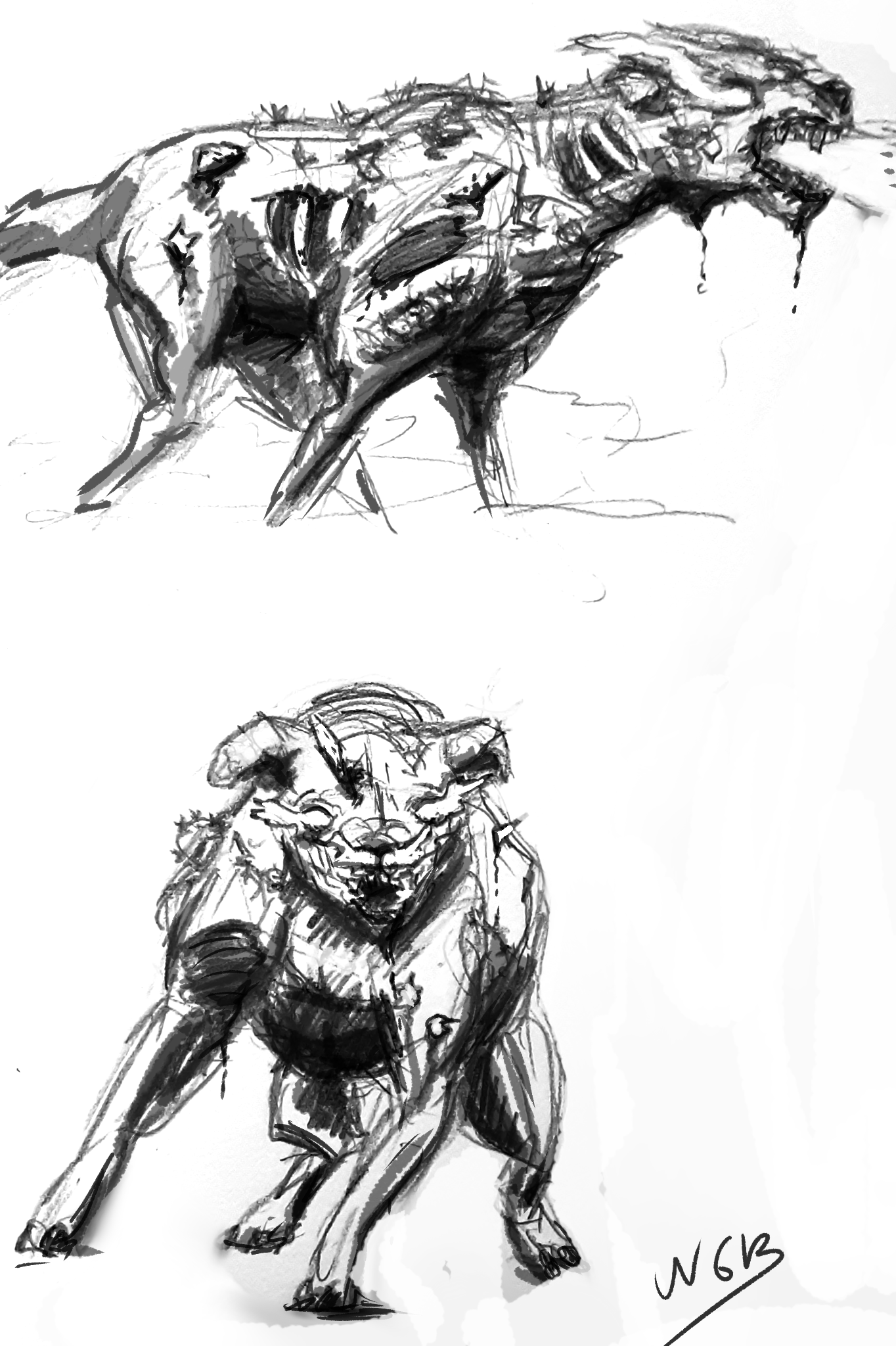
Health: 8
Willpower: 8
Armor: 2
Speed: 4
Evasion: 12
Skills: Ballistics +2, Melee +2
Tags: Construct, Controller (Obskuracorps Character), Demonic, Enchanted, Faction (Obskuracorps), Minion, Size (1)
Attacks:
Brassy Bite
Melee Attack
Damage: 1D6
Tags: Melee
Shotgun Maw
Ballistics Attack
Damage: 2D6
Tags: Range (4)
GM Note: Dogs of War are typically summoned by Beschwörer to act as front-line assault beasts. They normally accompany elite troops in guarding the inner reaches of such mages’ strongholds.
Flame Elemental
Serpentine tongues of living flame the size of a man, Flame Elementals want nothing save to burn. Ripped from a reality of endless infernos, they long to make our world more pleasing to them in the only way they know how.
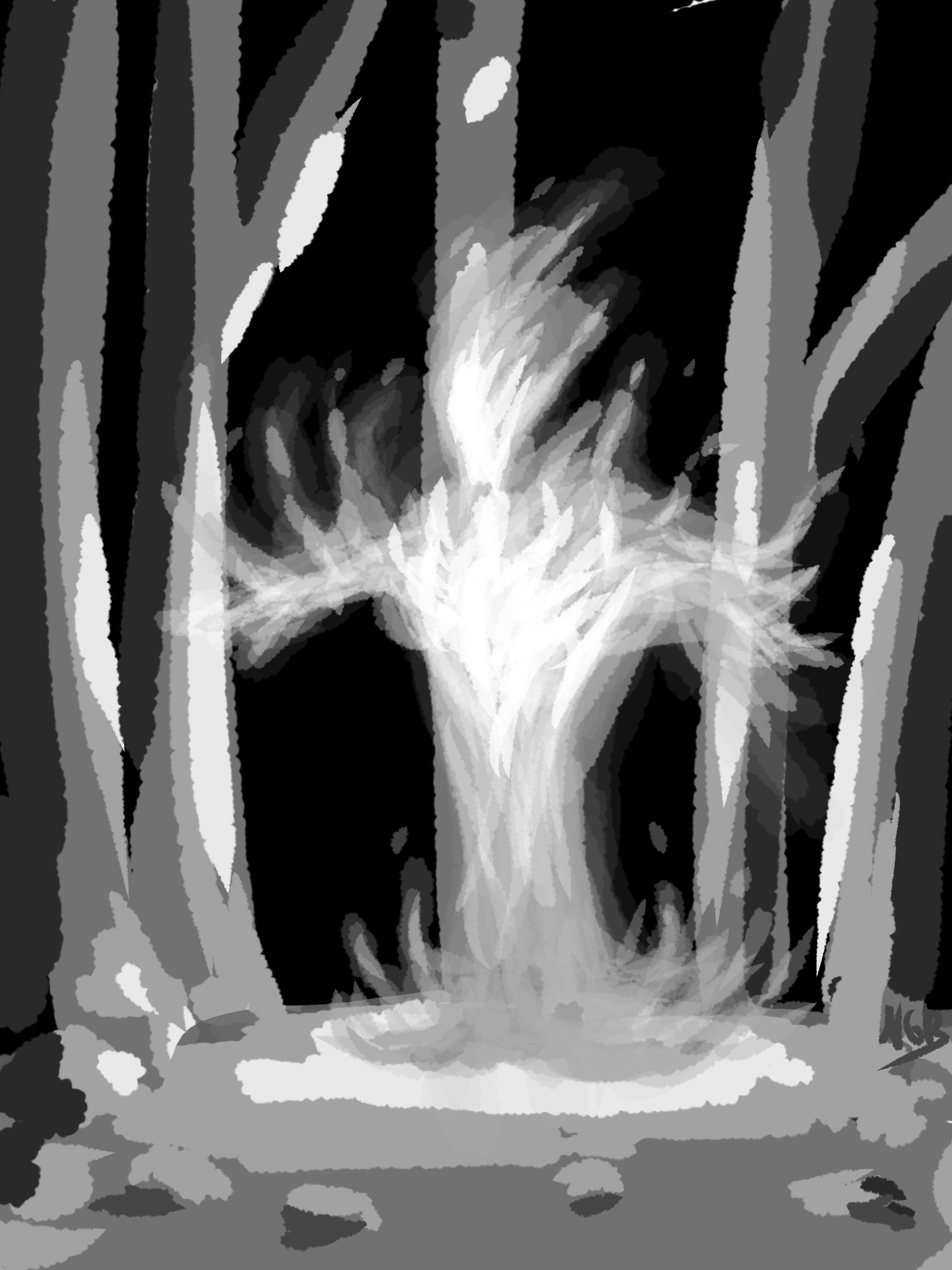
Health: 10
Willpower: 10
Armor: 1
Speed: 4
Evasion: 12
Skills: Melee +1
Tags: Controller (Obskuracorps Character), Demonic, Enchanted, Faction (Obskuracorps), Minion, Size (1)
Abilities:
Burning Aura
At the start of their turn, all characters within 1 hex of the Flame Elemental gain the Burning (1) tag.
Living Flame
The Flame Elemental can never gain the Burning (x) tag, and is immune to damage with the Burning (x) tag. If the Flame Elemental ever enters a hex with conditions which would extinguish it, such as water deeper than a puddle, extremely powerful wind, or a complete lack of oxygen, it immediately dies.
Attacks:
Burning Blade
Melee Attack
Damage: 1D6
Tags: Burning (2), Melee
GM Note: Flame Elementals act as living, moving environmental hazards, conjured up to guard locations or act as incendiary weapons. They cannot be reasoned with or persuaded, and only obey their summoners' directions thanks to the power of their bindings.
Frost Giant
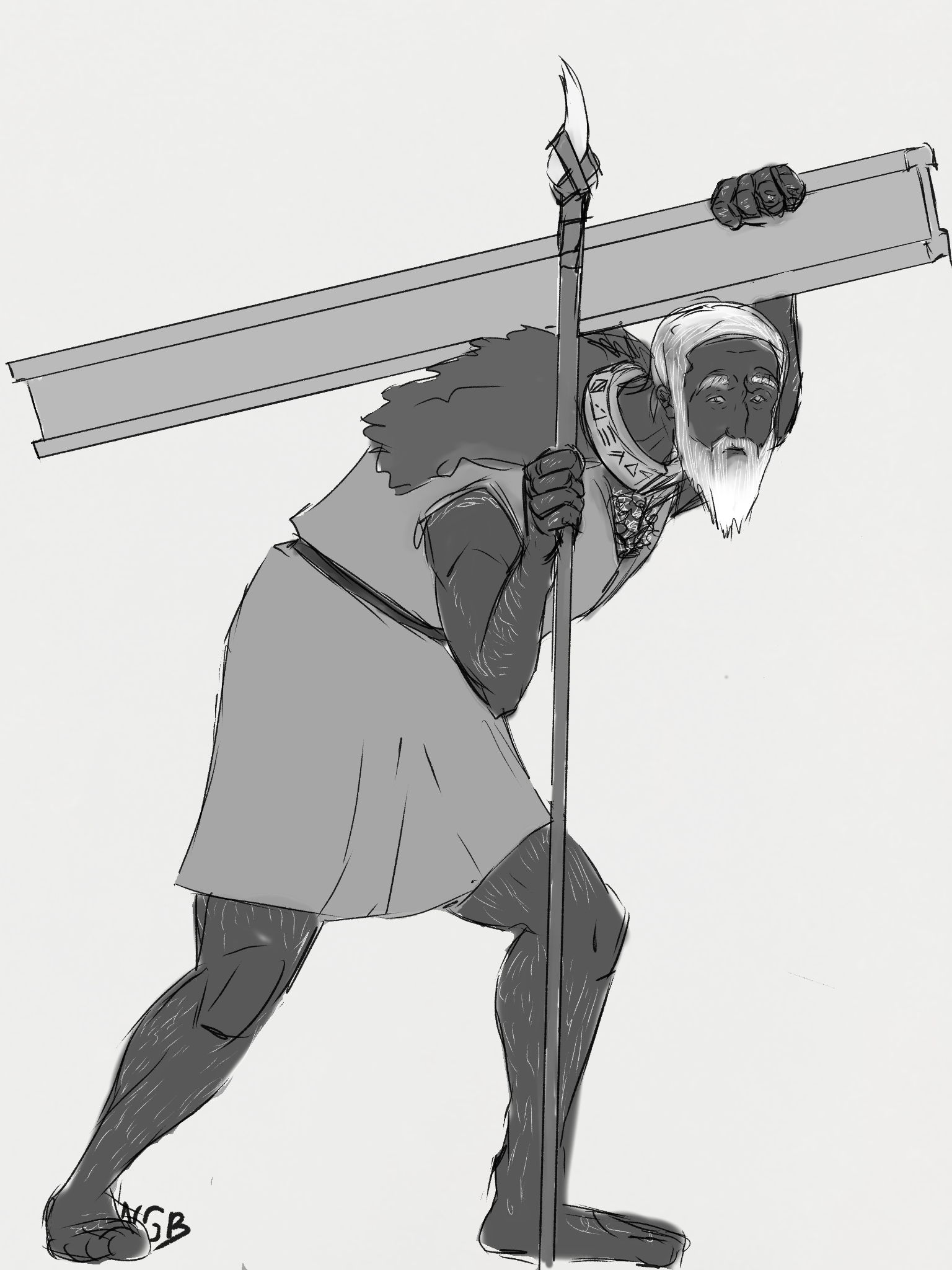
Ponderous humanoids standing three meters tall, ripped from a glacial reality in which life adapted to constant ice ages and enslaved by sorcerous means. Frost Giants hold no love for Obskuracorps, but the runic collars around their necks force them to obey or suffer agonizing pain. A small handful of freed Frost Giants have established an enclave in the Alps, which has been approached by the AOI as a potential ally.
Health: 18
Willpower: 10
Armor: 2
Speed: 4
Evasion: 9
Skills: +1 Ballistics, +2 Melee
Tags: Demonic, Enchanted, Faction (Obskuracorps), Size (2)
Abilities:
Frost Armor
At the beginning of its turn, the Frost Giant loses all Shredded (x) tags as its armor refreezes. While the Frost Giant has the Burning (x) tag, it loses all Armor.
Runic Collar
A Frost Giant’s runic collar can be destroyed by a well-placed shot, substantial force, or magical means. Should the collar be destroyed, the Frost Giant loses the Faction (Obskuracorps) tag and, at GM’s discretion, may either become hostile to all humans, or gain the Faction (AOI) tag and become an ally to the players. If it does so, it will attempt to extract with the players.
Attacks:
Saber-Tooth Spear
Melee Attack
Damage: 2D6
Tags: Melee, Armor-Piercing (1)
Mammoth-Bone Longbow
Ballistics Attack
Damage: 2D6
Tags: Armor-Piercing (2), Range (8)
GM Note: Ice Giants are usually deployed in groups to guard facilities in the Arctic or high on snowy mountaintops. They may labor under a Beschwörer or Tierbändiger overseer, though lazy or careless masters often assume that their loyalty is assured by their collars and leave them to their work unwatched. Their intelligence and hatred for Obskuracorps means they can function as excellent “unlikely allies” to the party, and serve to emphasize the cruelty and evil of the Reich. Many of them speak at least some German.
Some of their number are capable of ice magic, usually no more than 1 per group. To represent these mages, give them +1 Thaumatology, +2 Willpower, and access to the following actions:
Blizzard
Cost: 2
Mechanics: The Frost Giant selects a hex it can see and makes a Thaumatology Check. On a success, a Blizzard Terrain Feature (see below) is created on that hex, and all adjacent hexes.
Tags: Ritual, Thaumaturgy
Blizzard
Special Rules: Frost Giants are immune to damage from this Terrain Feature, and ignore its Difficult tag.
Tags: Blocks Vision, Damaging (1D3), Difficult, Enchanted, Passable, Temporary (3)
Ice Wall
Cost: 3
Mechanics: The Frost Giant selects up to 6 contiguous hexes it can see and makes a Thaumatology Check. If successful, each selected hex becomes occupied by an Ice Wall Terrain Feature (see below).
Tags: Ritual, Summon, Thaumaturgy
Ice Wall
Health: 10
Armor: 2
Tags: Blocks Vision, Enchanted, Temporary (4)
Hellhound
Fiery, dog-like beasts native to numerous hellish afterlives, Hellhounds are summoned via ritual sacrifice and fed on innocent blood and flesh. So long as their dark hungers are sated, they remain loyal to their masters, their bone-chilling howls sapping the strength of any who hear them.
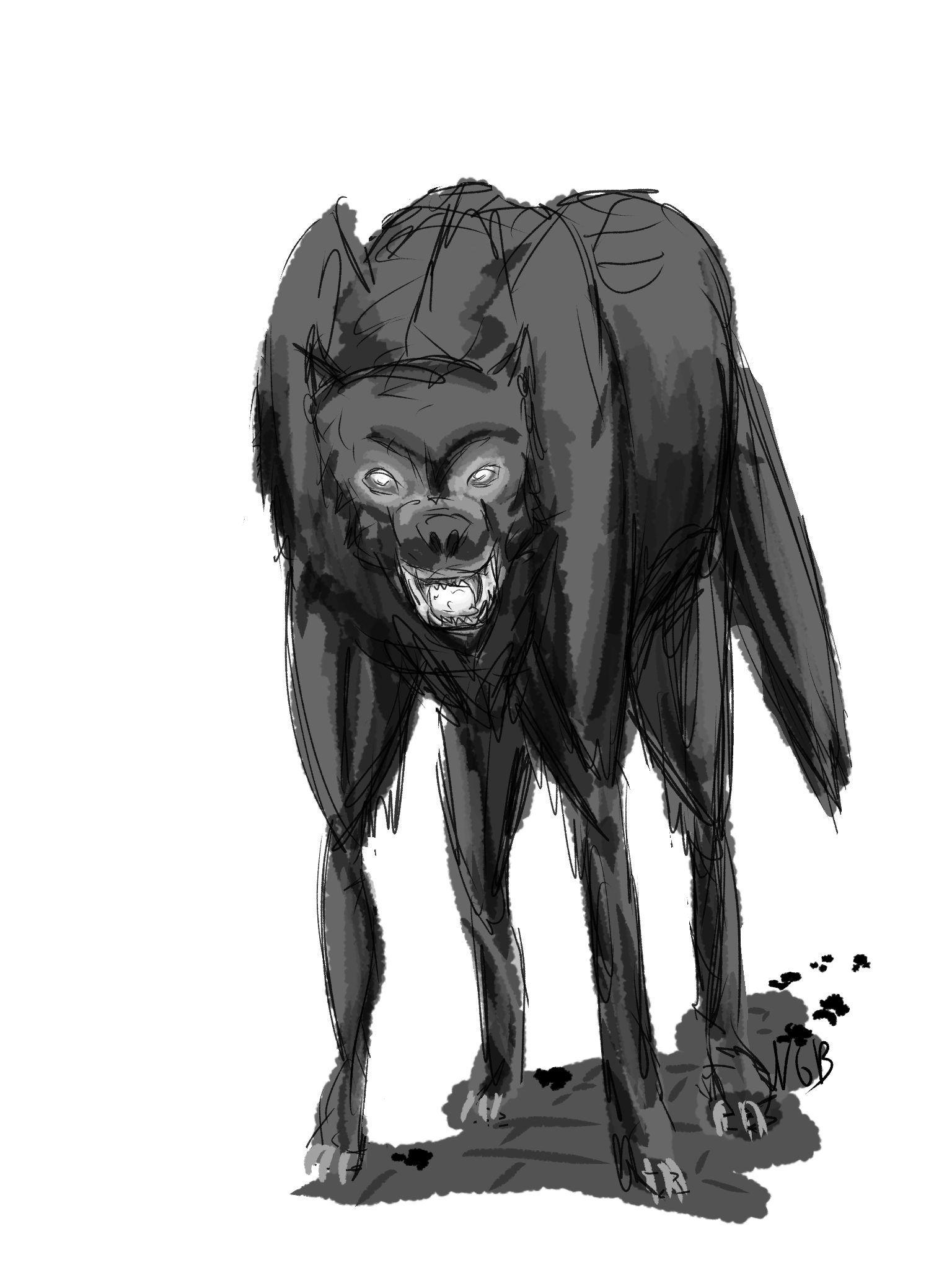
Health: 13
Willpower: 10
Armor: 2
Speed: 4
Evasion: 12
Skills: Melee +2
Tags: Beast, Controller (Obskuracorps Character), Demonic, Enchanted, Faction (Obskuracorps), Minion, Size (1)
Actions:
Infernal Howl
Cost: 1
Mechanics: All characters without the Faction (Obskuracorps) tag and within earshot of the Hellhound must make a Camaraderie save with a target value of 11. On a failure, they lose 1D6 Willpower. The Hellhound may only take this action once per turn.
Attacks:
Burning Bite
Melee Attack
Damage: 2D3
Tags: Burning (1D3), Melee
GM Note: Hellhounds can be summoned by Beschwörer or commanded by Tierbändiger. In either case, they are insidious psychological warfare beasts which are dangerous in melee and difficult to put down, often deployed behind the first line of troops where their howls can be the most effective. Any location which deploys them must have a ready supply of innocents to feed them with, and a disruption to this supply will cause them to turn on their masters.
Imp
Small, crude, violent creatures which infest afterlives and parallel worlds alike, Imps come in a variety of shapes and sizes, and need little compulsion to serve Obskuracorps, for they revel in suffering. Their mystically-attuned nature makes them useful as living buffers for backlash, which usually detonates the Imp in a multicolored explosion. When left to their own devices, groups of imps, known as “stabbings” quickly descend into violence and murder until only a single imp is left, who then splits into numerous other individuals, beginning the cycle anew.
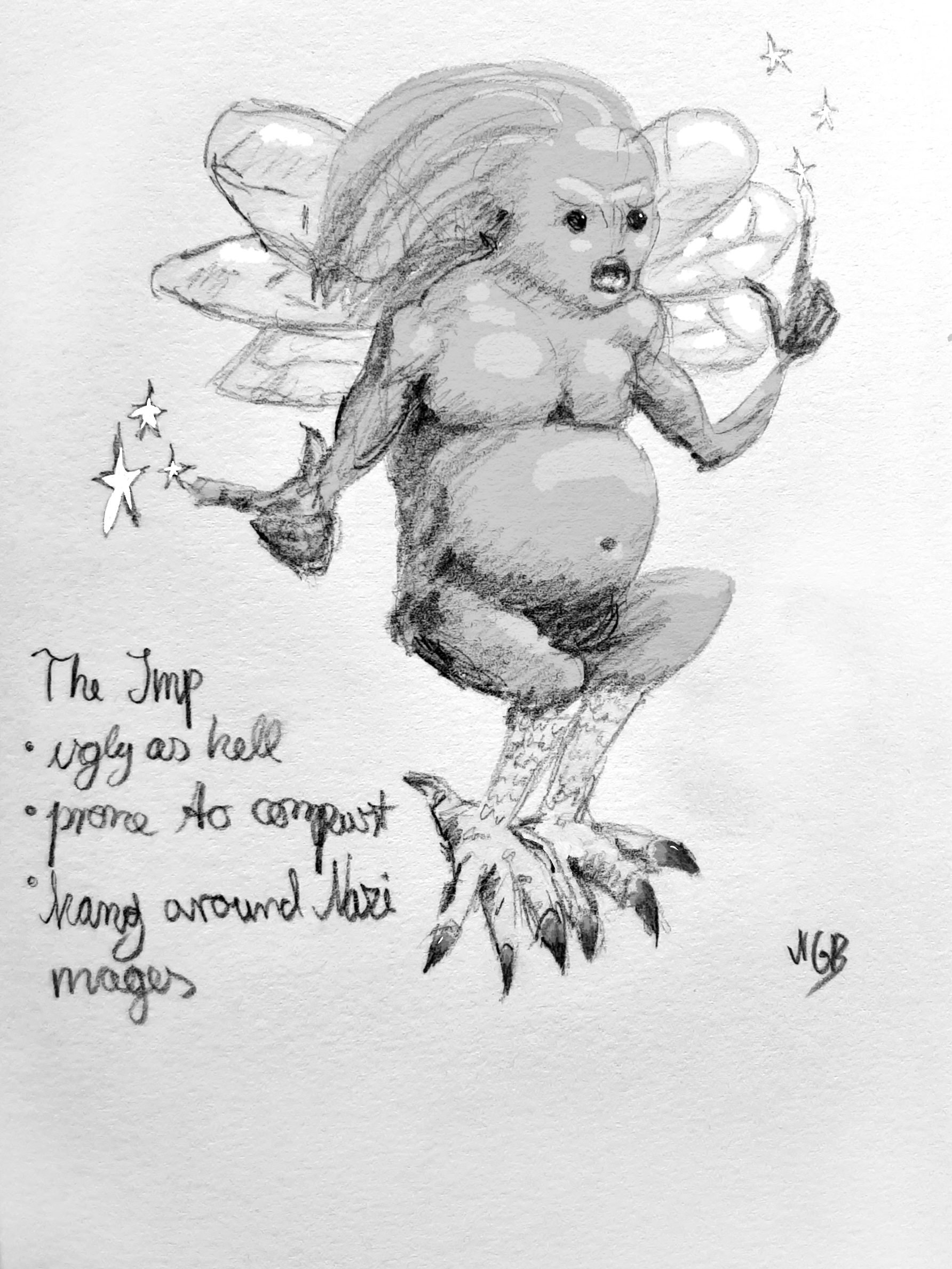
Health: 3
Willpower: 10
Armor: 0
Speed: 4
Evasion: 13
Tags: Demonic, Enchanted, Faction (Obskuracorps), Grunt, Size (¼)
Abilities:
Living Buffer
Whenever a character with the Faction (Obskuracorps) tag suffers backlash within 3 hexes of an Imp, they may instead choose to project the backlash onto the Imp. If they do so, the Imp detonates in an Explosive (1) attack centered on its position which deals 1D3 Damage.
Attacks:
Chaotic Bolt
Ballistics Attack
Damage: 1D3
Tags: Range (4)
Filthy Claws
Melee Attack
Damage: 1D3 + 1
Tags: Melee
GM Note: Imps often accompany Obskuracorps thaumaturges who are cavalier about backlash. Their love of suffering extends to the suffering of their fellows, and their detonations can provide a humorous note to an otherwise serious encounter. On a narrative level, they can be effectively used as a symbol of the self-destructive nature of fascism.
Tartarean
Among the first demons summoned, Tartareans are rarely seen summoned by Obskuracorps. They are representatives of a species with a strict martial culture centered around an alien code of honor. AOI Demonologists theorize that some strictures of this honor code put them at odds with the ideology of the Reich, though which precisely are unknown, as cruelty and slavery are known to be acceptable to them.
Health: 12
Willpower: 10
Armor: 3
Speed: 2
Evasion: 8
Skills: Melee +2
Tags: Controller (Obskuracorps Character), Demonic, Enchanted, Minion, Size (1)
Attacks:
Sulphur-Alloy Blade
Melee Attack
Damage: 1D6
Tags: Melee
Mundane Creatures
A variety of ordinary creatures serve countless roles in the Seventh Occult War, just as they do in the Second World War. The most commonly seen on missions are dogs and horses, both widely-used by Obskuracorps and the AOI.
German Shepherd
German Shepherds are deployed by Obskuracorps in the same roles as they fill in the Wehrmacht, guarding locations, tracking fugitives, and attacking their handlers’ enemies.
Health: 3
Willpower: 5
Armor: 0
Speed: 4
Evasion: 12
Skills: Melee +2
Tags: Beast, Controller (Obskuracorps Character), Faction (Obskuracorps), Minion, Size (1)
Abilities:
Exceptional Nose
Characters with the Infiltrating or Hidden tags lose those tags when they occupy a hex within 3 hexes of a German Shepherd.
Attacks:
Bite
Melee Attack
Damage: 1D3 + 1
Tags: Melee
GM Note: German Shepherds can be given a Schütze or Sergeant as their master, giving character and flavor to “boring” enemies. They are also deployed in packs by Tierbändiger. Their ability to pierce even the best stealth also allows them to act as a counter to skilled infiltrators.
Horse
Despite their sorcerous might, Obskuracorps is not exempt from wartime fuel restrictions, and they employ thousands of horses as mounts and pack animals. Most are little different from any other horse, though some are ensorcelled to be unnaturally calm and obedient.
Health: 7
Willpower: 3
Armor: 0
Speed: 4
Evasion: 12
Tags: Beast, Crew (1), Faction (Obskuracorps), Size (2)
Attacks:
Hooves
Melee Attack
Damage: 1D3 + 1
Tags: Melee
Obskuracorps Troops
The human soldiers of Obskuracorps are recruited from the Wehrmacht, the SS, and various occult societies of the Reich. While the majority of such soldiers know little about the finer details of Obskuracorps’ plans or capabilities, virtually all are fanatically loyal to the organization as a whole and their commanders personally. Each and every one of them is dedicated to the furtherance of fascist control over the entire world.
GM Note: The characters in this section can easily be used to represent mundane German or Allied troops, should you need to. Simply swap out the Faction (Obskuracorps) tag for the appropriate faction tag.
Sergeant
Leaders of groups of Schützen, Sergeants are better-trained than the troops they lead, and expected to maintain order on the battlefield.
Health: 10
Willpower: 10
Armor: 1
Speed: 3
Evasion: 10
Skills: Ballistics +2
Tags: Faction (Obskuracorps), Human, Size (1)
Actions:
Rally
Cost: 1
Mechanics: The Sergeant selects a character with the Faction (Obskuracorps) tag they can see and who can hear them, and gives them an order to rally. The target regains 1D3 Willpower.
Attacks:
Schütze
The numerical majority of Obskuracorps’ human troops are Schützen, or riflemen, well-equipped and trained but generally unaware of the paranatural beyond glimpses of their superiors’ doings.
Health: 7
Willpower: 8
Armor: 1
Speed: 3
Evasion: 10
Skills: Ballistics +1
Tags: Faction (Obskuracorps), Grunt, Human, Size (1)
Attacks:
Untersturmführer
Leaders of platoon-strength groups or acting as adjutants to higher-ranking officers, Untersturmführer are the lowest-ranking Obskuracorps members who are made aware of the existence of the paranatural as a matter of course.
Health: 10
Willpower: 12
Armor: 1
Speed: 3
Evasion: 10
Skills: Ballistics +2, Military Science +1
Tags: Faction (Obskuracorps), Human, Officer, Size (1)
Attacks:
Combat Knife
Melee Attack
Damage: 1D3
Tags: Melee
Service Rifle
Ballistics Attack
Damage: 1D6
Tags: Range (9)
Pistol
Ballistics Attack
Damage: 1D6
Tags: Range (2)
GM Note: The Untersturmführer typically leads from behind, as they are not especially effective in combat, but tend to be in charge of issuing orders that affect the flow of battle. We encourage you to have Obskuracorps troops fall into disarray once their leadership is decapitated
Obskuracorps Specialists
Obskuracorps’ “specialists” are their occult and paranatural assets, a mixture of true believers and opportunists who have thrown in with fascism as an easy path to power. A rare few of them are AOI turncoats from before the universal rollout of loyalty geasa.
Beschwörer
Highly respected within Obskuracorps for their utility and power, Beschwörer, or Conjurers, allow the forces of the Reich to call upon and bind demons, elementals, and other creatures from outside of baseline reality for purposes academic or military. Their understanding of the multiversal structure also allows them to conjure forth short-range portals.
Health: 10
Willpower: 14
Armor: 1
Speed: 3
Evasion: 10
Skills: Thaumatology +3
Tags: Elite, Faction (Obskuracorps), Human, Size (1)
Actions:
Dimensional Rift
Cost: 2
Mechanics: The Beschwörer selects two unoccupied hexes which it can see, and makes a Thaumatology check. On a success, a Portal Terrain Feature is created on each hex (see below).
Tags: Ritual, Thaumaturgy
Portal
Special Rules: Portals are always created in pairs. A character occupying a Portal may move to the hex containing the other Portal in the pair as if the two hexes were adjacent.
Tags: Enchanted, Passable, Temporary (3)
Strengthen Binding
Cost: 2
Mechanics: The Beschwörer selects a character with the Minion tag which has a Controller (x) tag corresponding to the Beschwörer, and makes a Thaumatology check. On a success, the selected character regains 1D3 Willpower.
Tags: Ritual, Thaumaturgy
Attacks:
Combat Knife
Melee Attack
Damage: 1D3
Tags: Melee
Pistol
Ballistics Attack
Damage: 1D6
Tags: Range (2)
GM Note: A Beschwörer is almost always accompanied by summoned servants, such as Imps, Hellhounds, Chlorine Elementals, Frost Giants, and/or Dogs of War.
Flammenmagier
Wielding the destructive power of fire, Flammenmagieren rarely survive long enough to rise high in the ranks of Obskuracorps, as they are usually relegated to front-line duty where they can act as living replacements for flamethrower units.
Health: 12
Willpower: 13
Armor: 1
Speed: 3
Evasion: 10
Skills: Thaumatology +2
Tags: Elite, Faction (Obskuracorps), Human, Size (1)
Actions:
Wall of Flame
Cost: 2
Mechanics: The Flammenmagier selects up to 5 contiguous hexes and makes a Thaumatology Check. If successful, the selected hexes gain the Burning (1D6) tag for 3 rounds.
Tags: Thaumaturgy
Attacks:
Combat Knife
Melee Attack
Damage: 1D3
Tags: Melee
Flamestrike
Thaumatology Attack
Damage: 1D3
Tags: Burning (1D6), Range (6), Thaumaturgy
Kriegsmagier
The most generalist of Obskuracorps’ thaumaturges, Kriegsmagier are trained in both evocation and ritual, and use both gladly to further their and their masters’ goals. Most are educated at the secretive Spezialakademie 5 located deep in the Black Forest, where they learn the ways of “Aryan Magic” and political backstabbing in equal measure.
Health: 10
Willpower: 14
Armor: 1
Speed: 3
Evasion: 10
Skills: Thaumatology +3
Tags: Elite, Faction (Obskuracorps), Human, Size (1)
Actions:
War Magic
Cost: Varies
Mechanics: The Kriegsmagier performs one of the following Unified Rituals or Unified Evocations Workings:
Attacks:
Nekromant
Necromancers using techniques stolen from the Scholomance and honed by experimenting on the corpses and spirits of the Reich’s Victims, Nekromants specialize in binding the undead to do their bidding.
Health: 10
Willpower: 14
Armor: 1
Speed: 3
Evasion: 10
Skills: Thaumatology +3
Tags: Elite, Faction (Obskuracorps), Human, Size (1)
Actions:
Profane Necromancy
Cost: Varies
Mechanics: The Nekromant performs one of the following Scholomance Necromancy Workings:
For the purposes of these workings, the Nekromant is considered to have a Level of 2.
Attacks:
Combat Knife
Melee Attack
Damage: 1D3
Tags: Melee
Pistol
Ballistics Attack
Damage: 1D6
Tags: Range (2)
GM Note: A Nekromant is typically accompanied by undead and spirits bound to their will, see the Spirits and The Undead sections for their stats.
Sturmsoldat
The most elite of Obskuracorps’ soldiery, Sturmsoldaten, or stormtroopers, are heavily-armed, heavily-armored, and “enhanced” through chemical and mystical means, including massive increases to their aggression, and a near-complete elimination of their sense of pain. Their training emphasizes suicidal loyalty to the Obskuracorps’s leadership above loyalty to any unit or even the greater Reich.
Health: 18
Willpower: 16
Armor: 3
Speed: 3
Evasion: 10
Skills: Athletics +3, Ballistics +3
Tags: Elite, Faction (Obskuracorps), Human, Size (1)
Attacks:
Combat Knife
Melee Attack
Damage: 1D3
Tags: Melee
One of the following:
Flamethrower
Ballistics Attack
Damage: 2D6
Tags: Burning (1D6), Heavy, Range (4)
Grenade Launcher
Ballistics Attack
Damage: 1D6
Tags: Dangerous, Explosive (2), Range (6), Ignores Cover, Indirect Fire
Heavy Machine Gun
Ballistics Attack
Damage: 3D6
Tags: Heavy, Range (5)
Shotgun and Shield
Ballistics Attack
Damage: 1D6
Tags: Range (4), Armor (1)
Tierbändiger
Opportunistic poachers supply any who can afford it with a variety of exotic beasts, often as part of vast criminal enterprises such as Marshall, Carter, and Dark, which remain nominally neutral. Some move beyond simple war profiteering, formally joining the Obskuracorps as beastmasters, where they train mundane and magical beasts alike to serve the Reich’s interests. Some even work alongside twisted scientists to develop ever-deadlier creatures.
Health: 12
Willpower: 12
Armor: 1
Speed: 4
Evasion: 12
Skills: Ballistics +2, Camaraderie +2
Tags: Elite, Faction (Obskuracorps), Human, Size (1)
Actions:
Command Beast
Cost: 1
Mechanics: The Tierbändiger selects a character it can see which has the Beast tag and does not have the Minion tag and makes a camaraderie check. If successful, it issues the target one of the following commands:
- Attack: The Tierbändiger selects a character it and the selected Beast character can both see. On its turn, the Beast character attempts to attack the selected character.
- Guard: The Tierbändiger selects a character or point it and the selected Beast character can both see. Until it receives other orders, the Beast character attempts to attack any character which approaches the selected character or point that does not have the Faction (Obskuracorps) tag.
- Heel: The selected Beast character regains 1D3 willpower.
Attacks:
Hunting Rifle
Ballistics Attack
Damage: 1D6
Tags: Range (6)
Whip
Melee Attack
Damage: 1D3
Tags: Range (1)
GM Note: A Tierbändiger almost always enters combat alongside tamed beasts, see the Supernatural Creatures section for their stats.
Obskuracorps Vehicles
The Obskuracorps makes use of a wide variety of vehicles, most requisitioned from the mundane Nazi arsenal. These vehicles have a reputation for over-engineering, and most require robust supply lines in order to stay in operation.
Kübelwagen
A rough equivalent of the American Jeep, the Kübelwagen is a light utility vehicle manufactured by Volkswagen. Quick and capable both on and off-road, its smooth underbody allows it to slide over sand, snow, and mud easily despite its lack of four-wheel-drive.
Health: 14
Willpower: N/A
Armor: 0
Speed: 8
Evasion: 8
Tags: Crew (1), Faction (Obskuracorps), Mechanical, Mindless, Passengers (4), Size (3)
Panzer IV
The most common tank in the German arsenal, the Panzer IV is a medium-weight close-support tank, designed for use against anti-tank guns and fortifications. They are occasionally used by Obskuracorps to guard fortified facilities near the Eastern Front, though their performance against Soviet tanks has been lackluster.
Health: 25
Willpower: N/A
Armor: 6
Speed: 5
Evasion: 6
Skills: Ballistics +2
Tags: Crew (5), Faction (Obskuracorps), Mechanical, Mindless, Size (4)
Minimum Drive: +3
Attacks:
Main Gun
Ballistics Attack
Damage: 4D6
Tags: Explosive (3), Heavy, Range (8)
Bow Machine Gun
Ballistics Attack
Damage: 2D6
Tags: Range (6)
Supernatural Creatures
In 1881, the greatest Working of the Sixth Occult War was performed. It killed the Thaumarch, an artificial demiurge responsible for the control of thaumaturgy on Earth. The resulting backlash killed thousands of people, destroyed the pocket dimension of Old Avalon, and caused the mass-extinction of supernatural life. Countless species unknown to parascience perished as the thaumaturgical processes their biology depended upon were interrupted. Those species that survived now must adapt to a changing world, and face threats from the spread of humanity, the rise of the Veil, and, increasingly, exploitation for the war effort.
Basilisk
Believed to have first been created by mad alchemists in 13th-century Cantabria, Basilisks are reptilian creatures roughly the size of a cat, with a rooster-like head crest, four legs, and cognitohazardous patterns on their scaly hides. Obskuracorps has learned through trial and error how to inoculate against this deadly defense, and now uses them as passive guard-beasts.
Health: 6
Willpower: 4
Armor: 0
Speed: 3
Evasion: 12
Tags: Beast, Enchanted, Faction (Obskuracorps), Size (¼)
Abilities:
Hazardous Hide
At the start of their turn, any creature with line of sight to the Basilisk takes 1D6 Damage.
Attacks:
Bite
Melee Attack
Damage: 1D3-1
Tags: Melee
GM Note: Basilisks are normally used as passive defense mechanisms around remote or secretive Obskuracorps bases, where the presence of large numbers of guards is not desirable. When deployed in battle by Tierbändiger, local Obskuracorps troops are typically made immune to their Hazardous Hide ability.
Chlorine Elemental
Elemental chlorine gas in the vague shape of a human torso, bound to a titanium ring around the construct’s “neck”. Chlorine elementals are used as living gas weapons by Obskuracorps, and are feared among the AOI for their lethality and durability.
Health: 14
Willpower: 8
Armor: 1
Speed: 3
Evasion: 15
Tags: Construct, Enchanted, Faction (Obskuracorps), Levitate, Size (1)
Abilities:
Corrosive Gas
All characters within 2 hexes of a Chlorine Elemental automatically suffer 2D6 Damage with the Armor-Shredding (1), Gas, and Ignores Armor tags at the start of their turn.
Attacks:
Gas Mortar
Ballistics Attack
Damage: 2D6
Tags: Explosive (1), Gas, Ignores Cover, Indirect Fire, Range (6)
GM Note: Chlorine Elementals are punishing anti-infantry constructs, which reward players with the foresight to bring a gas mask. Obskuracorps only uses them when friendly fire is not a concern, either as lone guardians of secret entrances, or in callous attacks where the loss of manpower is judged to be worth the damage done. Beschwörer who summon them always carry a gas mask.
Hydra
Many-headed serpentine creatures which dwell in several branch realities connected to Earth’s jungles, Hydra are believed by ICSUT’s Zoologists to be the last living dinosaurs. Regardless of their place on the tree of life, their noxious breath, thick hide, and regenerating flesh make slaying them exceptionally difficult.
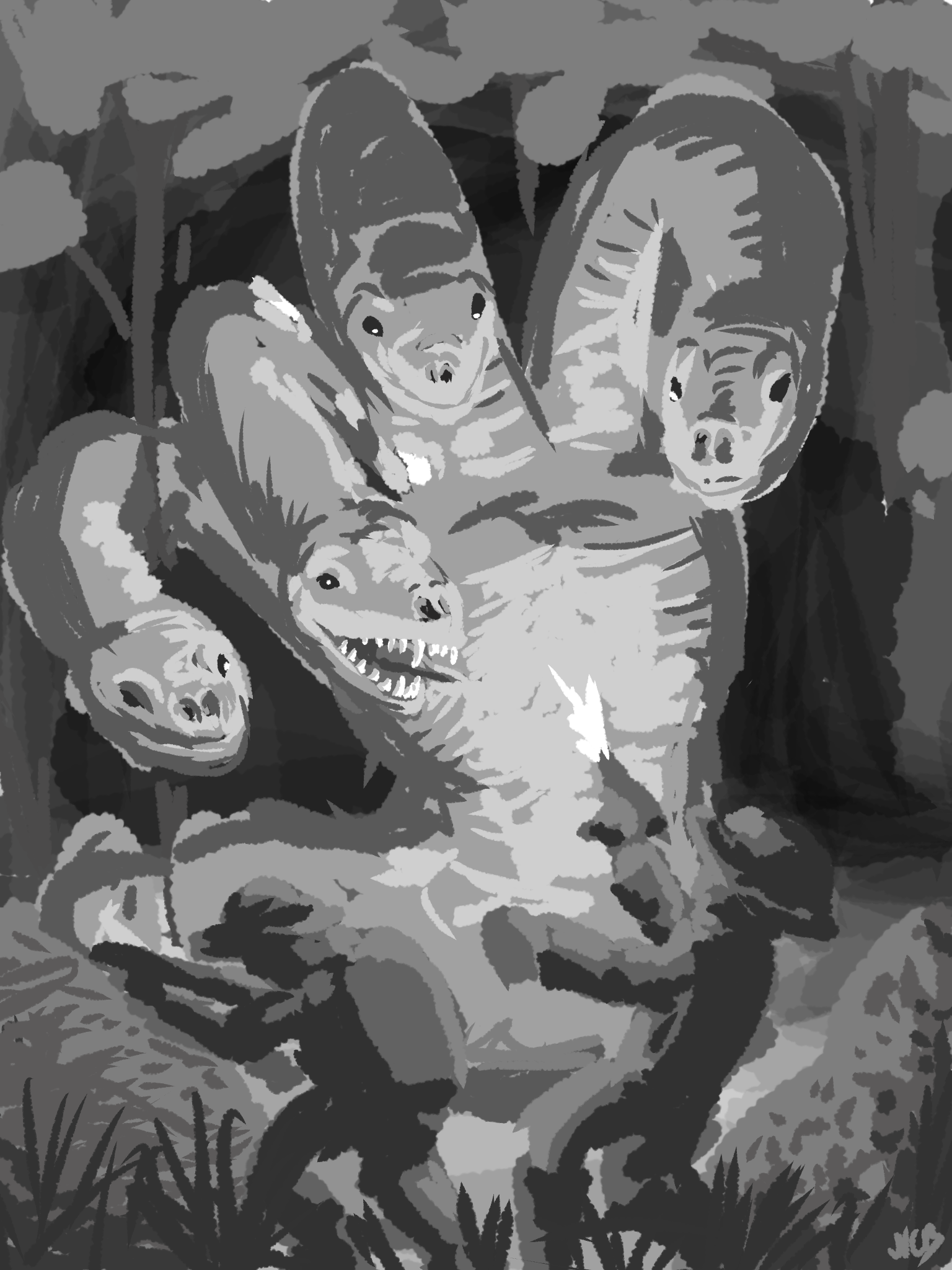
Health: 40
Willpower: 10
Armor: 3
Speed: 2
Evasion: 8
Tags: Beast, Enchanted, Faction (Obskuracorps), Size (3)
Abilities:
Flammable
Attacks and Damage with the Burning (x) tag gain the Ignores Armor tag when made against the Hydra.
Inured to Poison
The Hydra is immune to damage with the Gas tag.
Many Heads
An uninjured Hydra has 4 heads. For every 10 Health the Hydra loses, it loses a head. At the start of its turn, the Hydra grows a number of new heads equal to double the number of missing heads, unless it has the Burning tag. For each head the Hydra has, it can make 1 free Poison Breath attack.
Regeneration
At the start of its turn, unless it has the Burning tag, the Hydra regains half of its missing Health, rounded up.
Attacks:
Poison Breath
Ballistics Attack
Damage: 1D6
Tags: Gas, Explosive (1), Range (3)
Rending Claws
Melee Attack
Damage: 3D3
Tags: Melee
GM Note: Hydras are lumbering “boss monsters” weak only to fire. Obscurakorps has precious few of them, mostly purchasing them on the black market from poachers in Southeast Asia, and they are used to guard extremely sensitive locations, always alongside at least two Tierbändiger.
Lindwurm
Ten-meter snakes with a dextrous pair of forearms, Lindwurm were once widespread across the forests of central Europe. In decline for centuries due to conflicts with humanity, the few individuals known to have survived the extinction of 1881 were captured in Småland by the Thule society in the 1920s. These few dozen serpents and their offspring are occasionally weaponized by enterprising Tierbändiger, making use of their extremely territorial nature to defend sites of importance to Obskuracorps.
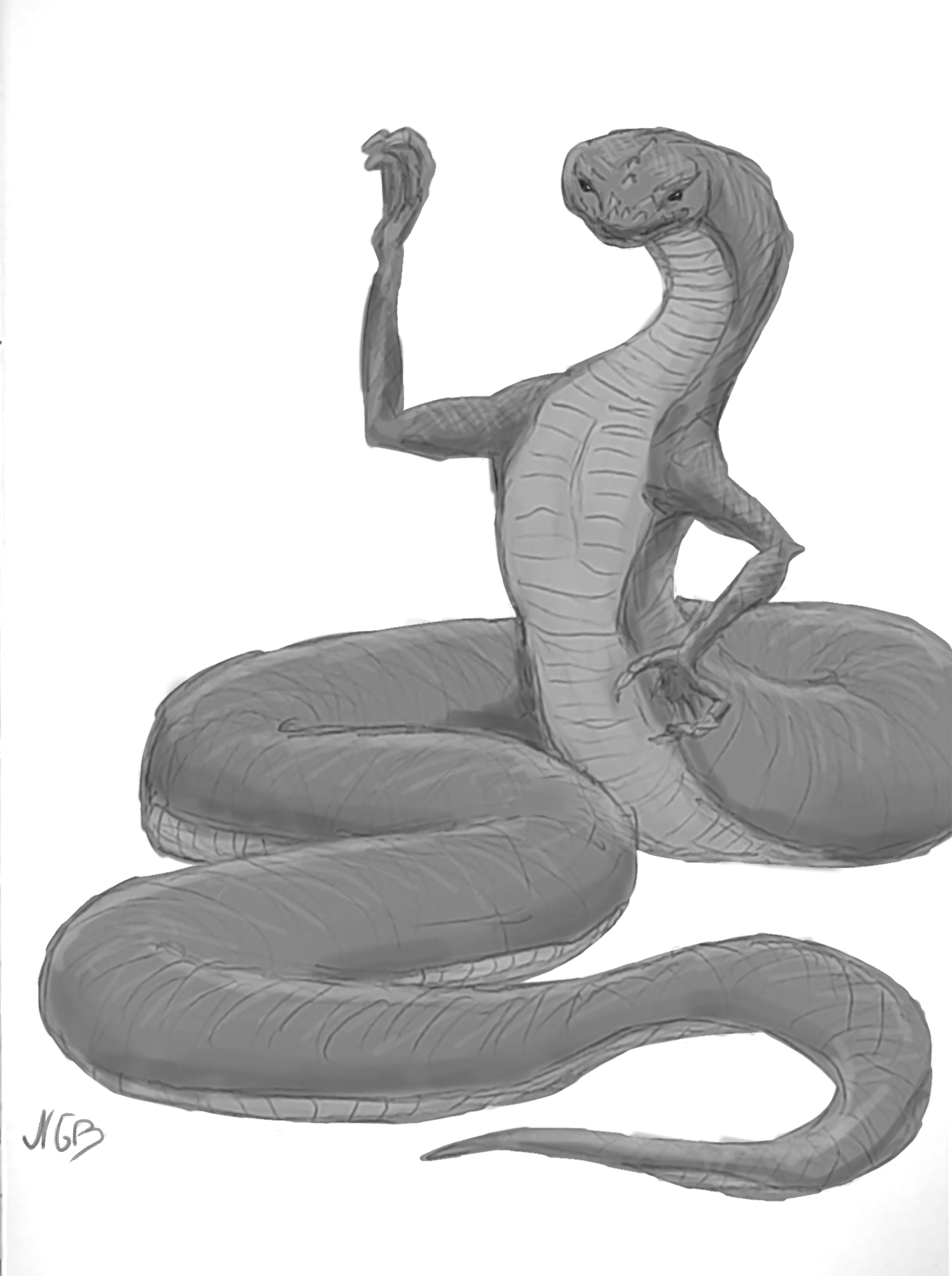
Health: 25
Willpower: 8
Armor: 3
Speed: 2
Evasion: 9
Skills: Melee +2
Tags: Beast, Enchanted, Faction (Obskuracorps), Size (3)
Abilities:
Devouring Serpent
The Lindwurm can swallow living prey whole, crushing them to death with its powerful digestive muscles. Any character which fails the Athletics save of the Serpentine Maw attack is removed from the battlefield, and considered to be inside the Lindwurm’s stomach. Only one character may be inside the Lindwurm’s stomach at a time. While they are inside the Lindwurm, the character takes 2D6 Damage at the start of each of their turns, gains the Blind and Stuck tags, and can take no actions except to attempt an Athletics save with a target of 18 to attempt to escape.
Inured to Poison
The Lindwurm is immune to damage with the Gas tag.
Actions:
Noxious Breath
Cost: 1
Mechanics: The Lindwurm selects a cone of hexes 3 long adjacent to it. Each selected hex gains a Toxic Gas Terrain Feature (see below). The Lindwurm may only take this action once per turn, and cannot use it two turns in a row.
Toxic Gas
Tags: Damaging (2D6 Gas), Passable, Temporary (3)
Attacks:
Rending Claws
Melee Attack
Damage: 1D6
Tags: Melee
Serpentine Maw
Melee Attack
Damage: 2D6
Tags: Melee
Special: This attack can only be used once per turn. A character with a Size (x) of 1 or less attacked with this weapon must make an Athletics save with a target of 14 or be devoured; see the Devouring Serpent ability.
GM Note: Lindwurm are mostly encountered alone, guarding locations Obskuracorps wants to remain undisturbed which are not in active use. Their deployment is extremely rare since despite their best efforts to breed the beasts in captivity, Tierbändiger have only managed to procure a half-dozen viable eggs, and the adults have proven impossible to break.
Reichsadler
Double-headed eagles, created through a combination of cruel surgery and thaumaturgical manipulation, which represent the combined authority of the Third Reich and the Nazi Party. Most are kept by high-ranking Obskuracorps members as signs of their authority and power, and one is rumored to have been gifted to Heinrich Himmler himself.
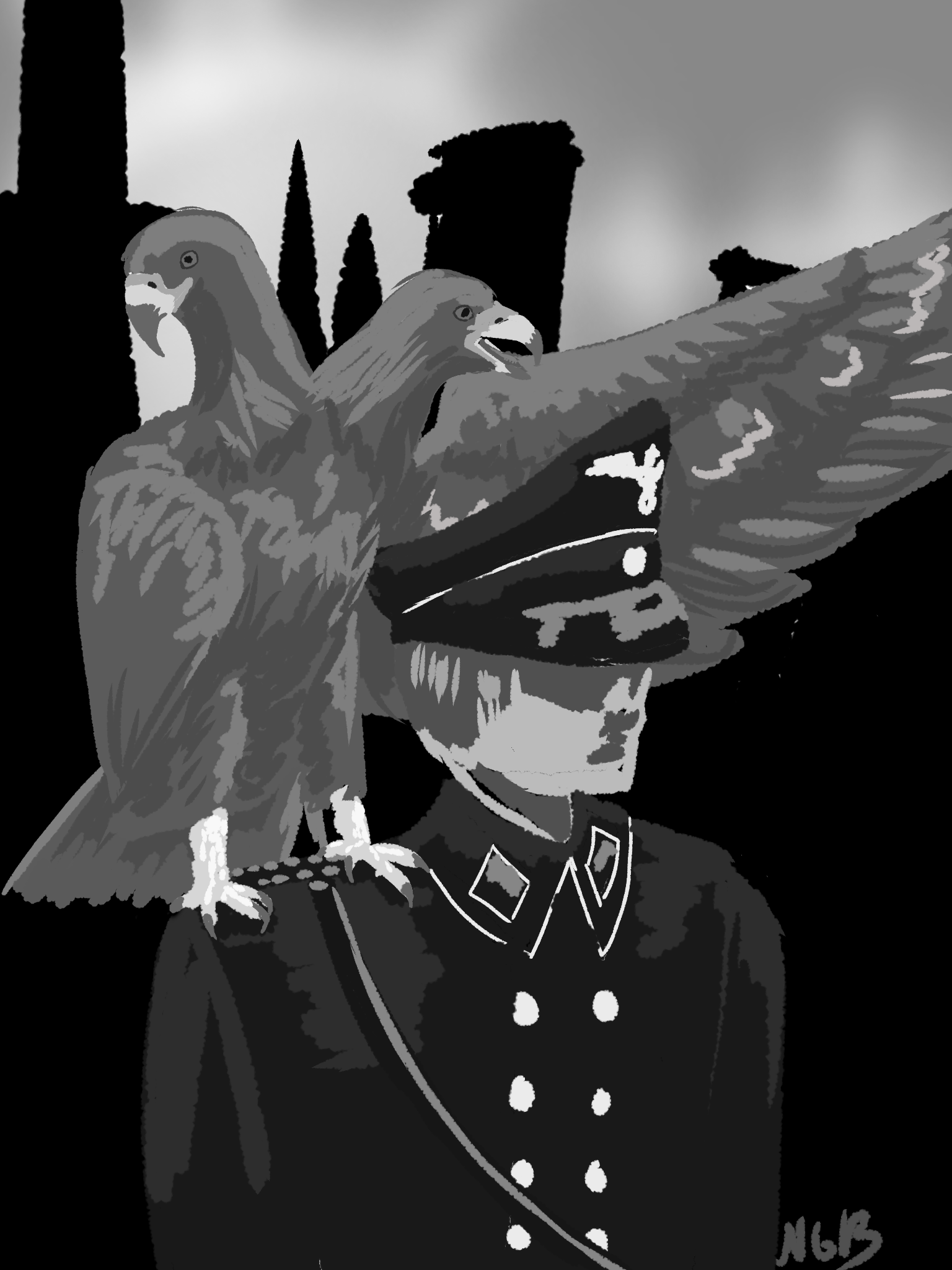
Health: 3
Willpower: 4
Armor: 0
Speed: 2
Evasion: 9
Tags: Beast, Enchanted, Faction (Obskuracorps), Fly, Size (½)
Attacks:
Claws and Talons
Melee Attack
Damage: 1D3
Tags: Melee
GM Note: Reichsadler typically accompany high-ranking Obskuracorps officers who are favored by the party, though some are trained as attack birds by Tierbändiger.
Spirits
"Spirit" is a catchall term for a variety of self-sustaining thaumaturgical entities, which exhibit consciousness despite a lack of physical body. Some are formed from the imprints of particularly intense emotional states, while others represent emergent intelligences of landforms, locations, or natural processes. Obskuracorps presses all into their service, with little regard for their natural function or desires; all that matters is that they offer power.
Bieresel
Donkey-like spirits formed from the memories and emotions of generations of livestock, Bieresel are among the most common non-ghost spirits in Europe. Traditionally performing minor household tasks in exchange for offerings of beer, Obskuracorps has found that they can be corrupted into bringers of plague and pestilence.
Health: N/A
Willpower: 6
Armor: 0
Speed: 4
Evasion: 11
Tags: Enchanted, Faction (Obskuracorps), Size (1), Spirit
Abilities:
Pox Aura
All characters which do not have the Mechanical, Undead, or Construct tags within 4 hexes of the Bieresel must succeed a Health save with a target value of 11 at the beginning of their turn or take 1D3 Damage with the Ignores Armor tag and gain the Slow (1) tag for 1 round.
Attacks:
Spiritual Buck
Melee Attack
Damage: 1D3 + 1
Tags: Melee
Boggart
Boggarts are created by twisting benevolent house spirits into a murderous madness by binding them to an artificially-constructed True Name. Once bound, they become the spiritual equivalent of fire-and-forget munitions, and are given a target which they will expend their very being in attempting to destroy.
Health: N/A
Willpower: 8
Armor: 0
Speed: 3
Evasion: 14
Skills: Melee +2
Tags: Enchanted, Faction (Obskuracorps), Grunt, Levitate, Size (1), Spirit
Attacks:
Spiritual Claws
Melee Attack
Damage: 2D6
Tags: Melee
Special: The Boggart loses 1 Willpower each time it performs this attack.
Geist
Tormented echoes of the Reich’s victims, Geists are created by mystically mutilating a sapient ghost before shackling them with cold iron fetters, driving them insane and forcing them into an unlife of servitude as spiritual weapons. The clinking of ice-cold chains and echoing, wordless wails of agony herald their approach.
Health: N/A
Willpower: 6
Armor: 0
Speed: 4
Evasion: 14
Tags: Enchanted, Faction (Obskuracorps), Levitate, Size (1), Spirit
Actions:
Haunting Wail
Cost: 1
Mechanics: All characters which do not have the Construct, Mechanical, Spirit, or Undead tags within 3 hexes of the Geist must make a Willpower save with a target value of 12. On a failure, each character loses 1D3 Willpower.
Attacks:
Cold Iron Chains
Melee Attack
Damage: 1D3
Tags: Melee
Gremlin
A recently-discovered spiritual "species", Gremlins are diminutive humanoids which appear to feed off of the entropy generated by combustion engines. Their presence causes spontaneous malfunctions in equipment, a process which they sometimes accelerate through active sabotage. Obskuracorps has little control over them, but still makes use of those they capture by deploying them against mechanized opponents as "gremlin bombs".
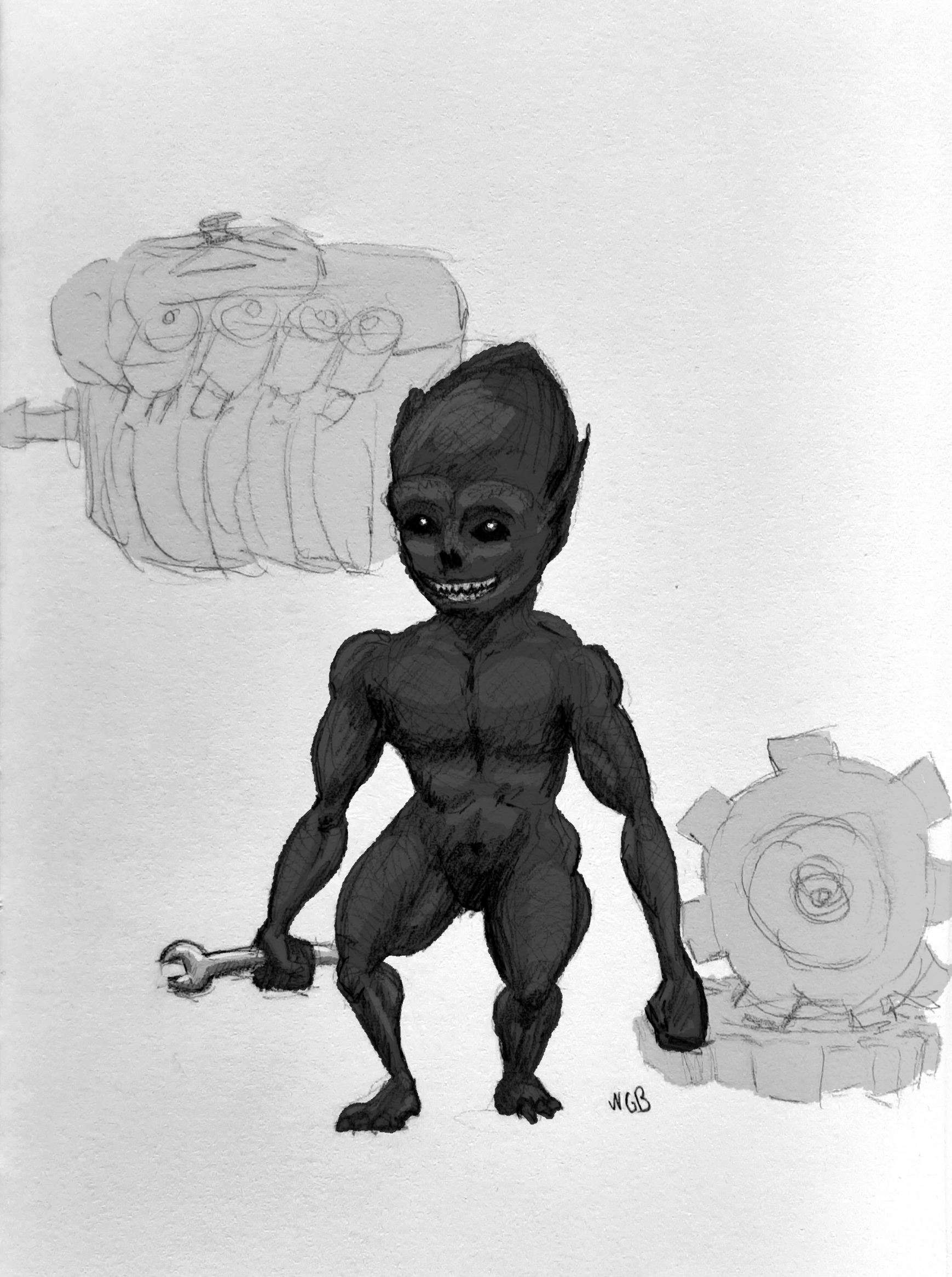
Health: N/A
Willpower: 6
Armor: 0
Speed: 4
Evasion: 16
Tags: Enchanted, Faction (Obskuracorps), Size (¼), Spirit
Abilities:
Chaos Aura
All characters with the Mechanical tag within 2 hexes of the Gremlin suffer +1 Difficulty on all rolls. This effect stacks with each additional Gremlin within range.
Seelenführer
Psychopomps are a genus of spirit which consume other spirits, typically those generated upon an intelligent creature’s demise. In a healthy spiritual ecosystem, they act as secondary consumers and apex predators. Through dark rituals and massed sacrifice, Nekromants can trap natural psychopomps and twist them into dark shades of their former selves, granting them greater influence over the physical world and a hunger for the energy of the living.
Health: N/A
Willpower: 10
Armor: 0
Speed: 4
Evasion: 14
Tags: Enchanted, Faction (Obskuracorps), Levitate, Size (1), Spirit
Abilities:
Devour Death
Whenever a character which does not have the Mechanical, Undead, or Construct tags dies within 5 hexes of the Seelenführer’s position, it increases its Willpower by 2.
Actions:
Choking Fog
Cost: 1
Mechanics: The Seelenführer expends 2 Willpower. All characters within 3 hexes of the Seelenführer’s position suffer 1D3+1 Damage with the Gas and Ignores Armor tags. This attack repeats at the beginning of the Seelenführer’s next turn.
Grave Grasp
Cost: 2
Mechanics: The Seelenführer selects a target it can see within 6 hexes, and expends 3 Willpower. The target must make a Camaraderie save with a target value of 11. On a failure, the target gains the Slow (2) tag for 3 rounds.
Attacks:
Draining Grasp
Melee Attack
Damage: 1D3 + 1
Tags: Ignores Armor, Melee
Special: The Seelenführer restores Willpower equal to half the damage done by this attack.
The Undead
More than any other force in existence, Obskuracorps runs on unliving labor. Industrial-scale operations turn the Reich’s countless victims into a vast, tireless labor pool. Twisted sorcerers and scientists work to create ever-greater feats of necromantic engineering, combining multiple corpses from multiple species into groaning abominations. The dead mindlessly haul loads, work on factory lines, and guard strongholds, freeing up living labor and reducing Obskuracorps’ reliance on the central structure of the Reich.
Falschfleisch
Stitched together by Obskuracorps scientists working off of the stolen research of Victor von Franckenstein, Faslchfleisch are undead Übermensch created from the choice body parts of fallen SS troops. More intelligent than Wiedergängen or Skeletons, they possess all of the fanaticism they did in life, along with greatly enhanced strength and stamina. When Sturmsoldaten are unavailable or impractical, they are often deployed as a substitute.
Health: 15
Willpower: 12
Armor: 3
Speed: 3
Evasion: 8
Skills: Ballistics +3, Melee +1
Tags: Elite, Faction (Obskuracorps), Size (1), Undead
Attacks:
Ghoul
Not technically undead, nor strictly alive, Ghouls are a cursed line of humanity, damned to eternally hunger for the flesh of corpses. Inured to the stench of death and the unease which even seasoned Nekromants often feel around their raised minions, they act as factory overseers and sergeants for the undead labor pool in exchange for any “leftovers” of the necromantic process. Their half-living nature gives them great affinity for this task, as the twisted construction they have in place of a soul allows them to tug at the bindings of raised undead with practiced ease.
Health: 10
Willpower: 10
Armor: 1
Speed: 3
Evasion: 10
Skills: Melee +2
Tags: Enchanted, Faction (Obskuracorps), Human, Size (1)
Actions:
Command Undead
Cost: 1
Mechanics: The Ghoul selects a character they can see, then issues one of the following commands:
- Guard Them!: Undead characters under the Ghoul’s command should attempt to prevent the target from taking damage.
- Kill Them!: Undead under the Ghoul’s command should attempt to kill the target.
- Seize Them!: Undead under the Ghoul’s command should attempt to knock the target unconscious.
All characters with the Mindless, Faction (Obskuracorps), and Undead tags within 3 hexes of the Ghoul when the command is issued obey the command on their turn.
Devour Flesh
Cost: 1
Mechanics: The Ghoul selects a corpse or an Unconscious character which does not have the Construct, Demonic, Mechanical, or Spirit tags within 1 hex of its position. The Ghoul then deals 1D6 Damage to the target character or destroys the target corpse, and regains 1D6 Health.
Attacks:
Carbine
Ballistics Attack
Damage: 1D6
Tags: Range (6)
Crude Cudgel
Melee Attack
Damage: 1D3
Tags: Melee, Non-Lethal
GM Note: The damage done by the Devour Flesh action and the healing from the same action are not the result of the same dice roll. A Ghoul could deal only 1 Damage with this action, but regain 6 Health; this might represent them biting off a particularly juicy, but not life-threatening, morsel!
Skeleton
Among the simplest and oldest necromantic constructs, formulae for the animation of Skeletons date back to at least Mycenaean Greece. Today, nekromants raise great hordes of skeletons as expendable guards and infantry, for their brittle bones are poorly suited to labor. They retain just enough dexterity to make use of firearms, though they are not particularly accurate shots.
Health: 4
Willpower: N/A
Armor: 0
Speed: 3
Evasion: 10
Skills: Ballistics -1
Tags: Controller (Obskuracorps Character), Enchanted, Faction (Obskuracorps), Grunt, Mindless, Undead, Minion, Size (1)
Attacks:
Stichbestie
Abominable creations made by combining numerous human and animal corpses together into one sorrowful package. Stichbestie, or Stitch Beasts, are unique works of demented art, the result of a particularly “creative” Nekromant attempting to create the ultimate undead soldier. No two are exactly alike, save that all are walking horrors.
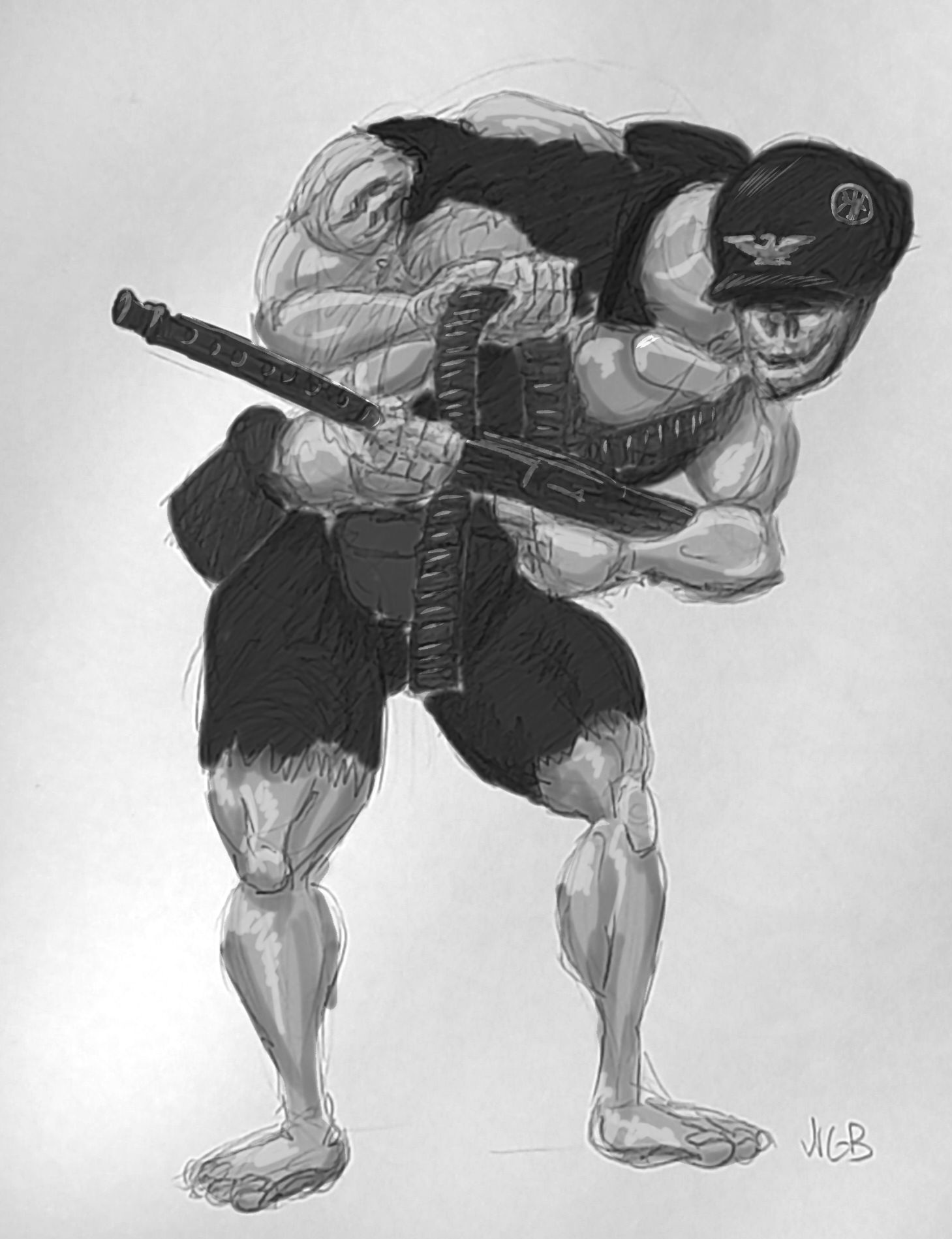
Health: See "Abominable Art"
Willpower: See "Abominable Art"
Armor: See "Abominable Art"
Speed: See "Abominable Art"
Evasion: See "Abominable Art"
Skills: See "Abominable Art"
Tags: Controller (Creator), Enchanted, Faction (Obskuracorps), Minion, Size (See "Abominable Art"), Undead
Abilities:
Abominable Art
Each Stichbestie is a unique creation, with unique capabilities. Their stats are determined from the creatures which go into their creation. When creating a Stichbestie, select one option from each of the following categories:
Body:
- Human: 10 Health, 0 Armor, 3 Speed, 10 Evasion, Size (1)
- Ox: 12 Health, 0 Armor, 3 Speed, 9 Evasion, Size (2)
- Lion: 8 Health, 0 Armor, 4 Speed, 12 Evasion, Size (2)
Brain:
- Human: 10 Willpower, +1 Ballistics
- Hound: 8 Willpower, +1 Evasion, +1 Melee
- Fox: 6 Willpower, +1 Athletics, +1 Evasion, +1 Melee
- Runestone: N/A Willpower, gain the Mindless tag
Additionally, select any number of the following enhancements:
- Enhanced Muscles: Increase the damage of the Stichbestie’s Undead Fists by 1D6.
- Enormous: +5 Health, -2 Evasion, Increase Size (x) by 1.
- Extra Limbs: +1 Melee, Once per turn the Stichbestie may take an Attack action for free.
- Heavy Weapons: The Stichbestie gains access to one of the Ballistics attacks from the Sturmsoldat stat block.
- Subdermal Steel Plating: +2 Armor, -1 Speed
- Volatile Organs: When slain, the Stichbestie performs an attack with the Explosive (2) and Armor-Shredding (1) tags which deals 2D6 Damage.
- Walking Wall: Characters with the Faction (Obskuracorps) tag adjacent to the Stichbestie treat it as being a Terrain Feature with the Cover (2) tag.
Attacks:
Undead Fists
Melee Attack
Damage: 1D6
Tags: Melee
Von Graff Fledgling
There are numerous groups of beings colloquially called “vampires”, the majority of which are living parahumans, and the vast majority of which have nothing to do with the Obskuracorps. All that unites them is a need to consume blood for sustenance. The Von Graff line, however, are both undead and fascists. Once a Prussian noble house which sought immortality and found a damned reflection of it, they see the rise of the Reich as Germany expanding its natural dominion over Europe, just as they will one day extend their natural dominion over Mankind.
There are dozens of Von Graffs, each of whom is a potent spellcaster made only more powerful in undeath. Some fledgling members of the line serve as Beschwörer or Nekromants. Others simply use their accursed gifts as comes natural to them, in service of both Obskuracorps and their own ambitions.
Health: 15
Willpower: 14
Armor: 0
Speed:4
Evasion: 14
Skills: Melee +2, Thaumatology +3
Tags: Elite, Enchanted, Faction (Obskuracorps), Faction (Von Graff), Undead, Unholy, Size (1)
Abilities:
Flammable
The Von Graff Fledgling always takes maximum damage from attacks with the Burning (x) tag.
Actions:
Bat Swarm
Cost: 2
Mechanics: The Von Graff Fledgling selects a hex it can see and makes a Thaumatology check. If successful, it discorporates into a swarm of bats and flies to that hex, then reforms into its humanoid form.
Tags: Thaumaturgy
Beckon
Cost: 1
Mechanics: The Von Graff Fledgling selects a character which does not have the Construct, Holy, Mechanical, Mindless, or Spirit tags who can see it, and makes a Thaumatology check. If successful, the target must make a Camaraderie save with a target value of 14 or spend its next turn attempting to move as close as possible to the Von Graff Fledgling.
Tags: Ritual, Thaumaturgy
Blood Mist
Cost: 2
Mechanics: The Von Graff Flegeling selects a Size (3) area centered on a hex it can see, loses 1 Health, and makes a Thaumatology check. On a success, a Blood Mist Terrain Feature (see below) is created on each selected hex.
Tags: Ritual, Thaumaturgy
Blood Mist
Tags: Blocks Vision, Enchanted, Passable, Temporary (3)
Special: Characters with the Faction (Von Graff) tag ignore this Terrain Feature's Blocks Vision tag.
Celerity
Cost: Bonus
Mechanics: The Von Graff Fledgling expends any amount of Health. It gains the Accelerated (1) and Prepared (1) tags for a number of turns equal to half the Health expended.
Hematic Spear
Cost: 2
Mechanics: The Von Graff Fledgling selects a straight line of up to 6 hexes from its position which it can see, loses 2 Health, and makes a Thaumatology check. If successful, all characters on the selected hexes must make an Athletics save with a target value of 14 or suffer 1D6 Damage with the Armor-Piercing (1) tag.
Tags: Thaumaturgy
Sanguine Will
Cost: 1
Mechanics: The Von Graff Fledgling expends any amount of Health. For each Health expended, it regains 1 Willpower.
Attacks:
Dueling Saber
Melee Attack
Damage: 1D6
Tags: Melee
Pistol
Ballistics Attack
Damage: 1D6
Tags: Range (2)
Vampiric Bite
Melee Attack
Damage: 1D3 + 1
Tags: Melee
Special: The Von Graff Fledgling regains all damage dealt with this attack as Health. This attack cannot target characters with the Construct, Mechanical, or Spirit tags.
If this attack deals damage to a character with the Holy tag, the Von Graff Fledgling takes 1D6 + 1 Damage, and regains no Health.
GM Note: The Von Graff Fledgling is a powerful enemy ideal as the target for an elimination mission. Their only weaknesses are fire and holy damage, both of which are well-known to the AOI. To increase the challenge posed by a fledgeling, they can be given access to the Nekromant’s Thaumaturgy or the Beschwörer’s Strengthen Binding actions, and provided with summoned or undead minions.
Wiedergänger
Created from relatively fresh corpses, Wiedergängen are substantially sturdier than Skeletons, though not as nimble. Similar to the Scholomance's wights, though often less sturdy, they form the backbone of Obskuracorps’ labor pool, and are sometimes pushed into service as living walls of flesh in battle. Their bloated fingers make it impossible for them to effectively wield weapons, though their unliving muscles are strong enough to allow them to be equipped with armor.
Health: 8
Willpower: N/A
Armor: 2
Speed: 2
Evasion: 10
Skills: Melee +1
Tags: Controller (Obskuracorps Character), Enchanted, Faction (Obskuracorps), Grunt, Mindless, Minion, Size (1), Undead
Attacks:
Rotting Fist
Melee Attack
Damage: 1D6
Tags: Melee
Sample Mission: The Battle of Prague
This section contains resources and advice to run a full mission based on the Battle of Prague, the first engagement of the 7th Occult War. This section is intended for GMs, not players. If you are a player, you can click here to skip to the next section.
Introduction
This mission is designed for a party of 3 to 6 level one characters. It is meant to serve as the first, or one of the first, missions that a strike team undertakes, and as such is balanced to be fairly easy to complete, regardless of the composition of the strike team. It is also meant to provide an example of a typical mission design, so even if you don't intend to run it, it can be useful to study it before designing your own missions.
Maps
The Area of Operations is the Old Town and Jewish Quarter of Prague on the night of March 20, 1939. A contemporary map of this portion of the city has been provided below.
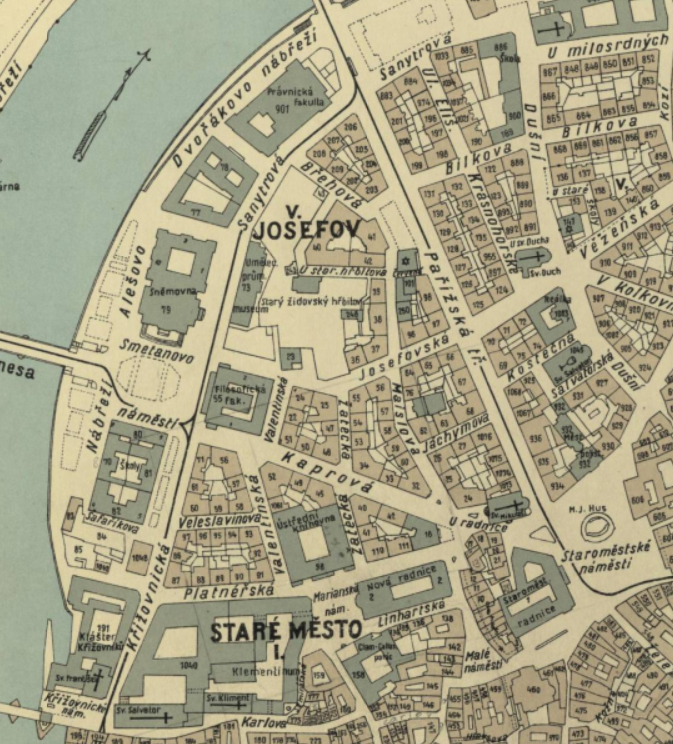
Hexagonal grid battle maps have been prepared for five locations within the AO; a sixth battle map, depicting a generic city street, has also been prepared. Each map is 32 hexes wide and 18 hexes tall. These maps have already been populated with terrain features, and can be printed or imported into a VTT. Later portions of this guide will provide advice on how to use each map in different scenes, including advice on enemy placement and composition.
The following table describes the symbols used on the maps, the terrain features they represent, and the tags that apply to each terrain feature.
| Symbol | Terrain Feature | Tags |
|---|---|---|
 |
Wall | Blocks Vision |
 |
Water | Passable, Difficult, Blocks Vision |
 |
Grass | Passable |
 |
Door | Passable, Blocks Vision |
 |
Barricade | Passable, Difficult, Cover (1), Flammable |
 |
Fountain | Passable, Difficult, Blocks Vision |
 |
Tombstone | Passable, Cover (1) |
 |
Bookshelf | Cover (2), Flammable |
 |
Table | Passable, Difficult, Cover (1), Flammable |
 |
Radio | Passable |
Map 1: Old Town Square
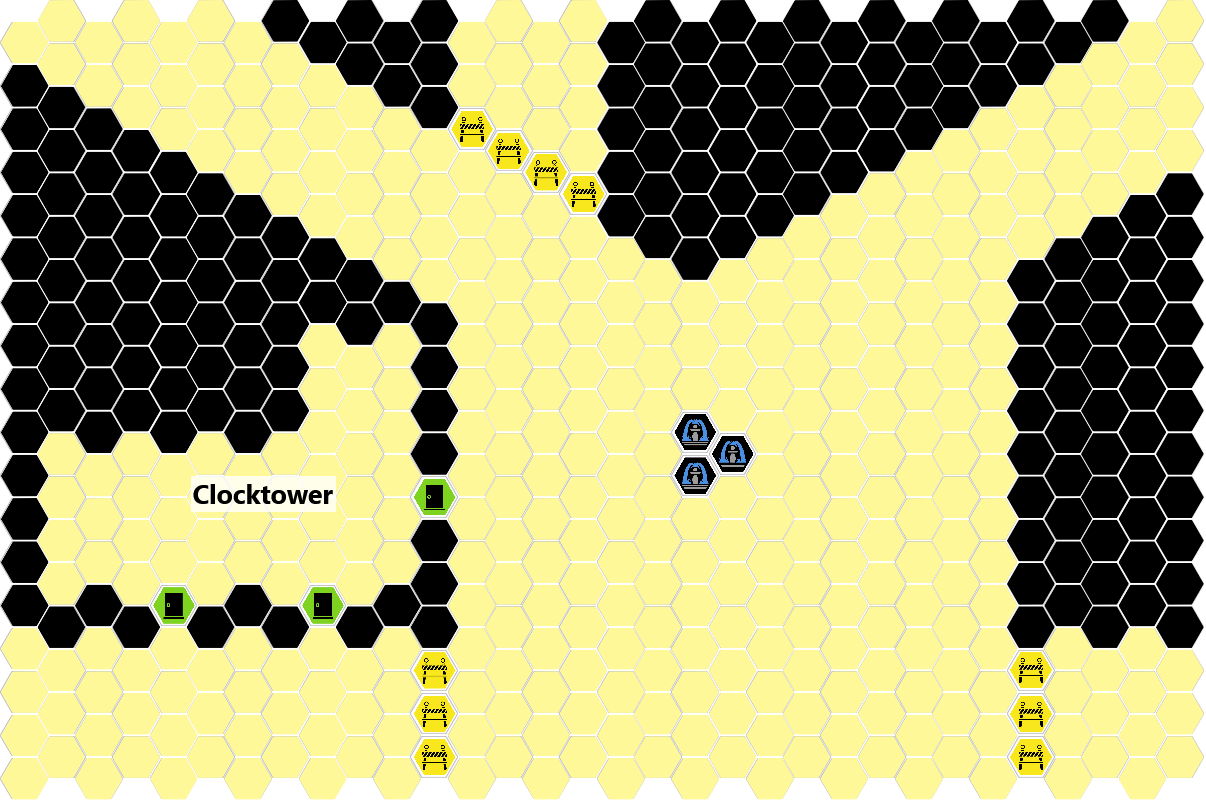
Map 2: Old New Synagogue
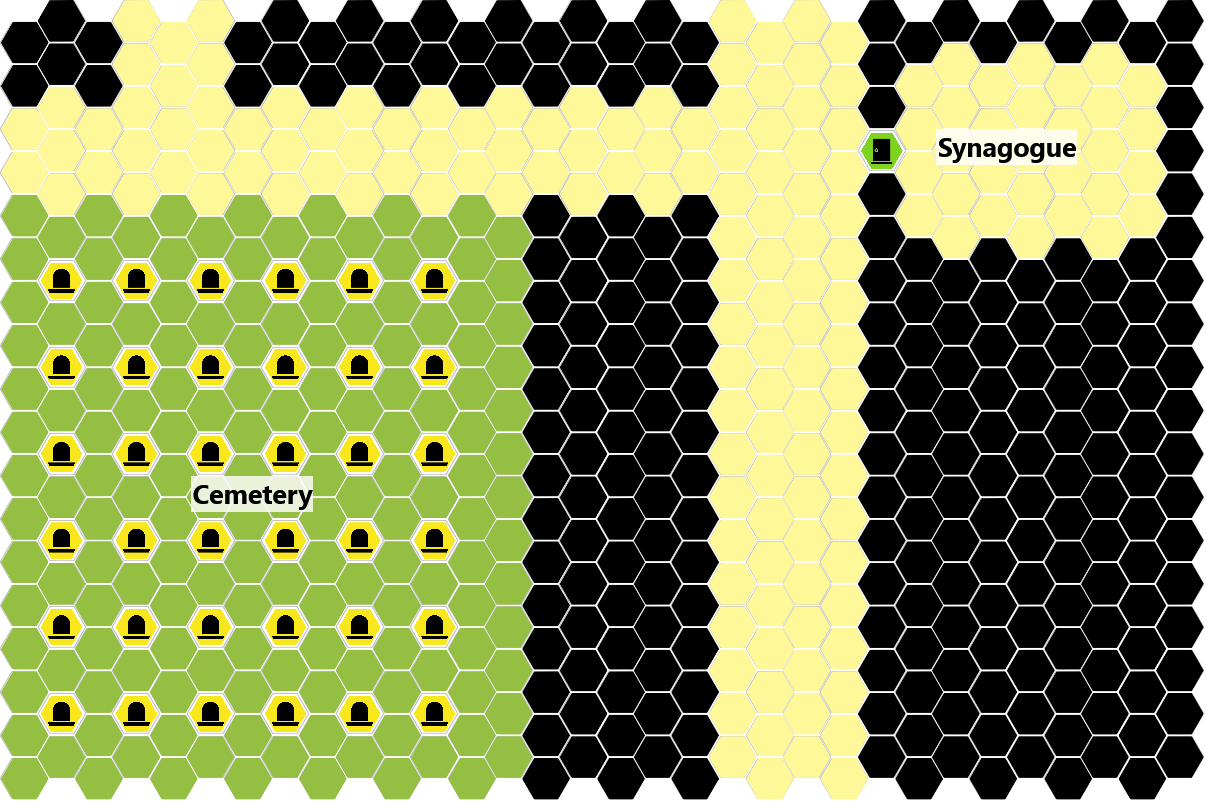
Map 3: Charles University
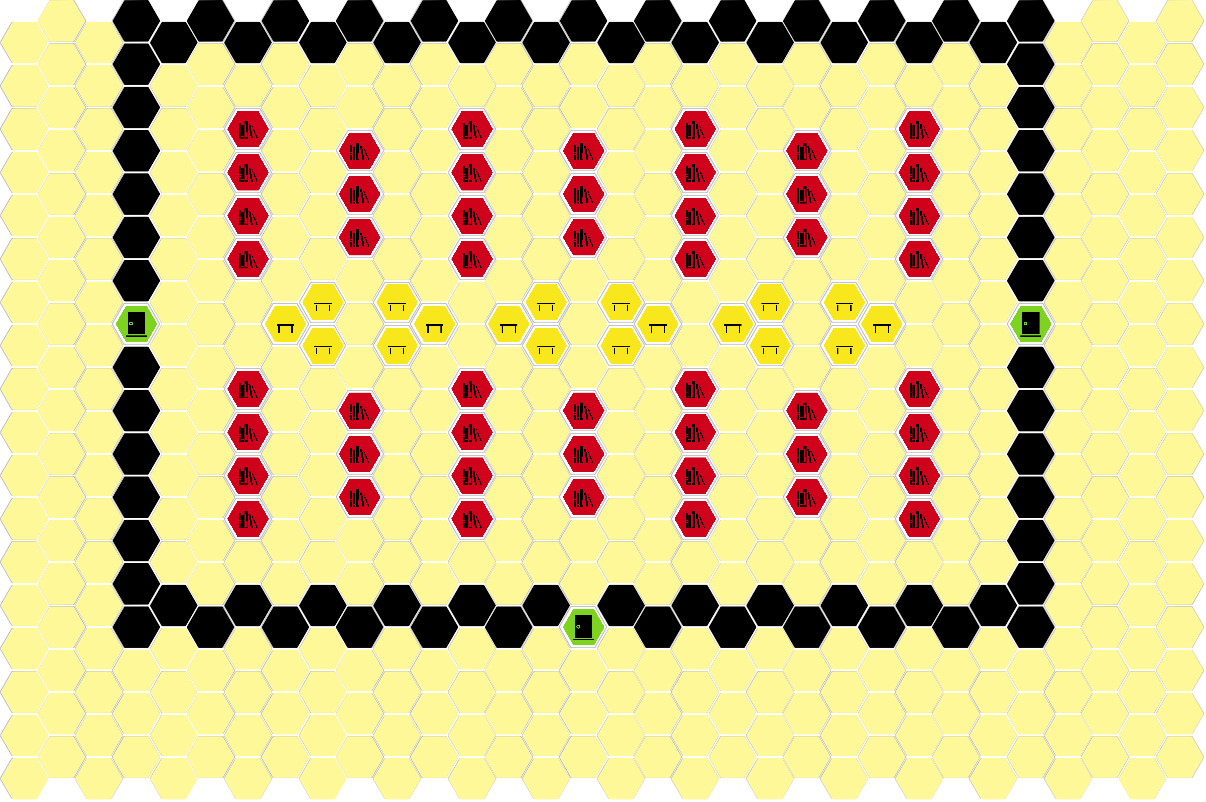
Map 4: Charles Bridge
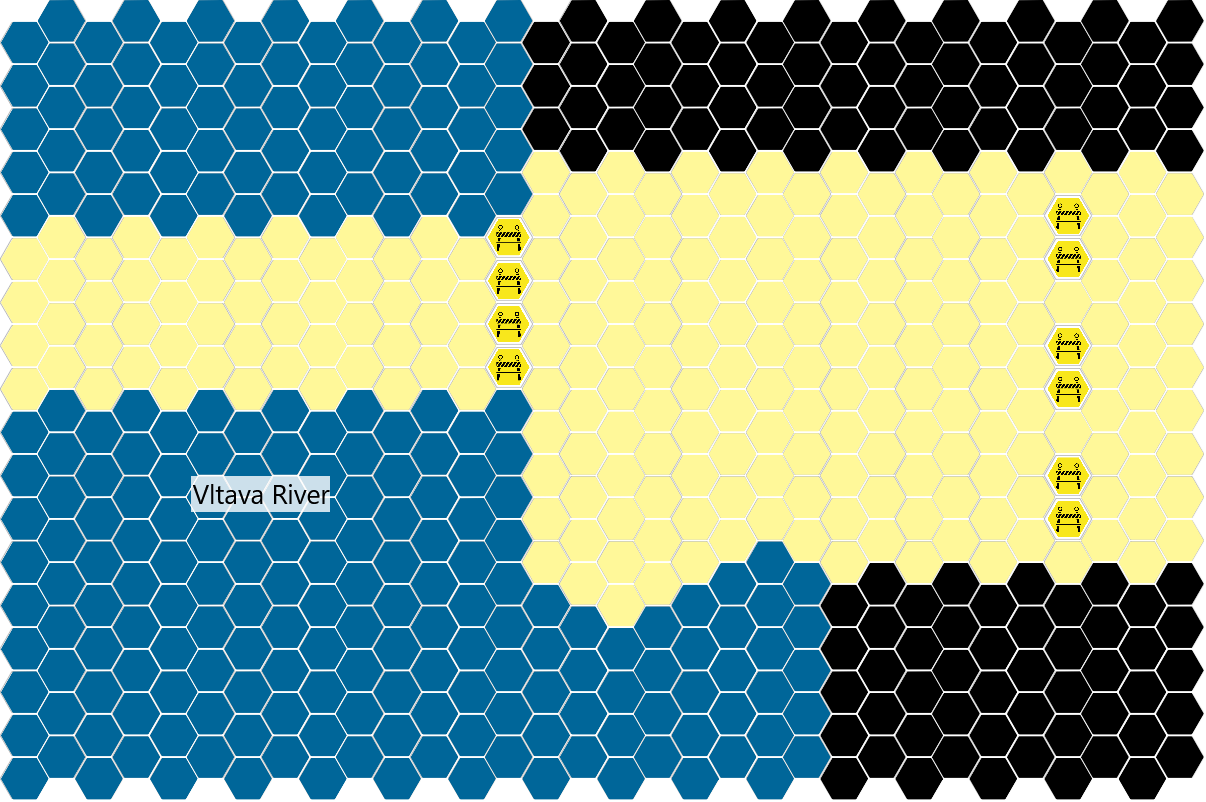
Map 5: SS Field Headquarters
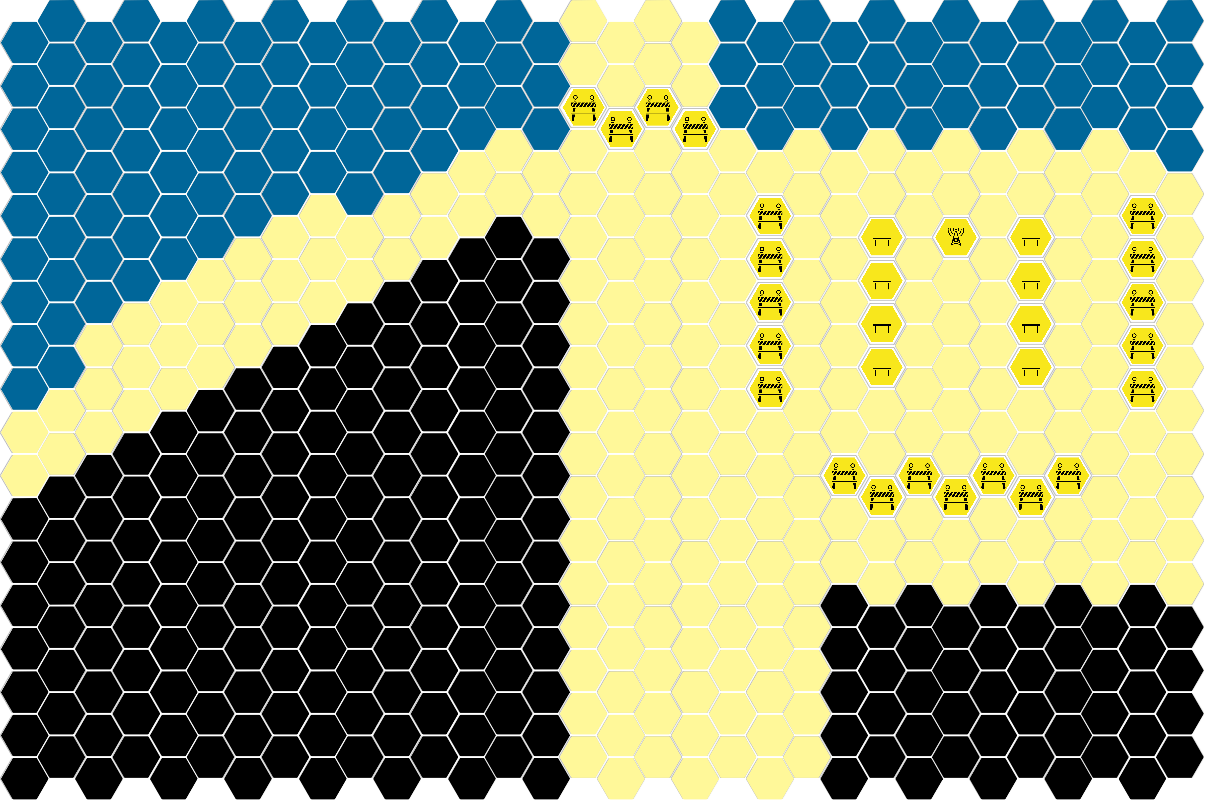
Map 6: Generic Street
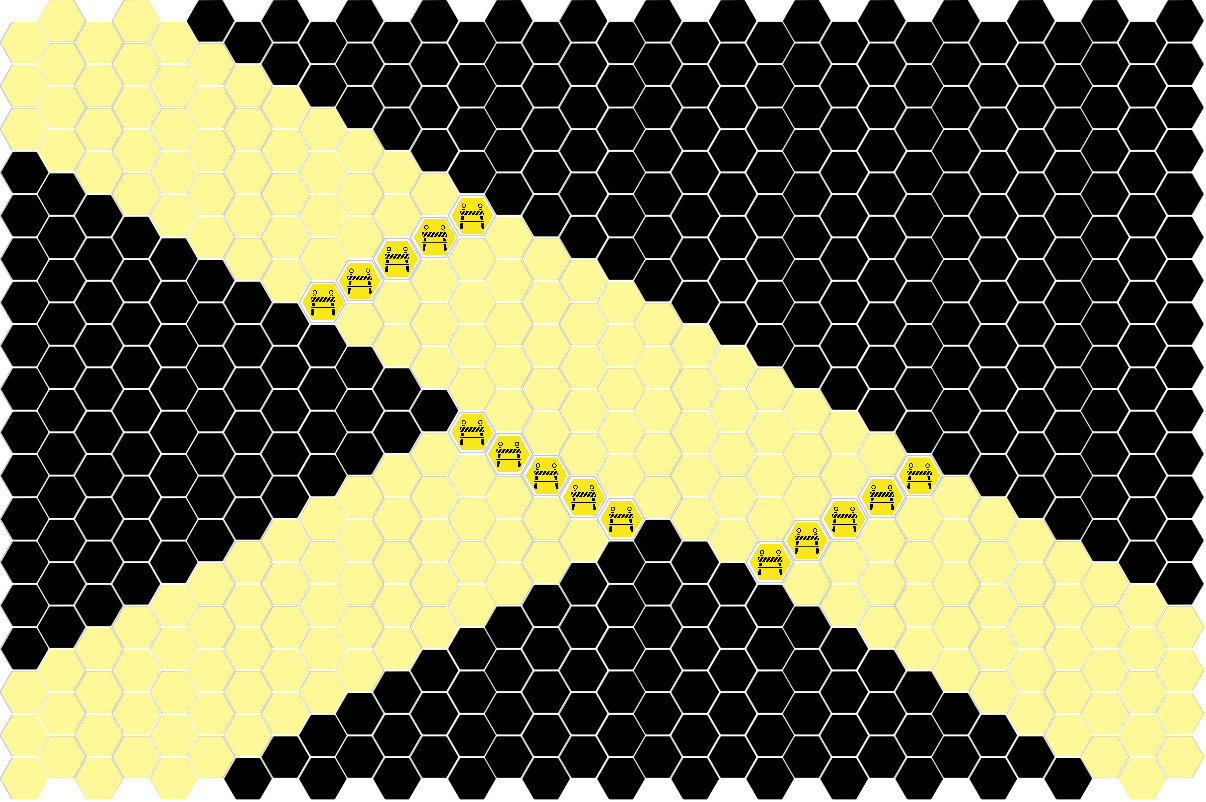
The Briefing
For the briefing scene, you'll probably want to use a non-player character to deliver exposition to the operatives. We recommend using either Sir Robert Durant or Dr. John Everhart (or possibly both!) from the Characters section. Using them as a mouthpiece, you'll want to deliver some or all of the following information to your players — you can use our wording verbatim, but you should feel free to use your own voice.
It is late in the evening on March 20th, 1939. One day before the vernal equinox. Five days since the German annexation of Czechoslovakia, which was done in direct contravention of the Munich Agreement. It is clear to everyone, particularly the Allied powers, that Hitler cannot be reasoned with. War is now inevitable.
For the Allied Occult Initiative, the war starts now. Sir Robert Durant has returned after six months undercover amongst the Thule Society, and he has brought vital intelligence with him. Based on what Sir Durant has learned from the Thule, AOI High Command is now reasonably certain of the Obskuracorps' next target: the Golem of Prague.
According to legend, the Golem was created by the Maharal to protect the Jewish citizens of Prague — no wonder the Nazis want to destroy it. If it still exists, the Golem must be recovered before the Germans can destroy it. If even a fraction of the folklore regarding the Golem is true, it would be a valuable asset in the coming war.
The strike team will be apportated from Zürich into Prague using an experimental prototype developed by Dr. John Everhart. Once in Prague, the team's objective will be to locate the Golem and then escape from the city via the Way network. Prague has been heavily occupied by the Germans, so opposition from both conventional Wehrmacht and the Obskuracorps should be anticipated should they discover the strike team and their mission. However, the team may avoid confrontation for a time by posing as Czech civilians.
The Golem's current status and location are unknown to both the strike team and the Obskuracorps. Intelligence provided by Sir Durant indicates that the Obskuracorps recovery team will begin their search at the Old New Synagogue, Europe’s oldest active synagogue. The strike team may attempt to shadow them, or they may choose to conduct their own search.
You should also take this time to describe some of the opposition forces that the strike team will likely encounter. You don't have to give away the exact name and number of enemies you plan on using, but some description of the type of resistance is appropriate — something like "moderate numbers of regular Wehrmacht infantry" to describe a dozen Schütze, for example.
Insertion
Apportation is the only method that can get the strike team into Prague in time to rescue the Golem. This is the first use of the experimental Everhart Resonator, and your first opportunity as a GM to really set the tone of the occult war — utterly fantastic and deadly serious at once. Describe the group's first apportation in detail — the scientist wizards of ICSUT preparing the ritual circle, the gleaming brass of the Everhart Resonator and the noise it emits, the strange sensation of being one place and then in a single moment being in another. Most of all, describe the backlash that results from the incredibly blatant act of magic just performed. Get weird, get detailed, and describe the strange events that occur, both trivial and catastrophic.
Operations
For the operations portion of the mission, we have three core scenes planned. For some of these, combat is optional depending on the actions of the operatives. If you want to increase the length and difficulty of the mission, you can always use Map 6: Generic Street as part of a filler scene where the players encounter a Nazi patrol.
Scene 1: Arrival
The strike team will apportate into either the Old Town Square or the Charles Bridge, shortly after nightfall. If any Nazi forces witness the apportation, they should immediately treat the operatives with suspicion (although this doesn't necessarily mean they open fire immediately). Otherwise, operatives will be treated like Czech civilians (not necessarily a good thing!) until they do something to draw attention and suspicion. There is a civilian curfew imposed by the occupiers, which can be used to force a confrontation with German security forces. Combat is optional for this scene, and you should try to reward creative thinking that allows the operatives to bypass the opposition.
- Old Town Square — There are more Nazi troops at this location, but there is also an interior location where the strike team can emerge undetected. It is your decision whether you want to drop them into the middle of the square or allow them to start inside the clocktower. (If you want to randomize this decision, you can roll a d6; on a 5 or a 6, the strike team starts inside the clocktower, otherwise they start in the middle of the square.) Place four or five Schütze at various points throughout the square, as well as a Sergeant or Untersturmführer. If you have an Infiltrator on the strike team and want to add additional difficulty, give one or two of the Schütze a German Shepherd as a minion to make it harder to sneak past.
- Charles Bridge — The bridge is guarded by two or three Schütze and a Sergeant, who should be placed near one of the barricades. The strike team will appear partway down the bridge — if you are feeling unkind, you may even choose to have some of them appear in mid-air over the river, leading to a splashy entrance. They will need to talk, sneak, or fight their way past the guards to gain access to the rest of the AO.
Scene 2: Investigation
The strike team can begin their search for the Golem at one of three locations. All three locations will be guarded, and all three locations will provide an important clue to the Golem's current whereabouts. This is another combat-optional scene, although avoiding combat entirely should come with some kind of drawback — an easy option is to have the strike team do another, repeated investigation scene at one of the other locations.
- Old New Synagogue — This is where the Obskuracorps began and ended their search. Two Schütze will be guarding the building when the team arrives. After talking, sneaking, or fighting past them, the team will discover the remains of the Obskuracorps recovery team inside the synagogue — slaughtered to a man by the Golem. Investigating further will provide a clue as to which direction the Golem went.
- Charles University — The vast stacks of the university library may contain a clue as to the Golem's whereabouts. Three Schütze patrol the perimeter, but the interior of the library is empty. After bypassing the guards and getting inside, the team can find a copy of the Maharal's journal. The journal is encrypted, but using the sympathetic link between the Maharal's creations (the journal and the Golem), any thaumaturge in the party can track the Golem's movements.
- SS Field Headquarters — The SS has setup a temporary field headquarters in the north of the Jewish Quarter, near one of the bridges over the Vltava River. Nazi forces are thickest in this area, which you should warn players about in advance. There should be at least six Schütze, a Sergeant, and an Untersturmführer, although you should feel free to add additional enemies of your choosing. If the team can get to the radio inside the command tent (by whatever means they choose) they will overhear a report from Wehrmacht forces that are currently fighting the Golem.
Scene 3: Recovery
Now armed with information about the Golem's current whereabouts, the strike team can proceed to any other of the five locations to rescue the Golem from the Nazis. Upon arrival, they will find the Golem battling a large group of Nazis. You should select a position for the Golem to be, and position five or six Obskuracorps Troops and 1 or 2 Obskuracorps Specialists near the Golem. When the operatives approach, the low-ranking troops should break off from attacking the Golem to engage the players. You don't need to simulate the continued battle between the Specialist(s) and the Golem, although you should describe its progress occasionally. Once the players have dealt with the first wave of troops, you should interrupt the battle between the Golem and the Specialist(s) to allow the operatives to engage the Specialist(s).
- Old Town Square — The fountain near the center of the map is a natural location to place the Golem and the Specialist enemies he faces. This allows you to scatter the Troops around the edges of the map, near the various barricades, and offers the strike team an opportunity to pick them off piecemeal.
- Old New Synagogue — The fight between the Golem and the Specialists should be placed in the nearby cemetery, allowing the Golem to make full use of his command of ghosts. However, the graves in the cemetery are too old to be used for normal necromancy, and attempts to do so will draw protests from the Golem. The cemetery does, however, provide lots of cover for both enemies and operatives.
- Charles University — The Golem will be battling the Obskuracorps in the streets outside the university library. The library itself, however, is unguarded. If fighting spills into the library, be sure to remember that books are very Flammable.
- Charles Bridge — The Golem will be fighting his way down the bridge. Place the two Specialists on the bridge with the Golem, and the Troops between the barricades. This is probably the simplest combat to run, although the lack of cover should give the operatives a challenge.
- SS Field Headquarters — The Golem is focused on destroying the SS field headquarters. This location should have some additional enemies added to it (consider 8 Troops and 2 Specialists), as this is the heart of the Obskuracorps efforts in Prague.
If the players are close to getting overwhelmed at any point during this combat, you can use the Golem to eliminate some of the opposition. We haven't provided complete stats for the Golem (because he is meant more as a plot device than as a combatant), but if you need him to make attacks, you can treat his Speed as 3, his Melee skill as 5, and his fists as melee weapons that deal 1d6 damage; he also has a spectral attack (he summons ghosts to haunt his enemies) with Range (7) and 2d3 Willpower damage.
Once the Obskuracorps forces are defeated, the strike team will have an opportunity to convince the Golem of their good intentions, and persuade him to return with them. This should be fairly easy to do, since they just rescued him from a bunch of Nazis, but feel free to call for a Camaraderie skill check — just remember that the operatives shouldn't actually fail this part of the mission. If you want to use bad rolls to draw things out and add a little bit of tension though, it can give the players the perception of much higher stakes.
Exfiltration
Exfiltration will be accomplished via the Way network. The AOI already possesses some knowledge of the Ways around Prague, so all the operatives need to worry about is fighting their way to the Way. There are three possible locations where they can find a Way out; you should choose one at your discretion, making sure that it isn't the location used for the previous scene.
All three locations will be guarded by a small contingent of Nazi troops. If the location is one which the players have already visited, you might increase or decrease the number of enemy troops to reflect the actions of the players — maybe they killed all the guards already, or maybe reinforcements were called in. Use your best judgement as a GM, and remember that by this point the players are probably getting tired and want to be done with things.
Once the entire team makes it through the Way, the mission is effectively over. We've loosely described the first destination for each Way, and you can spend additional time describing the strange locales across the world tree that the strike team must journey through to get home — after all, traveling through the Way network is a challenging endeavor in and of itself. You might even ask for the players to make a few skill checks to see how effectively they navigate through the world tree, but you should avoid the temptation to add another combat scene — the players are fresh off their first triumph against the Obskuracorps, and you don't want to dilute or diminish that with a pointless random encounter.
- Old Town Square — The Way out is located inside the clocktower, and leads to an impossibly tall tower constructed by a long-dead wizard.
- Charles University — The Way out is located inside the university library, and leads to the Wanderer's Library; remember that the AOI hasn't yet negotiated transit rights with the Serpent, so the strike team might run into trouble with the Librarians, but that's still preferable to being caught by the Nazis.
- Charles Bridge — The Way out is located about halfway down the bridge, and leads to a marsh full of dead Swedish soldiers from the 1600s.
Resources
The following resources are supplementary guides and tools intended to help GMs and players alike with playing and running the game.
Community
- Discord — The Third Law Discord server has a dedicated section for the 7th Occult War: The Role-Playing Game. Here you can ask the developers questions, share feedback, discuss the game with others, or find other people to run a campaign with.
Character Sheets
- 7th Occult War Character Sheet | Form Fillable PDF by Anorrack — If you decide to print a physical copy of the character sheet, it is highly recommended that you print in black and white.

Safety Tools
The 7th Occult War: The Role-Playing Game can touch on heavy topics, and depict events that can be seriously disturbing or triggering for players. We recommend the following tools to help tables deal with such topics.
- Script Change by Beau Jágr Sheldon. — A more comprehensive approach to managing sensitive topics in RPGs, which we recommend highly for its inclusion of a positive "yes please" option for themes players want to explore. (Pay-what-you-want on Itch.io)
- X-Card by John Stavropoulos — A useful tool for helping players and GMs navigate sensitive topics during role-playing. (Google Doc link.)
Tabletop Assets
- Game-icons.net by various artists — A collection of CC-BY-SA icons intended for use in tabletop roleplaying games. A very useful source of tokens for virtual tabletops, or even physical play.
- Procgen Arcana by watabou — A collection of procedural generation tools for producing maps of buildings, dungeons, cities, and regions.
- HexTML by playest — A map making tool with built-in support for hex maps.
- donjon — A website full of procedural generators to suit your every need.
- 2-Minute Tabletop by Ross McConnell — A collection of hand-drawn maps and assets, many availble as pay what you want.
- ASL Geomorphic Boards by Multi-Man Publishing — A collection of hex-grid battlemaps for Advanced Squad Leader, a World War 2 tactical wargame, which can easily be reused for 7th Occult War campaigns.
- AnyDice by Catlike Coding — A dice probability simulator, very useful for visualizing probability distributions for abilities and attacks.
Military History
- Hyperwar by various authors, collated by UNC Chapel Hill. — A vast collection of official documents produced by the United States and British governments during the war, covering everything from force organization to tactics and strategy to medicine, maintained by the University of North Carolina at Chapel Hill. All US-produced materials are Public Domain.
- Old Maps Online — A collection of historical maps of cities around the world.
Frequently Asked Questions
This section exists to answer frequently-asked questions about rules interactions, design intent, and more.
I found an issue/bug/typo!
Great! While we strive to make this game as close to perfect as possible, we know that there will always be problems. Please reach out to DrGrimoire via either wikidot DMs or on discord (@evengrimmer) with all balance/rules interaction problems and bugs, and any of the contributors with typo issues. Alternatively, you can post these issues in the Third Law Discord server.
I have this cool idea for homebrew/my own thing/etc, can I make it?
Absolutely! This entire game is CC-BY-SA 3.0, and you can feel free to modify, extend, remix, etc. it however you'd like.
When is X being added/will X be added?
It depends on what X is, the best way to get answers to these questions is to ask them in the Third Law Discord server. Please do not DM us asking to have your favorite Org/Archetype/Character added to the game, we currently have a year+ of planned additions.
I have a question that isn't answered here!
No worries! This section is intended to grow and change. Please reach out to DrGrimoire via either wikidot DMs or on discord (@evengrimmer) with your question, or post it in the Third Law Discord server.
Inspirations
This game, and the 7th Occult War as a concept, have been heavily influenced by a variety of media. We've included as many as we could below, and recommend you take a look at as many as you can for your own inspiration, and just because they're really good.
Books
Fiction
- Dracula by Bram Stoker. — You know what this one is. The Von Graff vampires are deeply inspired by Stoker's Dracula, as opposed to our actual Count Dracula (Lazlo Sarkany), who is based more on Romanian mythology.
- Throne of Bones by Brian McNaughton. — A dark, gothic, Lovecraftian collection of stories which greatly influenced our ghouls, and necromancy in general. Be warned if you intend to read this that it includes deeply disturbing imagery and extremely sexual themes, which we did not include.
Nonfiction
- The Alchemy of Air by Thomas Hager — The history of the Haber-Bosch process and the development of German industrial chemistry, which gives extensive insight into the material conditions underpinning the Second World War.
- November 1942: An Intimate History of the Turning Point of World War II by Peter Englund — A history of the most critical month of the war, told from the perspective of 39 individuals from across the world. Gives a great ground-level view of the war and the experiences of average individuals impacted by it.
Graphic Novels
- Hellboy by Mike Mignola — A series absolutely packed with Nazi mad science and black magic. Hellboy kicks more than his fair share of Nazi ass, and his antagonists are a great source of inspiration of Obskuracorps villains.
Movies and TV
- Atlantis, the Lost Empire — The dieselpunk adventures of a team of archeologists and mercenaries investigating the legend of Atlantis. Provides fantastic examples of several stock character archetypes.
- Indiana Jones — Indiana Jones' archeological adventures to thwart the Nazis are one of the primary inspirations for the development of the Seventh Occult War, particularly its early stage as an archeology contest. Any of Indy's missions could easily be adapted as a 7OW:RPG campaign.
- Inglorious Basterds — A ragtag band of misfits sets out on a brutal campaign of terror against the Nazis in Occupied France, with the ultimate mission of assassinating a high-ranking Nazi official.
- James Bond — The prime example of a British Occult Service infiltrator, and the model for many BOS talents.
The SCP Wiki
- Black Sunrise by ChaoSera, GreenWolf, NatVoltaic, and tawny0. — The first series within the larger 7th Occult War narrative, and the world we hope to help you inhabit with this game. Written as part of DoomsdayCon 2018, it introduced many of the concepts and characters we used to create this game.
- Everybody Look What's Going Down by Ch00bakka. — Ch00bakka's JamCon2020 piece, which is a great example of the Gormogons kicking ass and taking names in the 7th Occult War. It's an inspiration and not self-promotion since Grim is the one who wrote the Gormogon rules.
- The GOC Casefiles Series by Clef. — Clef invented the 7th Occult War for this series, as well as codifying how thaumaturgy works in the "Transcript of a Lecture given by Professor ████████████" tales. Their influence cannot be understated.
- Sifting Through The Sand by Anorrack. — Established the existence of Falschfleischer, and the canon existence of Doctor Franckenstein and the Order of the New Templars. Again, not self-promotion since Grim is the one who wrote those rules.
Tabletop Games
Roleplaying Games
- Delta Green by Arc Dream Publishing. — A cosmic horror investigative roleplaying game, where players take on roles of government agents covering up the supernatural in the Cthulhu universe. Inspired our visual language and some mechanics.
- Lancer by Massif Press. — A game of tactical mech combat on the fringes of a utopian future. The most major inspiration for 7OW:RPG's combat mechanics.
- Pathfinder 2nd Edition by Paizo. — A fairly tactical, combat-focused fantasy game, which inspired the development of our tag system.
- Vampire the Masquerade: 20th Anniversary Edition by White Wolf Games. — A dark, gritty, gothic urban fantasy with deep and complex mechanics. Its use of mechanics to convey narrative was an inspiration for our talent design.
Wargames
- Trench Crusade by Factory Fortress. — A skirmish wargame set in an alternate-history World War I, fought between the forces of heaven and hell. Inspired much of the Templars' lore, and the Wounded (x) tag as a mechanic.
- Warhammer 40,000 by Games Workshop. — Specifically, the 9th and 10th editions. Inspired many of our more technical rules decisions.
Video Games
- Wolfenstein by Muse Software and id Software. — B.J. Blazkowicz' boomer-shooter adventures in slaying the Reich should be an inspiration to anyone, and the demented Nazi experiments he faces inspired many of Obskuracorps' weapons.
Changelog
This is a record of changes made to the game since its initial release.
Version 1.3
July 13, 2026
- Variety of minor wording tweaks and error corrections, most issues identified as part of the ongoing Japanese translation effort by FattyAcid
- Added missing talent Overcharge which was intended to be added with 1.2, also identified as part of the translation effort.
Version 1.2: UNDERDOG
June 23, 2026
In the first major update to 7OW:TRPG, nearly every part of the ruleset has received reworks and improvements! You may enjoy revamped mechanics, reworked Thaumaturgy and Necromancy, 19 new Talents, reworks and fixes for over 44 existing Talents and 17 existing Workings, many new build options, buffs to some underperforming Organizations and Archetypes, and much more.
Overview
- TyGently has joined the development team and spearheaded the 1.2 update with this sweeping balance pass and many new content additions. Her untold genius will be an incredible asset for years to come. She also wrote this changelog.
- Thaumaturgical Workings now require Willpower to cast, with higher cost workings requiring more Willpower. This should introduce more strategic gameplay for thaumaturges and much-needed resource attrition. A few new methods to regain Willpower have been added to compensate. We’re going to keep an eye on the balance here to make sure thaumaturges are still powerful and fun to play.
- Added a Respecialization mechanic, to allow you to change some of your operative building choices between missions.
- Reworked explosive damage. Explosive attacks now require a roll and deal half damage to secondary targets in the blast radius. Various explosive attacks have been reworded or reworked to comply with this change.
- Skeleton Necromancy has been reworked to use a new “bone pile” mechanic, creating a stronger niche for skeletal summoners. Scholomance gets a new action, a new Talent, a new Working, and several reworks to accommodate this.
- Reworked the Statistics section to make mechanics simpler and more intuitive. The distinction between “base stats” and “max stats” has been removed.
- Operative Death mechanics have been reworked, making the process of dying more fun and intuitive.
- Added optional High Lethality rules to allow groups to adjust the game's difficulty if they wish.
- The Prepare action has been removed. Prepare allowed for some unintuitive overuse to bank AP forever, and didn’t make a ton of sense in-universe.
- A new Channel action has been added to fulfill a similar function to Prepare for thaumaturges, as some workings are impossible without a way to bank AP reliably. The Channeling tag has been reworked and now stacks. Edits have been made to various rules and talents to accommodate this.
- Every single Org and Archetype has received improvements, reworks, or new talents.
- Some BOS Archetype Talents have been reworked, and new Talents added, to allow for more interesting and powerful builds.
- The Soldier and Knight Archetypes have been significantly expanded with four and three new talents respectively and additional reworks.
See below for more detailed changelogs.
Talent Changes
Gormogons
Summary: A rework and tweaks to prevent exploits and overtuned abilities.
- Demomaniac: You can now only self-trigger the effect once per turn, as it previously allowed you to deal infinite damage.
- Shaped Charges: Reworked. Now allows you to choose hexes in an explosion’s blast radius to exclude from the effect. The old version allowed for extensive battlefield gerrymandering through unwieldy and unrealistically-kraken-shaped blast radii. The new version should still be very useful to avoid murdering your foolish, non-Gormogon allies with powerful explosive attacks.
BOS
Summary: Edited for clarification and to prevent exploits. No major balance changes.
- Mincemeat: Now specifies what happens if multiple operatives have the talent. The Psychological Warfare option now properly excludes Elites.
- Poisoner: Now specifies what happens if multiple operatives have the talent. Pyretic has been reworked, it now reduces enemy Armor by 1.
- Spot of Tea: Tweaked to prevent exploits. You may now only carry one Fine Tea at a time, since as a 0 Bulk item you could previously bring a near-infinite and frankly unreasonable amount of tea.
Templar
Summary: Leap of Faith has been streamlined and Fear no Evil has been tweaked. Templar operatives should be more intuitive and just as powerful as before.
- Templar Faith: Tweaked and improved wording and clarity.
- Leap of Faith: Reworked. Now may be activated once per scene to attempt to regain up to your maximum number of Faith Points.
- Fear No Evil: Fixed wording that made the duration self-refresh infinitely, and clarified which hexes are affected.
ICSUT
Summary: Minor tweaks and fixes.
- Faculty Mentor: No longer has a prerequisite. Scaling has been buffed to make it more viable to take after Operative Creation.
- Demonologist: Previously had the wrong name for the Demonology Workings list.
GRU-P
Summary: GRU-P operatives should now have more robust support options and potential for very creative play with psionic abilities.
- No Retreat: Reworked. Now gives 1D3 Willpower when taking damage from an enemy, a limited number of times per mission.
- Skilled Conditioning: Now specifies what happens if multiple operatives have the talent. Clarified that skills are limited to 10.
- Telekinesis: Clarified wording and tweaked balance.
- Suggestion: Clarified wording. No longer allows operatives to force enemies to harm themselves or each other directly. Get creative!
Scholomance
Summary: A few Scholomance talents have been edited for flavor, clarity, and consistency, and to accommodate the Skeleton Necromancy rework.
- Dimensional Ossuary (New Talent): Grants an infinite extradimensional storage space for bones.
- Necromancy: Now also grants the new Strip Flesh action, used to convert corpses into usable bones.
- Gallows Humor: Now requires you to come up with a real joke, and fails if the joke is insufficiently funny.
- Deathly Pallor: Reworked. Now gives Gas immunity and makes mindless undead initially neutral.
- Inured to Terror: Now only triggered by hostile effects.
Clairvoyant
Summary: Templar Clairvoyant has been buffed and given new build options. Some of the overtuned Clairvoyant options, such as the upgrades to Prophecy, have been brought into line but should still be quite powerful and worth building around.
- Foreseen Faith (New Templar Talent): Can use Nudge to grant Faith Point benefits to other characters.
- Holy Visions: Now also grants the effects of Blessed Prophet, which has been removed.
- Blessed Prophet: Removed talent, the effects have been merged into Holy Visions.
- Prophecy: Clarified that you must still add relevant modifiers to the Prophecy Result when using it to replace a roll.
- Strands of Fate: Level scaling has been halved.
- Weave Future: Reworded to clarify that it only affects one character.
Conjurer
Summary: The new talent helps offset the increased Willpower drain of the Thaumaturgy rework.
- Reap Essence (New Talent): Regain Willpower when your summoned creatures expire.
- Chained Summons: Tweaked to fit the Channeling rework.
Evoker
Summary: Slightly tweaked to fit with the various reworks to thaumaturgy mechanics.
- Ablative Insight: Tweaked to account for the removal of Willpower damage as a default Backlash option.
- Cordite Backlash: Explosive scaling has been tuned down to a more reasonable radius.
- Channel Backlash: Tweaked to fit the Channeling rework. Changed the Evasion Save to an Athletics Save.
- Energetic Overspill: Changed the Encumbrance Save to an Athletics Save.
- Explosive Evocations: Tweaked, the damage boost is now optional to help with some edge cases (like increasing self-damage from Cordite Backlash).
Guardian
Summary: Tweaked and clarified some talents.
- Rapid Reposition: Fixed, previously erroneously allowed for multiple Interposes per turn instead of per round.
- Vengeful Strike: Corrected “Advantage” to “Accuracy”.
- Avalanche: Buffed. If you also have Rapid Reposition, the Interpose limit is increased from once per round to twice per round.
- Front Toward Enemy: Now deals half damage on a successful save, and specifies that there is no additional blast radius beyond the initial AoE
Infiltrator
Summary: Some streamlining and buffing. Also fixed some erroneous Talent prerequisites.
- Licence to Kill (New BOS Talent): Adds several new options for Quartermaster Division gadgets.
- Quartermaster Division: Dart Gun has been rewritten and clarified to keep its power in line with other BOS debuff options.
- Colonial Martial Arts: Removed as it didn't really fit the archetype. More options for unarmed builds will be added later.
- Die Another Day: Reworked. Now allows an “extra life” once per mission.
- Saboteur: Reworded and clarified. Now has a limit on the number of planted explosives that can be active at once.
Knight
Summary: BOS Knight’s niche has been refined to gain access to Willpower damage and powerful debuff options. Added talents to enable builds with light weapons, including adjusting Knight’s Blade to no longer be Heavy.
- Blinding Assault (New Talent): Charge as a Bonus Action with non-Heavy weapons.
- Oathbow (New BOS Talent): Gain access to a longbow that deals devastating debuffs.
- The Long Cut (New Talent): Once per combat, charge through a whole crowd of enemies, hitting them all.
- Knight’s Blade: Removed the Heavy tag from the blade and adjusted damage to compensate.
- Commando Crusade: Now deals Willpower damage on Charge in addition to imposing Difficulty on enemy attacks.
- Swift as Wind: Now clarifies that the speed boost applies to your Charge, and is capped at once per round.
- Devastating Blow: Buffed, no longer requires a Heavy weapon.
Ritualist
Summary: The new talents help offset the increased Willpower drain of the Thaumaturgy rework.
- Recursive Meditation (New Talent): Spend time in quiet contemplation outside of combat to restore Willpower.
- Ritual Factorization (New Talent): Complex Workings no longer require extra Willpower to cast.
- Unified Rites: Tweaked to fit the Channeling rework.
- Circle Workings: Now grants the Channeling (x) tag, and allows you to transfer levels of your Channeling (x) tag to the target.
Soldier
Summary: BOS Soldier’s niche has been refined to gain access to powerful debuff options. Added talents to enable more dynamic play and add an alternative to Heavy weapons builds. Removed the ability to heal others as it was overtuned and didn’t fit with Soldier’s flavor.
- Suppressive Fire (New BOS Talent): Attacking enemies imposes Difficulty on their Attacks.
- Knock ‘em Down (New Talent): Gain AP when you kill an enemy or critically strike.
- Spray ‘n Pray (New Talent): Accept increased Difficulty on your shots in exchange for dealing some damage on a miss.
- Lead Storm (New Talent): Attack with non-Heavy weapons as a Bonus Action.
- Heavy Weapons Specialist: Now mutually exclusive with Lead Storm.
- Danny Boy: Removed talent and replaced with Suppressive Fire.
- No Soldier Left Behind: Removed as it made Soldier the best healer in the game.
General Talents
Summary: Added six new talents to support various playstyles, including historically-accurate substance abuse.
- Chainsmoker (New Talent): Acquire a tactical nicotine dependency.
- Morphine-Based Lifeform (New Talent): It’s probably fine to just keep taking it, right?
- Speed Demon (New Talent): These newfangled amphetamines really are marvelous.
- Scrounger (New Talent): Use a Limited item for free once per scene.
- Warfighter (New Talent): Specialize in mundane warfare to deal extra damage to humans.
- Overcharge (New Talent): Keep your Channeled energy in reserve for when you need it most.
- Thaumaturgy: Now grants access to the new Channel action.
- Fists of Fury: Damage buffed from 1D2 to 1D3.
Thaumaturgy Changes
Summary: Many Workings have been tweaked, improved, or reworked.
- All workings now require Willpower, scaling with their base AP cost. This Willpower cost is now noted on the spell.
- Undead Defender (New Working): A new defensive summon spell on the Scholomance Wards list.
- Imp-Plosion: Adjusted damage to complement explosive rework, should be equivalent to before.
- Multiversal Knowledge: Now specifies that skills are capped at 10.
- Explode: Explode radius now scales slower.
- Fireproof: Improved clarity.
- Magic Mine: Explode radius now scales slower.
- Alter Mass: Cannot be used on worn or carried items. Cannot reduce Bulk below zero.
- Create Door: Now clarifies that the resulting door is entirely mundane.
- Invisibility: Now has added Difficulty.
- Raise Ward: Ward gain is halved and capped at 10.
- Apportate: Removed, as it could previously be exploited to instantly kill anything with no counterplay.
- Probability Beacon: Totally reworked, now calls for a resupply or reinforce from the AOI.
- Chain Lightning: Damage reduced to 1D6 and maximum targets capped at four.
- Banish Spirit: Banishment reduced, as the spell could previously instantly kill every spirit in the game by over double their Willpower.
- Cleanse Wound: Now costs 2 AP instead of 1 and now removes 1D3 levels of Wounded instead of up to 10.
- Fortify Undead: Now grants Ward instead of increasing Health.
- Bone Wall: Now has the Undead tag, and may be targeted by the Raise Skeleton spell.
- Bone Rampart: Now has the Undead tag.
- Control Weather: Slightly clarified wording in Torrential Rain.
Tag Changes
- Dying (x): New tag. Now contains new and improved rules for death and dying.
- Channeling (x): Reworked to accommodate the removal of the Prepare action. Now stacks.
- Spirit: Added an entry for the Spirit tag, which was erroneously left out.
- Explosive (x): Reworked to explicitly require a roll and be a bit less oppressive. Explosive attacks have been rebalanced across the board and should still be strong.
- Burning (x): Tweaked to clarify that Attacks with the Burning (x) tag apply that tag to characters they damage.
Equipment Changes
- Gormogon Grenade Launcher: Now has the Heavy tag.
- Flail: Now deals 4D3+2 damage against lightly-armored targets instead of 4D3.
- Flare Gun: Now weighs 1 Bulk instead of 2.
- Frag Grenade: Now has mechanics for use as a booby trap.
- Smoke Grenade: Clarified how hex targeting works, in line with new rules.
- Cigarettes: Use is now capped at once per non-combat scene.
- Medical Kit: Now makes checks to stabilize a Dying operative auto-succeed.
- Morphine: Use is now recommended not to exceed once per scene. May now be used in combat on Dying operatives.
- Enchanted Blade: Removed the Heavy tag and adjusted damage to compensate.
Miscellaneous Changes
- Effects that were previously “per session” have been revised to “per mission” and adjusted where appropriate. This should keep out-of-universe scheduling factors from significantly impacting encounter balance.
- You may no longer choose to increase your Evasion when levelling up, as it was near-impossible to balance.
- Added a new Advanced Rule, Duplicate Terrain Features, clarifying that hexes may not contain multiples of the same terrain feature.
- Thanatology has been renamed to Necrodynamics to avoid confusion with Thaumatology.
- Rewrote Guardian summary text.
- Corrected instances of "Templar Knights" to "Knights Templar".
- Standardized the abbreviation of the game's name from 7OW:TRPG to 7OW:RPG.
- Added a "Bottom" navigator to quickly get to the discussion section or edit box.
- Fixed various typos.
- Fixed many formatting issues.
- Fixed several broken links.
- Improved various wordings for consistency and comprehensibility, and to improve lore and flavor.
Exploit Fixes
- Patched an exploit that allowed thaumaturges with guns to shoot enemies through terrain for free.
- Patched an exploit that allowed Gormogon Saboteurs to place infinite bombs.
- Patched an exploit that allowed Gormogon players to deal infinite damage to every enemy in a single turn without rolling, using Demomaniac, the Gormogon Grenade Launcher, and a few other Talents. In retrospect, infinite damage was probably a bit much.
Version 1.1
June 9, 2026
- Clarified character creation's talents, rephrased those granted by org and archetype to "base" talents.
- Reworked the multi-attack penalty into the multi-weapon penalty, which applies only to ranged weapons.
- Various typo fixes.
Version 1.0: OVERLORD
June 6, 2026
- Public Release
Version 0.8
June 5, 2026
- Release Candidate
- Added Index.
- Clarified rules on activating characters when sides have uneven numbers in combat.
- Passed the Bechdel test.
- Added alt text to all images.
- Added FAQ.
- Added the Flammable tag.
Version 0.7
June 2, 2026
- Buffed the majority of workings by either increasing damage, decreasing cost, or both
- Buffed Battlefield Medicine, allowing it to fully clear the Wounded (x) tag
- Added the Grunt tag, which reduces the starting AP of low-level enemies, intended to make low-level combat less punishing.
- Removed the requirement for a roll to benefit from the Too Stubborn to Die rule.
- Reworked First Aid Kits, improving their utility, making them consumable, and tying them into the changes to Battlefield Medicine.
- Added the Channeling tag, encouraging evokers and ritualists to perform workings and giving them extra AP to do so.
- Removed the Duck and Cover action, discouraging "trench warfare" gameplay.
- Fixed an erroneous level requirement on the Mind Control talent.
- Gave the Psionic Suggestion action the Range (8) tag.
- Improved the Curse working, intended to make it a viable choice for low-level thaumaturges.
- Switched from I-go-you-go to alternating activation style initiative.
Version 0.6
May 28, 2026
- Added crosslinks to equipment
- Improved the table of contents
- Added Bane Powder to the AOI equipment list, giving teams a way to deal with enemies which have the Spirit tag.
- Added the side nav helper
Version 0.5
May 27, 2026
- Cross-linked tags, talents, archetypes, and other similar rules for quick reference
Version 0.4
May 20, 2026
- Reduced most enemies' Health based on playtest feedback.
- Reworded and reworked the Telekinesis talent's in-combat uses.
- Removed TBDs in the Talents section.
- Updated the Late Awakening talent to interact with Perfect Memory and other rules which reference the Thaumaturgy talent.
Version 0.3
May 19, 2026
- Changed shotgun damage to 3D2.
- Changed grenade range to 3.
- Made the Telekinesis talent usable in combat.
- Clarified that the Psionic Barrage weapon is not subject to the weapon switching penalty.
- Clarified that magic is not subject to the weapon switching penalty.
Version 0.2
May 13, 2026
- Added a clause to the Size (x) tag specifying a default for characters not stated to have one.
- Gave all AOI Operatives access to Submachine Guns, removing them from the GRU-P equipment list.
- Added a range limit to the Telekinesis talent, preventing it from being used to fling enemies into interstellar space.
- Reduced base encumbrance stat of Operatives to 5.
- Added rules for fall damage.
Version 0.1: WATCHTOWER
May 8, 2026
- Initial release for playtesting.
Credits
A list of everyone who has contributed to this project.
Game Development
DrGrimoire
Lead Game Designer
Visual Designer
Writer
GreenWolf
Lead Writer
Game Designer
Anorrack
Lead Visual Designer
Writer
ch00bakka
Game Designer
Writer
Gelbsucht_IE
Lead Artist
TyGently
Game Designer
Balance Lead
Additional Artists
Critique
German-Language Assistance
Translators
FattyAcid
Japanese Translation
Special Thanks
radian628
CSS/Technical Assistance
Playtest Gamemasters
Playtesters
DigDinos
Index/Rules Reference
This section is a complete reference of all rules and concepts within the 7th Occult War: The Roleplaying Game. It is broken down into subsections, each of which is further subdivided into groups of related rules. These groups do not strictly reflect organization within the game's text, but rather related concepts, and are presented thus for ease of reference. Particularly important concepts, and those with many -sub and -sub-sub concepts are Bolded for ease of reading.
Subsections
Actions
Bestiary
Core Rules
Equipment
GM's Guide
Lore
Operatives
Tags
Talents
Terrain Features
Thaumaturgy
Actions
Basic Actions
Attack
Command
Move
Run
Step
Take Aim
Use
Bestiary
AOI Vehicles
Demons
Dog of War
Flame Elemental
Frost Giant
Blizzard (Terrain Feature)
Ice Wall (Terrain Feature)
Hellhound
Imp
Tartarean
Mundane Creatures
Obskuracorps Troops
Sergeant
Schütze
Untersturmführer
Obskuracorps Specialists
Beschwörer
Portal (Terrain Feature)
Flammenmagier
Kriegsmagier
Nekromant
Sturmsoldat
Tierbändiger
Obskuracorps Vehicles
Supernatural Creatures
Basilisk
Chlorine Elemental
Hydra
Lindwurm
Toxic Gas (Terrain Feature)
Reichsadler
Spirits
Bieresel
Boggart
Geist
Gremlin
Seelenführer
The Undead
Falschfleisch
Ghoul
Skeleton
Stichbestie
Von Graff Fledgling
Blood Mist (Terrain Feature)
Wiedergänger
Core Rules
Advanced Rules
Actions Outside Combat
Armor Coverage
Armor Mitigation and Damage
Battlefield Medicine
Coup de Grace
Death
Too Stubborn to Die
Dying (Tag)
Driving Vehicles
stats Expending Stats
Fall Damage
Flight, Levitation, and Terrain
Increasing and Decreasing Tags
Languages
Measuring Distances
Measuring with Large Characters
Multi-Weapon Penalty
Overencumbrance
Pulling Punches
Rounding
Self-Targeting
Sightlines
Summon Limit
Tag Transience
Terrain Feature Stats
Too Stubborn to Die
Within vs. Wholly Within
Your Level vs. Your X Level
Yourself vs. Your Position
Common Terms
The Mission
The Briefing
Exfiltration
Insertion
Operations
Rolling the Dice
Accuracy and Difficulty
Attacks
Attack (Action)
Ballistics (Skill)
Melee (Skill)
Melee (Tag)
Multi-Weapon Penalty
Pulling Punches
Non-Lethal (Tag)
Range (Tag)
Sightlines
Tag Transience
Take Aim (Action)
Checks
The Roll Formula
Rounding
Saves
Specific Beats General
Skills
Exceptional Skills
Combat Engineering
Pilot
Psychotronics
Templar Doctrine
Necrodynamics
Thaumatology
Tradecraft
Veiled History
General Skills
Athletics
Ballistics
Camaraderie
Deceit
Drive
First Aid
History
Melee
Military Science
Navigation
Science
Stealth
Statistics
Armor (Statistic)
Encumbrance
Overencumbrance
Evasion
Health
Death
Too Stubborn to Die
Dying (Tag)
Speed
Stat Modifiers
Willpower
Story Phases
Combat Scenes
Actions and the Turn
Non-Combat Scenes
Tags (Overview)
The Zeroeth Rule
Equipment
Armor
Bone Shield (Scholomance)
Blast Armor (Gormogons)
Flak Jacket
Helmet
Plated Armor
Sanctified Steel Plate (Templars)
Melee Weapons
Athame
Combat Knife
Enchanted Blade (BOS)
English Greatsword (BOS)
Entrenchment Tool
Foxhole (Terrain Feature)
Flail (BOS)
Garotte (BOS)
Greathammer (Templars)
Machete
Sainted Blade (Templars)
Shortsword (BOS/Templars)
Thirsting Blade (Scholomance)
Warden Mace (Scholomance)
Warden Sword (Scholomance)
Zweihander (Templars)
Ranged Weapons
Carbine
Combat Shotgun
Demonic Grenades (ICSUT)
Flare Gun
Gormogon Grenade Launcher (Gormogons)
Grenades
Pistol
Psionic Barrage (GRU-P)
Sanctified Grenades (Templars)
Satchel Charges (Gormogons)
Service Rifle
Smoke Grenades
Thick Smoke (Terrain Feature)
Sniper Rifle
Submachine Gun
Other Equipment
Adrenaline
Amphetamines
Bane Powder
Binoculars
Chocolate
Cigarettes
Everhart Battery (ICSUT)
Fine Tea (BOS)
Flashlight
Gas Mask
Maps
Medical Kit
Morphine
Personal Probability Field (ICSUT)
Profane Tome (ICSUT)
Radio
Raphaelite Holy Water (Templars)
Reichsmarks
Rope
Trance Inducers (GRU-P)
Heavy Munitions
Anti-Tank Rifle
Heavy Machine Gun
Rocket-Propelled Grenade
GM's Guide
Introduction
Designing the Mission
Designing Scenes
Designing Combat Scenes
Balancing Combat
Battlefield Construction
Running Combat
Set-Piece Battles
Designing Non-Combat Scenes
Insertion and Exfiltration
Amphibious Landing
Apportation (Insertion Only)
Border Crossing
The Library (Exfiltration Only)
Parachute Jump (Insertion Only)
Stolen Vehicles (Exfiltration Only)
Way Network
Flying Aces
Optional Rules
Using Skill Checks
Applying Conditions
Choosing Checks
Choosing Checks Continued
Communicating the Stakes
Failing Forward
Helping on Skill Checks
Repeated Skill Checks
Lore
Characters
Allied Occult Initiative
Captain Sofya Voronina
Sir Robert Durant, GCVO
Dr. John Everhart
Josef, the Golem of Prague
Knight-Commander Isabel Johanna-Michaela Habsburg
Oecumenicus Volgi Vincenzo Santini
Vice-Headmaster Lazlo Sarkany
Axis Forces
Maximilian Bauer
Herwig Voss
Konrad "Kord" Weiss
Neutral Powers
Lieutenant Julian Corwin
C. Goldbaker
Locations
Allied Occult Initiative
Grand Occident Wedge
ICSUT Zürich
Three Portlands
Axis Forces
Castle Werfenstein
Kriegskontrollzentrum
LZ-137 Horst Wessel
Spezialakademie 5
Neutral Powers
Bahnhofstrasse 26, 8001 Zürich, Switzerland
Site 138
Wanderer's Library
Organizations (Lore)
Allied Occult Initiative
Ancient Noble Order of the Gormogons
British Occult Service
Holy Order of Knights Templar, Reformed
International Center for the Study of Unified Thaumatology
Main Intelligence Directorate, Psychotronics Division
The Scholomance
Axis Forces
Ahnenerbe Obskuracorps
Krupp Dämonik
Order of the New Templars
Thule Society
Neutral Powers
The Reinz Economic Concern
The SCP Foundation
Operatives
Archetypes
Clairvoyant
Conjurer
Summon Limit
Evoker
Guardian
Knight
Infiltrator
Ritualist
Soldier
Backgrounds
Athlete
Artist
Criminal
Detective
Doctor
Laborer
Lawyer
Merchant
Pilot
Flying Aces
Soldier
Scholar
Levelling Up
Operative Creation
Organizations (Character Option)
Ancient Noble Order of the Gormogons (Gormogons)
Evoker
Guardian
Infiltrator
Ritualist
British Occult Service (BOS)
Infiltrator
Knight
Soldier
Holy Order of Knights Templar, Reformed (Templars)
Clairvoyant
Guardian
Knight
Soldier
International Center for the Study of Unified Thaumatology (ICSUT)
Conjurer
Evoker
Ritualist
Main Intelligence Directorate, Psychotronics Division (GRU-P)
Clairvoyant
Infiltrator
Soldier
The Scholomance
Clairvoyant
Conjurer
Guardian
Ritualist
Skills
Exceptional Skills
Combat Engineering
Pilot
Flying Aces
Psychotronics
Templar Doctrine
Necrodynamics
Thaumatology
Tradecraft
Veiled History
General Skills
Athletics
Ballistics
Camaraderie
Deceit
Drive
First Aid
History
Melee
Military Science
Navigation
Science
Stealth
Tags
Tags List
Accelerated
Armor (Tag)
Armor-Piercing
Armor-Shredding
Banished
Beast
Blind
Blocks Vision
Broken
Burning
Channeling
Construct
Controller
Cover
Crew
Dangerous
Damaging
Demonic
Disguised
Difficult
Draw Fire
Dulled
Dying
Elite
Enchanted
Enclosed
Exceptional
Exceptional Skills
Explosive
Faction
Flammable
Fly
Gas
Grunt
Heavy
Hidden
Holy
Human
Ignores Armor
Ignores Cover
Indirect Fire
Infiltrating
Interrupt
Jammed
Levitate
Lifted
Limited
Mechanical
Melee
Attack (Action)
Mindless
Minion
Movement
Non-Lethal
Observing
Officer
Passable
Passengers
Prepared
Prescient
Prone
Psionic
Range
Attack (Action)
Ritual
Shredded
Size
Slow
Stuck
Summon
Summon Limit
Temporary
Thaumaturgy (Tag)
Unconscious
Undead
Unholy
Warded
Wounded
Talents
Archetype Talents
Clairvoyant Talents
Autonomous Conditioning (GRU-P)
Delphic Oracle
Comforting Prescience
Divine Intent
Evil Eye (Scholomance)
Foreseen Faith (Templars)
Holy Visions (Templars)
Intuit
Nudge
Prophecy
Remote Viewing (GRU-P)
Spirit's Whispers (Scholomance)
Strands of Fate
Weave Future
Conjurer Talents
Advanced Necromancy (Scholomance)
Advanced Necromancy (Workings List)
Battlefield Architect
Battlefield Architecture (Workings List)
Book of Names
Greater Demonology (Workings List)
Chained Summons
Commanding Presence
Conjurer's Inspiration (ICSUT)
Demonologist
Demonology (Workings List)
Dimensional Armor
Experienced Summoner
Raised Hordes (Scholomance)
Reap Essence
Studied Constructs (ICSUT)
Swarming Summons
Evoker Talents
Ablative Insight (ICSUT)
Backlash Buffer
Brutish Workings
Channel Backlash
Cordite Backlash (Gormogons)
Energetic Overspill
Evoker's Insight (ICSUT)
Explosive Evocations (Gormogons)
Greater Channeling
Reshape Working
Unified Evocations
Unified Evocations (Workings List)
Willpower Reclamation
Guardian Talents
Avalanche
Bone Shield (Scholomance)
Bone Shield (Item)
Blast Shielding (Gormogons)
Blast Armor (Item)
Draw Fire
Distant Protector
Front Toward Enemy (Gormogons)
Graveyard Guardian (Scholomance)
Scholomance Wards (Workings List)
Guardian Angel (Templars)
Interpose
Living Wall
Mountain Stance
Rapid Reposition
Sanctified Armor (Templars)
Sanctified Steel Plate (Item)
Vengeful Strike
Infiltrator Talents
Assassinate
Deep Cover
Die Another Day
Double Agents
Improbable Acrobatics
Licence to Kill (BOS)
Master Of Disguise
Mental Puppeteer (GRU-P)
Mind Control (GRU-P)
Play Dead
Saboteur (Gormogons)
Stealth Engineer (Gormogons)
Ungentlemanly Warfare
Quartermaster Division (BOS)
Knight Talents
Blinding Assault
Charge
Commando Crusade (BOS)
Devastating Blow
Heavy Arms Specialist
Holy Wrath (Templars)
Knight's Blade (BOS)
Enchanted Blade (Item)
Knightly Courage
Lance Tactics
Oathbow (BOS)
Sainted Blade (Templars)
Sainted Blade (Item)
Seize the Moment
Swift as Wind
The Long Cut
Tireless Charger
Ritualist Talents
Cantrips
Circle Working
Dark Rituals (Scholomance)
Detonation Field (Gormogons)
High-Energy Rituals (ICSUT)
High-Energy Rituals (Workings List)
Improvised Geometry
Inspired Memory (ICSUT)
Precision Demolitions (Gormogons)
Quick Circle
Recursive Meditation
Risky Rituals
Ritual Factorization
Thirsting Blade (Scholomance)
Thirsting Blade (Item)
Speckmann Rebound
Steady Hand
Unified Rites
Unified Rites (Workings List)
Soldier Talents
Big Guns
Divine Munitions (Templars)
Sanctified Grenades (Item)
Dual Wield
Grit
Knock 'em Down
Heavy Weapons Specialist
Lead Storm
Pack Mule
Psionic Barrage (GRU-P)
Psionic Barrage (Item)
Psychic Bombard (GRU-P)
Saint Michael's Chosen (Templars)
Sniper
Specialty Ammunition
Spray 'n Pray
Suppressive Fire (BOS)
Tommy (BOS)
General Talents
Academic Expertise
Amateur Pilot
Flying Aces
Artful Dodger
Athame
Athame (Item)
Blood Sacrifice
Chainsmoker
Cigarettes (Item)
Fast
Familiar
Fists of Fury
Great War Veteran
Grimoire
ICSUT Educated
Late Awakening
Morphine-Based Lifeform
Morphine (Item)
Noblesse Oblige
Overcharge
Perfect Memory
Resistance Supplies
Scrounger
Speed Demon
Amphetamines (Item)
Thaumaturgy
Universal Workings (Workings List)
Warfighter
Wayfinder
Willful
Organization Talents
British Occult Service Talents
Commando Crusade (Knight)
Commando Training
Dandy
Intelligence Officer
Knight's Blade (Knight)
Enchanted Blade (Item)
Licence to Kill (Infiltrator)
Mincemeat
The Briefing
Oathbow (Knight)
Oxbridge Occultist
Perfidious Albion
Poisoner
Quartermaster Division (Infiltrator)
Spot of Tea
Fine Tea (Item)
Suppressive Fire (Soldier)
Tommy (Soldier)
Gormogon Talents
Blast Shielding (Guardian)
Blast Armor (Item)
Blastproof
Cordite Backlash (Evoker)
Demomaniac
Detonation Field (Ritualist)
Explosive Evocations (Evoker)
Front Toward Enemy (Guardian)
Gormogon Arts
Gormogon Antimasonry (Workings List)
Grand Occident Rites
Grand Occident Rites (Workings List)
Gunpowder Mage
Keystone
Precision Demolitions (Ritualist)
Saboteur (Infiltrator)
Shaped Charges
Stealth Engineer (Infiltrator)
Wardbreaker
GRU-P Talents
Autonomous Conditioning (Clairvoyant)
Commissar
Mental Puppeteer (Infiltrator)
Mind Control (Infiltrator)
No Retreat
Psionic Barrage (Soldier)
Psionic Barrage (Item)
Psionic Suggestion
Psychic Bombard (Soldier)
Psychic Leech
Psychometry
Remote Viewing (Clairvoyant)
Skilled Conditioning
Subconscious Conditioning
Telekinesis
ICSUT Talents
Ablative Insight (Evoker)
Arcane Insight
Battlefield Brilliance
Broad Insight
Conjurer's Inspiration (Conjurer)
Evoker's Insight (Evoker)
Faculty Mentor
High-Energy Rituals (Ritualist)
High-Energy Rituals (Workings List)
Inspired Memory (Ritualist)
Restricted Access
Studied Constructs (Conjurer)
Sudden Inspiration
Unified Thaumatologist
Unusual Insight
Templar Talents
Abjure the Wicked
Consecrate
Divine Munitions (Soldier)
Sanctified Grenades (Item)
Fear No Evil
Foreseen Faith (Clairvoyant)
Guardian Angel (Guardian)
Holy Visions (Clairvoyant)
Holy Wrath (Knight)
Leap of Faith
Sweeping Denunciation
Templar Faith
Lay On Hands
Sainted Blade (Knight)
Sainted Blade (Item)
Saint Michael's Chosen (Soldier)
Sanctified Armor (Guardian)
Sanctified Steel Plate (Item)
Scholomance Talents
Advanced Necromancy (Conjurer)
Advanced Necromancy (Workings List)
Anatomist
Blood of the Dragon
Bone Shield (Guardian)
Bone Shield (Item)
Dark Rituals (Ritualist)
Deathly Pallor
Dimensional Ossuary
Evil Eye (Clairvoyant)
Forbidding Air
Gallows Humor
Graveyard Guardian (Guardian)
Scholomance Wards (Workings List)
Inured to Terror
Necromancy
Scholomance Necromancy (Workings List)
Raised Hordes (Conjurer)
Solomonari
Solomonari Rites (Workings List)
Spirit's Whispers (Clairvoyant)
Thirsting Blade (Ritualist)
Thirsting Blade (Item)
Terrain Features
Terrain Features List
Blizzard
Blood Mist
Bone Wall
Bone Rampart
Conjured Firestorm
Corpse
Detonation Field
Foxhole
Hail
Hellgate
Ice Wall
Magic Mine
Neutron Spikes
Planted Explosive
Portal
Plumbomagnetic Mire
Thick Fog
Thick Smoke
Torrential Rain
Toxic Gas
Trench
Van Der Waals Barrier
Thaumaturgy
Backlash
Basic Workings
High AP Workings
Non-Combat Workings
Working Lists
Advanced Necromancy
Bone Wall
Bone Wall (Terrain Feature)
Raise Greater Wight
Greater Wight (Creature)
Skeletal Construct
Skeletal Construct (Creature)
Battlefield Architecture
Neutron Spikes
Neutron Spikes (Terrain Feature)
Plumbomagnetic Mire
Plumbomagnetic Mire (Terrain Feature)
Van Der Waals Barrier
Van Der Waals Barrier (Terrain Feature)
Demonology
Beckon Imps
Imp (Player-Summoned)
Call Tartarean
Tartarean (Player-Summoned)
Exorcize Demon
Fortify Demon
Imp-Plosion
Multiversal Knowledge
Summon Flame Elemental
Flame Elemental (Player-Summoned)
Greater Demonology
Bind Demon
Open Hellgate
Hellgate (Terrain Feature)
Summon Tartarean Knight
Tartarean Knight (Creature)
Gormogon Antimasonry
Break Ward
Charm Ammunition
Curse Ammunition
Entrench
Trench (Terrain Feature)
Explode
Fireproof
Magic Mine
Magic Mine (Terrain Feature)
Grand Occident Rites
Collapse Way
Erode
Firestorm
Conjured Firestorm (Terrain Feature)
Implode
High-Energy Rituals
Modify Velocity
Probability Beacon
Reactive Ward
Scholomance Necromancy
Banish Spirit
Bind Spirit
Cleanse Wound
Fortify Undead
Nekyia
Raise Skeleton
Raised Skeleton (Creature)
Raise Wight
Raised Wight (Creature)
Restore Spirit
Scholomance Wards
Regrow Shield
Bone Shield (Item)
Bone Rampart
Bone Rampart (Terrain Feature)
Raise Skeletal Defender
Skeletal Defender (Creature)
Spine Whip
Solomonari Rites
Animate Skeleton
Beast's Speech
Dragon's Flight
Unified Evocations
Chain Lightning
Fireball
Ice Shard
Incinerate
Tremor
Unified Rites
Alter Mass
Backlash Reconstruction
Control Weather
Hail (Terrain Feature)
Thick Fog (Terrain Feature)
Torrential Rain (Terrain Feature)
Create Door
Invisibility
Raise Ward
Transmogrify
Source: SCP Foundation · CC BY-SA 3.0
Community rating
Was it worth the sleep you're about to lose?