Past Caring
Site-43: Lambton County, Ontario, Canada
"And you're sure we failed?" Wettle asked for what felt like the fiftieth time. Everything he did wrong had a multiplicative effect on Nascimbeni's mood. He was an expert thorn.
"Yes. I'm sure." Nascimbeni tapped the executive debriefing summary Ngo had sent to each of them. Ibanez had taken Wettle's copy, reasoning that their operational security wouldn't last long if Wettle lost it in the halls somewhere. "We just spent a year in nowhere land."
"Like, from the Beatles?"
He sighed. "Sure. Like from the Beatles." He had good memories in this office. It was a warm, working space. The walls were homely red tiles, there was well-loved equipment in every corner, there was a mirror — the omnipresent reminder that Philip Deering, for all his faults, was still plugging along. Nascimbeni loved his office. He resented feeling trapped within it, a feeling he almost never had except for when William Wettle was standing there. "You were saying, Eileen?"
Veiksaar opened her mouth, but Wettle cut her off. "No, look. I was just asking for confirmation, because it… uh… confirms something pretty major. This is a replication study. The biggest replication study of all time, in terms of consequences. I want to make absolutely sure the data is right."
Eileen got her mouth all of the way open this time. "I can't speak to that data, but this data," and she tapped a much thicker sheaf of papers — they were printing these things out to keep them off the network, because nothing said security like an air gap — "confirms what Noè's seeing. It's the same situation with all the computer systems."
"Restate that situation?" Wettle reached up to adjust his glasses, hitting the lens as he always did and tracing a greasy smear across it. He wouldn't bother trying to clean it off until the end of the day, because what would be the point? "Chief? Other Chief? Technician Chief? Maintenance technician Chief? Hardware—"
Nascimbeni slapped the table, and Wettle jumped in his seat. "You can call me Noè too, Wettle."
Wettle blinked. "Oh. Okay. Thanks? Uh."
"I'm still going to call you Wettle."
"That makes sense. But yeah… yeah?"
Nascimbeni nodded. "Yeah. The situation. Every piece of containment apparatus in the Site, judging by the representative sample my people have looked at already, is down in operational efficiency due to damage, unusual wear or component failure, by about forty-four percent."
"How confident are you in that figure?" Wettle almost sounded like an intelligent person when he talked about his area of expertise. It was jarring.
"Very. The only thing keeping me from saying 'forty-three point nine zero percent' is that it feels silly being that precise about something like this. But I really do think it's that precise."
"Uh huh." Wettle consulted the papers in front of him, which were dogeared and stained despite having only been printed maybe an hour ago, tops. "Thirty-six point four four last year, after the Breach. Thirty-three point…" He was looking down, so of course his glasses fell off. He put them back on, nearly stabbing his own eye out with the armature. "Where was I…?"
Veiksaar leaned over and pointed.
"Yeah. Okay. Thirty-three point seven seven the year before that. Thirty point five nine before that… we had a good long stretch where nothing fucked up, eh?"
"Yeah." Nascimbeni looked away.
"That's good. A long control period. Confirms the initial hypothesis that under normal circumstances, the damage the Breach does increases in strength by just over three percent each year. Not exactly the same number, but that makes sense."
"Explain your preconceptions." Eileen's voice was strained, but then it usually was when Wettle was in the room. Particularly when he made up such a large percentage of the people who were. Nascimbeni felt a weird sense of solidarity with her over it. "Why does that make sense?"
"Because this is a weird, goofy magical explosion." Wettle was still running his stubby fingers over the numbers. "Of course it's not going to go like clockwork. But the general trend is solid. Three, three and a half percent extra damage every year. If this goes on too long, we're definitely fucked."
"But that isn't the worst of it." Veiksaar said this; Nascimbeni had tried to, but it had gotten stuck deep down in his throat.
"No." Wettle nodded. "Because now that we've got three fucked-up Breaches to look at, we can confirm that they take out around seven percent of our available budget. Of one hundred percent."
"So that's all settled, then." Veiksaar glanced down at her calculator, and pressed the memory button once before continuing. "If everything goes swimmingly in F-D each September from now on, every subject in containment at Site-43 will be decontained in sixteen years. 2027."
"Or if it goes drowningly each September," Wettle agreed, "we've got an even, tidy eight."
"Except neither of those things are true," Nascimbeni rumbled.
They both turned to look at him.
"Because plenty of the stuff we've got contained will break out of containment well before efficiency hits zero." He collected his papers, and stood up. "I'd say we're working with a range of, oh, six to ten years before SCP-5243 kills every single person at this facility."
It wasn't going to be one of his better memories.

Her eyes were half-lidded, and for a moment McInnis thought that Ilse Reynders was asleep. But no; she smiled when he approached the window, and as always, placed one palm against her side.
He reciprocated the gesture, as he always did. "You're looking relaxed."
"I am." She exhaled, shuddering. Relief, pleasure, or both? "I am very relaxed. It's stopped again."
He nodded, and looked down at his duty tablet. "You've been telling such interesting stories."
She laughed. "Not so interesting, this time. More apocalyptic, though."
"The spiders were quite apocalyptic, I thought."
"Yes, but they didn't literally erase the entire world."
Ilse had been telling the baseline counterparts of Sampi-5243 all about the events of the alternate timeline, such as they were. They'd also witnessed her sharing stories of baseline itself with her fellow prisoners; there had been fierce debate among the Chairs and Chiefs about whether to tell her to stop doing that. Cross-contamination of information between baseline and the alternate lines was a sticky issue, and they'd eventually called in Alice Forth and Thaddeus Xyank for a consult.
The local timeline cops had said it was probably fine. It wasn't like they could actually stop Reynders from doing anything she wanted to do, short of killing her by breaking the glass, and there was no will either at Site-43 or Overwatch Command to do that. And demanding she keep mum would make the denizens of the alternate timelines suspicious, potentially leading to cross-contamination anyway when they realized they were living on a branch that would grow no farther than next September.
The multiversal timeline cops had said that they had standing orders not to intervene on any matters pertaining to Ilse Reynders, and had declined to explain why.
A third timeline cop, with credentials that scanned and a name that appeared in no Foundation database McInnis could access — Danica Azzopardi — hadn't come with advice, but rather musings. "You're already living in the corrected timeline," she'd said. "Isn't that fun? You're able to perceive Dr. Reynders as spinning tall tales because the correction that won't be made, where she is, until September 8 has already ontologically been made, or else baseline wouldn't be able to exist to perceive it. We already know they're going to succeed. But we can't tell them that, because that would be a paradox. Or would it?" Her enthusiasm had suddenly vanished, and then in a blink of an eye, so had she.
One hour before she arrived, two postdated messages to be opened one hour after she left reached McInnis from both the Department of Temporal Anomalies and the Temporal Anomalies Department, absolutely forbidding them from using Ilse Reynders to channel information to their alternate selves.
Which, really, was fine.
What information did they even have to share?
"I take it the bad dreams have passed, then," McInnis said.
"The waking nightmares are over, yes. Again." This had happened twice already, as Wettle would be pleased to hear. After the alternate timelines were collapsed, Ilse stopped seeing them. This suggested the dying elseworlds were really and truly dead, which was… interesting, academically. The emotional import was something else entirely, and that was what McInnis had come here to discuss.
"I think it would be for the best if you didn't share that information with the others."
She raised a brow. "Really. Why?"
"It might be a cause of some distress to realize that everyone we interacted with for an entire calendar year has effectively died."
"Except it's one day later, and all your memories have switched over to the canon track. So…"
"Nevertheless." McInnis struggled to find the words to explain what he meant, which wasn't how things usually went. But this was a philosophically, perhaps even theologically sticky matter. "I believe, in some sense, that the experiences of the dead timelines—"
"Let's call them deadlines," she suggested.
He nodded. "The experiences of the deadlines are effecting change on my personnel. Something of the years they spend outside the natural course of reality…" He spread his hands, as though reaching out for the proper words. "…clings," he finished. It was close enough.
Ilse nodded, lips funneling into an expression of open pondering. "Interesting. And why do you think that?"
"Because Harry didn't remember to mention his renewed interest in teaching at the debriefing, and he didn't write it down, and no-one else raised the subject, and yet this morning before his shift he applied to teach a course at Falconer University."
The funnel became a full-on purse. "Not fully dead lines, then, perhaps."
"Perhaps. But if not fully dead, then… what?"
She canted her head, and those half-lidded eyes shut fully before snapping back open again. "Converging?" she suggested.
15 September
Grand Cove: Grand Bend, Lambton County, Ontario, Canada
She put on her glasses—
—and saw it in an instant. It wasn't there, but she saw it anyway.
The silhouette.
An elongated skull, no hair, distension on each side in rough approximation of ears, a wide and knobbly jaw set in a cruel eternal smirk, a long gaunt neck and emaciated chest and inhumanly elongated, bony shoulders. She saw it, and she saw through it, and what she saw through it was not her darkened living room where no light entered through the thick black shades and no light was cast by the ceiling fixture or the lamp on her coffee table, because she'd taken all the bulbs out, and therefore there could be no reflections, and therefore the silhouette could not actually be there, but it was, and through it she could see the past.
All of it. All at once. All of it wrong, all of it bad. She couldn't even focus on a single image, there were simply too many of them and they all hurt far too much.
Her eyes filled with tears in the dark, and she tore the glasses off and threw them across the room. They landed on the carpet, and she fell back on the couch, and she cried until she couldn't cry anymore.
The word came down from on high, which was appropriate.
The Chair of Theology and Teleology at Site-43 had taken a complaint from one of his researchers, and kicked it up the ladder to his own boss at Tactical Theology. Tactical Theology had taken the matter up with Overwatch Command, which had consulted the two temporal departments, and after a few more years of waiting and seeing, a decision was made and kicked all the way back down to Udo Okorie.
She could, was in fact directed to, explain her encounters with Corbin's so-called semigods in detail.
She wasn't sure why it had to be her, outside of the fact that she was a thaumaturge. Blank was the storyteller. Lillian was the theorist. McInnis was their leader, both in the provisional taskforce and Site-wide. But the directive, like Corbin, had targeted her directly, and so here they were.
"What you're saying," the wiry theologian mused as she chewed on the end of her pencil, "is that there's consistency between iterations."
"You shouldn't do that."
Corbin blinked. "Do what?"
"Chew your eraser. Wettle did in the last deadline, and he ended up swallowing rubber."
The other woman raised her eyebrows without opening her eyes an iota wider.
"What? You wanted privileged extrauniversal information, and I'm obliging."
Corbin set put the pencil down. She already had a full page of notes, just from their awkward five minutes of discussion. "Why are you so opposed to talking about this?"
"Because I don't have anything to tell you. That's why they assigned me to do it."
This time the lids crept up toward the brows. "What do you mean?"
Udo leaned forward. "Brenda, I didn't see Wirth in the last timeline. All I know is what Allan told me, and Allan didn't tell anyone much, and what Lillian explained to me, and for all her genius and bluster, Lillian was only guessing. So, yeah. It seems like Wirth could control minds in the two deadlines we saw him in — only we never saw him at all in the first one, and only Allan saw him in the second one. That doesn't qualify as data. It's hearsay."
"Hearsay is data in theological matters." Corbin grinned. "Have you ever actually read the Bible? It's wall to wall 'trust me on this'. A comprehensive record of all the things somebody might have heard a burning bush talk about. It all gets compiled, and then the editors come in to sort the hearsay that tracks with the hearsay that doesn't, and they reconfigure the latter as heresy."
Udo rolled her eyes. "They're blowing you off, Brenda. Giving you access to me is their way of placating TactTheo without giving away the gritty details of what's actually going on."
All the mirth disappeared from Corbin's face. "You think this is about me? What's it say about you?"
Udo frowned. "What?"
"Maybe your time isn't worth as much as McInnis' or Lillihammer's."
Udo shrugged. "I mean, it isn't. That's a Site Director and a Section Chair you're talking about."
Corbin picked up the pencil again, and began expertly twiddling it through her fingers. It was kind of hypnotic. "That doesn't bother you? Being low on the totem pole?"
"Low, but not the bottom."
"Who's the bottom, then?"
A moment passed, and they both answered the question at once. "Wettle."
Corbin laughed. "Fair."
"It doesn't bother you?"
"What?"
"Never getting the answers you're looking for. They consult you on the nature of these things, and then they go away and reach conclusions you never get to hear about."
"I think of it as assembling an automobile." There was something disingenuous about Corbin's tone, now. "Everyone supplies one piece, one weld, one step of the process. It's a group thing."
"That sounds… not true. At all."
Corbin shrugged. "Maybe I've just made peace with the fact that I don't get to know how this ends. Can you say the same?"
30 September
Flora Nascimbeni pressed her hands to the purification tanks, and cooed. "I can feel the water circulating."
Her grandfather smiled. "That's the lifeblood of every community for miles around you're feeling." They were standing on the premises of Lake Huron Supply, Control and Purification, the not-quite-false front for Acroamatic Abatement Facility AAF-A. These legitimate, not at all anomalous topside systems provided clean drinking water to the indigenous reservations all around Lake Huron, pre-empting a federal government that regularly fell far short of its obligations.
"That's awesome." She tapped the metal and cocked her head to one side, as though listening for variations in the tone. "What're these made of?"
"Polyethylene."
"Not copper?"
He frowned. "Why would they be made of copper?"
"I've got this… memory." Flora sighed, and pressed her back up against the tank, eyes downcast. "You know what, never mind."
Flora had neatly transitioned from bouncy, energetic child to thoughtful, reserved teenager without passing first through the usual set of awkward, explosive life stages. Her father had done the same. Nascimbeni wondered if it had something to do with him. "No, go ahead."
She looked guilty. "It's just… I remember this thing. You were arguing with Uncle Romo."
Nascimbeni tried not to let it show, the sudden perceived drop in his internal temperature. He nodded with an encouragement he did not feel.
"Maybe not arguing. Discussing." She smiled a little, and met his eyes. "Sometimes hard to tell with our family."
Our family. Romolo Ambrogi. He reached up to massage the lump in his throat, smiled, and nodded again. "What were we discussing?"
"Copper pipes. Something about…" Her eyes rolled back a little as she tried to call up the scene. "Homeopathic… theophysics?"
Nascimbeni glanced around the factory floor. None of the LHSCP employees were anywhere near earshot. "You heard that?"
She nodded. "What does it mean?"
"It means…"
Suddenly, he laughed. Her hands slipped a little on the tank as she started in surprise. "It means you've got an incredible memory. What were you, four? Five? Remind me to introduce you to a friend of mine, some day. You two would have a lot to talk about."
She smiled again, this time in earnest. "As long as we do it here, you can introduce me to anyone you want."
12 October
Grand Cove: Grand Bend, Lambton County, Ontario, Canada
She put on her glasses, and saw it again. The same silhouette. Her living room was still dark, though she'd left the curtains open; she'd waited until the evening, fortified with a glass of wine, to try again. She could take it this time. It'd been a month.
She still couldn't take it. She could focus on the images, if she tried, and she wondered if that was because she was simply replaying an old memory, and the tapes in her head were winding down, running slower. She zeroed in, and saw herself sitting on the edge of her bed, crying up a storm. She was eight years old, and holding the wallet her mother had bought her for her seventh birthday. She kept pennies in it. She bought candy with the pennies, for herself, for all her friends. And for no reason she could adequately explain — not that she would ever speak a word of this to anyone — she went along with her friend Christina's scheme to put the pennies on the tracks down the road and test a theory that it would derail the train.
She stayed up all that night, horrified, petrified, thinking that she might have done something unforgivable for no better reason than because one of her friends had told her to. Her mother wouldn't understand. Her father wouldn't understand. They always told her to get her head out of the clouds, focus on what was happening in front of her, realize the consequences of her actions. And now she'd derailed a train, probably.
That wasn't the night that she saw, through the reflection in her glasses that wasn't there. She saw the next night, when the news filtered into her house through dad's old transistor radio that a homeless man was run down on the tracks in the early morning, run down by the late-running midnight special. Nobody knew what he was doing on the tracks.
She was holding the empty wallet, and she knew. The droids were staring up, tilted back as though in shock, trying to get farther away from her.
Because she was a murderer, at eight years old.
Her eyes blurred again, and it got harder to focus, and the things she saw next all in a rush were so terrible that she didn't even notice for several minutes that the act of clawing the glasses off her face coincided with the act of tearing a deep gash in her forehead with one long fingernail. She didn't notice this until she started to see red.
She'd loved that wallet. Her mother had known that she loved it. Her mother had bought it for her because she knew she'd love it, because she loved her.
A murderer.
She'd put it in a dresser drawer that night, and never took it out again. When her mother found it there, years later, helping to clean her room, she'd said "So that's where that went. I thought you liked this one."
She could see that without the glasses, in her mind's eye. She could hear the inscrutable tone of her mother's voice. She could remember the confusion of guilt.
She waited until her eye started to sting before getting up.
Koda Anoki placed both hands on the manila folder in front of him. It compressed thin as a sheet; perhaps there was nothing inside of it at all. Anoki knew the value of props as well as Ngo did. It was psychological. "She's been quite insistent, you know."
Ngo nodded. "Karen is consistently insistent. Yes, sir."
The Chair of Psychology and Parapsychology narrowed his eyes at her. He had a very judgemental office. Glowering portraits, framed degrees, awards, motivational posters with a rhetorical edge. Like the office of Michael Nass, only secularized. But Anoki was psychologist to the other Chairs and Chiefs, of course, and they regularly played gods themselves. This was probably the only place in the Site where they were ever made to account for their decisions, so the decor made a certain good sense. "Chief Elstrom has the authority to make these requests, and hold us to them. You know that."
Ngo shifted in her chair. "Of course. It's just…"
"It's just what?"
She sighed. "It's just that I don't much care for the ethical ramifications of setting up dates for someone we're already gaslighting into—"
Anoki raised a hand. "Gas lighting?"
She backed up her train of thought. "From an old movie where a man tries to drive his wife insane by changing the brightness of the gas lights in their house, and insisting she's imagining it. Lying to people to make them believe the truth is crazy."
Anoki tutted. "Insane and crazy. Very professional terminology."
Ngo tried not to rise to the bait. "What I'm saying, sir, is that Phil is already going through a lot, and a lot of that is stuff we're putting him through. I don't think it's particularly moral to interfere with his love life like this."
"I see." Anoki tapped the probably empty folder again. "You seem to care a lot about him."
"Of course I do. He's one of my patients."
"He is. He is in fact one of your patients." She had the sudden sense of having committed an error. "And as such, you should take care not to take your personal feelings into account when considering his course of treatment."
She wanted to laugh in his face, but that wouldn't have helped anyone. "This is not a course of treatment, sir. This is an abuse of authority, to keep him complacent."
Anoki's composure was unshaken. "If you don't think you can continue to offer Mr. Deering the care that will enable him to retain his mobility within this Site, then just let me know. I'll take up the duty myself, and lighten your case load."
"That's not—"
Anoki sat back. "And maybe then, when some time has passed, you can ask the man on a date yourself. Since you're so very concerned about the legitimacy of his love life."
23 October
It wasn't something she could pursue during work hours, because it had little to no bearing on the security of Site-43. The woman she was investigating had once invaded the facility, a squad of brainwashed Mounties in tow, had even taken potshots at the Director before being chased off by immortal Austrian memeticist Thilo Zwist — that file had been a hell of a read — but by 2012, Elizabeth Crocker was no longer considered a threat.
Because by all accounts, she should be dead.
The woman would be ancient by now. She'd never been particularly subtle with her machinations; she'd nearly disassembled the Foundation in the 1960s through a series of devastating attacks and leaks which had turned most of the world's governments against the cause of normalcy, in what was now known internally as the Panopticon Crisis. She'd assassinated an Overseer, probably (the records were, not surprisingly, spotty on this matter). She'd evicted a Site Director from his post — Daniil Sokolsky's father, coincidentally. And then she'd vanished into the ether, presumably to die.
But there were traces…
Donations to right-wing think tanks from public figures whose records just stopped abruptly if you followed them too far back or too far forward. Blurry photographs of fascist action leagues — photographs of fascist action leagues were often blurry, because hate was rarely brave — where a familiar bouffant hairdo was visible in the back row. Always in the back row. And deep in the government records filched from the RCMP's Occult and Supernatural Activities Taskforce, scattered references to infiltration by an E.C. who had thoroughly embarrassed the organization by provoking direct conflict with the Foundation.
It was possible, just possible, that Elizabeth Crocker was still out there somewhere. An historical outlier.
And if she was, well. Outliers were vulnerable. Isolated. Often fragile.
And Ibanez was in the prime of her life.
1 November
The cat lurched across the carpet, and Lillian noted his hesitation before leaping up onto the couch and crawling onto her lap. She razzed him like he was a tiny dog, and he began to purr as he always did.
"Getting old," she remarked.
"Are you?" Harry asked, from the kitchen table. He was going over personnel evaluations for Archives and Revision.
She looked around for something to throw at him, but didn't find anything physical until the moment had nearly passed. The cat certainly wouldn't play ball. Something verbal, then. "You talk to Udo lately?"
He didn't look up. "Why would I?"
It took almost a solid minute for her penetrating stare to discomfit him enough to sigh, theatrically, and make eye contact. "No, seriously. Why would I?"
"Because when fuck buddies stop fucking, they can still be buddies."
His face expanded a little as it filled with air. He stifled the guffaw, literally swallowing it down. "I'm busy, and she's busy."
"She's getting busy. With Laiken." Lillian made a complex and vulgar gesture. Her long fingers were perfect for that sort of thing.
He rolled his eyes, and looked down again. "Good talk, Lil. Don't you have some mischief to make somewhere else?"
Scout meowed. It sounded a little hoarse to her ears.
She suddenly smiled. "You know what?"
Stacey Laiken made perhaps half a dozen stammering excuses and left in a blur of blush and golden hair. Udo watched her go, bemused. "She seriously cannot be real."
"She isn't," Lillian agreed. She flopped down on the recliner that was now, by everything but actual law, hers. "I just thought of an experiment. Can I run it past you?"
Udo gathered her hair back behind her head, and tied it. Lillian had the sense she might have interrupted something intimate; she had a good sense for that, since she'd done it so often. "Shoot."
"Exactly. Shots. The ones we think might be… are you going to lie to me?"
Udo frowned. "Huh?"
Lillian pointed at her. "Your expression changed when I mentioned the shots."
"It did not."
"It did! You've got something to hide."
"Lillian." Udo sat up straight, and considered her quite gravely. "You can't tell someone is going to lie with one second of face-reading. Not even you."
"You're just a really shit liar, is all." Lillian kicked back in the chair, and its springs sproinged in protest. "Okay, putting a pin in that. The shots. The ones we think might be holy water from the fountain of youth. I know how we can check that out."
Udo shrugged. "Why bother? We already pretty much know."
Lillian sneered at her. "I realize you're a witch, Udo, but some of us are scientists."
"Uh huh." Udo shifted on the couch, and Lillian realized she was trying to hide the fact that the button on her jeans was popped out of its slit. She felt a sudden rush of sympathy for the other woman. Fooling around with jeans on was the hard mode of heavy petting. "This is about science, then. Not your pathological inability to leave well enough alone."
"I just heard you say the same thing twice."
"Uh huh," she said again. "Okay. How do you propose to get a sample of the water, for whatever test you've got planned?"
"You'll just give me yours, obviously."
Udo blinked.
"Hey, that's really good."
"What is?"
"Either you're not planning to lie to me this time, or you're hiding it better already. I'm really proud of you, either way."
Udo didn't say anything.
"I know you haven't been taking the shots, Udo. How've you been tricking Forsythe? Micamancy?"
Still nothing.
"Abusing your thaumaturgy so they don't find out about your deep, dark secret is hot, I don't mind saying."
She finally rose to the bait. "What secret would that be?"
Lillian smiled, and took her own turn not responding.
Udo sighed. "Speaking theoretically… if I did fake taking the shots, what makes you think I'd still have them?"
"Because they're anomalous, and you don't know how to safely and secretly dispose of them. For all you know, pouring that shit down the drains will set off some filter and get Ibanez down here on your ass, or else contaminate the groundwater and make everyone in the Site into some immortal grey goo shit. You're too careful for that, and you picked up some of Harry's OCD responsibility bullshit while you were banging. So, no. You've still got them here somewhere, and you're going to share."
The other woman's eyes flashed orange. "Or what? You'll turn me in?"
Lillian grinned. "Of course not. I'm not a monster. I'll just tell Stacey about all the Barbie doll shit you did with Corbin in 5243-A."
She could see that it was almost enough, but not quite.
"And I'll tell Corbin, too."
"I'll go get the shots."
5 November
He massaged her shoulders. "Come on."
"No."
"Come on."
"No!" Eileen wanted to reach up and slap Sokolsky's hands away, but…
…but damned if he didn't know just the right pressure points on her stiff neck and back.
He leaned over her shoulder, and whispered in her ear: "It would be really, really funny."
She shivered. Being nuzzled by Daniil Sokolsky's bald head was like rubbing your cheek against a deflated balloon. "Is that what we've come to now? Assigning people custody of dangerous anomalies because their suggested use cases are funny?"
He slid away, clutched the back of her chair, and turned her to face him. He was, in many ways, like a male version of Lillian Lillihammer. "Eileen, everyone else's suggested use cases are dreadful. They're boring. We don't learn anything from them, except how dreadful and boring everyone who works here can be when they really, really do not put their minds to it. And by 'it' I mean interesting things to do with the most interesting anomaly we have in containment." He tapped her upturned forehead. "Or rather, you have in containment. As for 'dangerous', well. I don't know what you're talking about."
She suppressed the urge to knee him in the groin. It was far too Ibanez a move. "LeClair tried to use the unforgettable password to cure her Alzheimer's. When that didn't work, she used it as a private password to store the files she was stealing from other facilities that were also studying Alzheimer's. You used it to defraud your research team—"
"I was teaching them a lesson on infosec, actually—"
"—and Pensak got the damn thing stuck in his head for a month because laryngitis wouldn't let him pass it on."
"It's been stuck in your head a lot longer, Eileen. Months and months. Am I to believe that no worthy projects have been proposed in that interim?"
"Oh, sure they have." She spun away from him, and called up a program so quickly that he couldn't have reproduced the keystrokes with a high-framerate camera to aid him. She began reading from the resulting display. "Lillian already wants to use it for another AI thing, despite the fact that she caused a runaway singularity and had to erase all her files the last time."
"You should see about restricting her permissions," Sokolsky mused. "She's not a programmer anymore."
"I should restrict all of your permissions. Bremmel wants to use it to generate pseudo-passwords algorithmically. He thinks he can find a way to replicate the anomaly in code. Can you imagine? More than one of this fucking thing?"
"I'm imagining it." She could hear the grin.
"Zlatá — who doesn't even work here anymore, he sent this in remotely — wants to try combining it with one of those thaumaturgical computers they're developing at Site-36. Reynders wants to test how transmission works through atemporal space, which is to say the incinerator she lives in. Astrauskas wants to see if it changes people's auras, and frankly, that's the only one I'm seriously considering for approval right now. Because Daniil," and she spun back around, "I'm convinced there's something in this thing that rots people's brains. It's an unforgettable, one-person password. It's not an eigenweapon. But every time we loan it to somebody, something horrible happens."
He placed one hand over his heart. "If it's corrupting your brain, Eileen, I owe it to you to carry that burden in your stead. Please, let me be the one to get the brain tumour. I'll let you have co-author when I write up my results."
"Your results will probably get written up by S&C, at this point. Or a mission report by Hammer Down, when they have to reclaim the Site from whatever eldritch monstrosities you end up releasing." She found herself raising her voice. She couldn't help it. It was just a fact.
He affected a wounded expression. "I don't do eldritch, Eileen. My schemes are strictly of the non-world-ending variety."
She stood up, and unzipped her sweater. The room suddenly felt too warm. "Get out."
He blinked.
"I said, get out. I'm done with this."
"Define this."
"This. No more schemes. No more bullshit. No more fucking NECK MASSAGES. I'm not your partner in crime. Get out of my office."
He nodded. "Business only, then. Alright. If you change your mind—"
"I'll turn myself in." She sat back down, and turned her chair's back to him. "Your requisition request is denied."
She expected him to say something like "For now," or "Perhaps I'll submit it to someone more qualified, next time," or something equally scathing, biting or cruel. Instead he said nothing, and eventually she turned around to see that he'd left without closing the door behind him.
She closed it herself.
2 December
The Federal Bureau of Investigation.
She threw a punch. The bag absorbed much of the impact, but still went rocketing away well out of proportion to the size of her tiny fist.
The Central Intelligence Agency.
Another punch. The leather creaked, and the chain jangled. People were staring. Let them stare.
The National Security Administration.
It was just her imagination that the leather was threatening to split.
The Department of Homeland Security.
The bag did not explode into a shower of stuffing and rubber strips, but the pain did reverberate down the bones of her hand, forearm, upper arm and shoulder, so she fell back against the mirrored well and relented. The federal government of the United States of America, her newest nemesis, conceptually reeled from the violence of her attacks against its constituent elements. Months of research, months of stonewalling. Threats from her, protestations of innocence and ignorance from them. Few governmental agencies were willing to outright deny requests from the SCP Foundation, but her every inquiry on the matter of Elizabeth Crocker met with dead end after dead end. They were hiding something. They were afraid of something.
Perhaps Crocker was afraid of something.
Perhaps that something was her.
"It fucking should be," she growled as she bent to collect her discarded jumpsuit.
"Talking to yourself?"
Ibanez glanced across the gymnasium at the yoga mats, where Nhung Ngo was performing a few easy practice stretches. She didn't answer.
"I always find dialogues more productive than monologues," the other woman smiled as she completed her final deep lunge. "We don't have to make an appointment. We could just—"
"Mind our own business?" Ibanez suggested. "Sounds great." She collected her jumpsuit, ID badge and firearm in a heap, and stomped off for the showers before the psychologist could riposte.
31 December
It was a typical Canadian celebration.
The saloon was packed — which didn't take much, since serving alcohol to the entire Site population had never been a desirable function — and everyone was mingling, in that way you did when every breath you took came directly out of someone else's lungs anyway. The big screen on the north wall kept flipping back and forth between the local New Year's Eve programming and the big ball countdown in New York, as whoever had the remote kept hoping against hope that Toronto would put on some decent music or the presenters might say something interesting. By eleven thirty, patriotism be damned, Anderson Cooper had won out.
There was cheering, hand shaking, back slapping and a little overdramatic snogging when the hour finally struck, and the compressed crowd proceeded to split in twain. Half of everybody started making their excuses and heading out, while the other half settled into the task of poisoning their bloodstreams in earnest. When there was enough space to move, little cliques formed. When a few of those dispersed, there was dancing. Harry found himself at the bar, spiked tomato juice in hand, and he didn't notice who else was there until the final phase began: just him and the rest of the dregs with nowhere better to go, propped up by their stools and not a lot else.
Udo yawned, breaking the silence that had rushed in to fill the space between them when technician third class Jessie MacCrum had stumbled off to use the washroom and never returned. He glanced at her, and she glanced back blearily. She blinked. She looked him up and down, and said: "You mess up alright."
It took him a moment to make the connection, recognize the reference. He glanced down at his rumpled sweater, his track pants, and even the hairs of a beard that projected far enough forward he could see it past his nose, and grunted. "I'm always messed up. This is just me being overt."
She pulled on a long strand of hair that had fallen in front of her face. Pulled it taut, straight, then let it go. It sprang back into curls as though composed of twisted wire. "We should probably get out of here."
He nodded. "Laiken'll be wondering where you are."
She frowned. "Why?"
He frowned back at her, noticing for the first time that she was wearing the same golden dress she'd worn at Area-21, a decade prior. If anything, she filled it out better than she had before. And before…
He shook his head. "What do you mean, why? Aren't you two…?"
She looked down at her empty glass — he had no idea what she'd been drinking — and then pressed four fingertips to it, and flicked. It tumbled off the counter on the empty bartender's side, and disappeared. There was no crash; the glasses at Site-43 weren't actually made of glass. "We were."
"Oh." He shrugged, "That's… okay."
"What?" Her orange eyes flashed,
"I mean… in the deadline…?"
"So you'll be heading home to Karen, then?" she snapped. "No wonder you're drinking."
He felt his cheeks flush, and thought he must be getting angry. But when he opened his mouth to say something cutting, what came out instead was "I'm heading home alone."
She nodded. "Me too."
He took a breath. "Want to go together?"
They went together.
2013
12 January
Grand Cove: Grand Bend, Lambton County, Ontario, Canada
She put on her glasses, and this time she was ready. It had been another month, and she'd had time to think. To grow. It was late again, and the lights were on.
I'm not living in the dark anymore. I'm starting to see things more clearly, and it's time I started seeing things more clearly.
She wasn't ready.
Ibanez longed for the days when the Temporal Anomalies Department had been a mysterious, distant threat.
One of the first things she'd done on returning to baseline was put in a request for a meeting with one Dr. Placeholder McDoctorate, Senior Researcher in Pataphysics at Site-87, to find out why his alternate universe counterpart was acting as some kind of interdimensional spoiler, and also to ask him in person what the fuck was going on with his name. The first result she'd gotten was a cease and desist order from TAD, which arrived in her inbox the instant she sent out the email. TAD was going to do its own investigation first, armed with Ngo's debriefing reports, and they'd get back to her when that was over and done with.
It had apparently taken them five months to achieve this goal.
But now here she was, standing at the base of a hideous square office building on a hill surrounded by forests in rural Wisconsin, waiting for the man with the ridiculous name to come trotting out for their lunch date. When the sliding doors slid open and he appeared, her first thought was he looks like he should work at 43.
Placeholder McDoctorate was statuesque — Classical Greek, specifically — with a very full head of curly hair. He looked like the movie version of himself. He saw her sitting at the picnic table near the path to the parking lot, and jogged over. "Hey!"
She raised a hand in greeting.
"Nice to finally meet you." He slid onto the bench seat across from her. "Heard so much about."
She raised a brow.
"Meaning," he stammered, "uh, that the TAD… they talked a lot about… well." He drummed the tabletop. "Told me what you guys had been up to. Out there." He waved vaguely.
She raised the other brow. "The TAD shared confidential timeline information with you?"
He almost looked offended. "Chief, I have Level 4 clearance. I used to be Director of Site-15."
"That wasn't in your file."
"It is, actually." He sighed. "You just can't remember reading it."
Her brows wouldn't go any higher.
He gripped the tabletop. "But let's not talk about me. Let's talk about you. And me. What do I have to do with you? It's been years since I was involved in anything important enough for Department heads to come calling, and it's been over a decade since the TAD bothered with me."
"Sounds like you already know."
He shook his head. "No. They showed me the L4 version of your file, 5243, and then audited all my activities since 2002, and asked me about correlations. Had I ever had administrative aspirations? I had not, beyond the obvious. Had I ever considered branching out to arachnology? I absolutely had not. Had I ever been involved in high technology? Obviously yes, and I refamiliarized them with that, but it apparently wasn't what they were looking for. Then they asked me about time travel and dimensional shifts, and I had to explain to them that the only dimensions I'm interested in these days are narrative."
She wrinkled her nose. The first time she'd heard about pataphysics, only the vaguest of superficial descriptions, she'd resolved to look no deeper. It sounded uniquely capable of both driving her to drink, and driving her nuts. It had something to do with the anomalous fiction (she didn't like fiction) and/or anomalous means of interacting with fiction (even worse) and/or the possibility that the real world was responsive to the 'laws' of fiction (potentially the worst thing possible). She was determined that no matter how this conversation went, it would not involve this man's area of specialty.
Except so far as it could explain what the hell was going on with his name.
"I don't want to talk about pataphysics," she told him. "I want to know why you showed up in every dead timeline, changed maybe one or two details, then fucked off again."
He blinked. "That's the most directly I've heard it stated. You're sure it was me?"
"No. I can't picture the guy at all, and you're plenty memorable." It couldn't have been the heat that was making him blush. Not in grey February. "But Allan, the Director, brought up a mysterious figure in his 2004 debrief whose name and face he couldn't remember, but he could remember a tag on the guy's uniform that said 'PHMD'."
"Ah."
"And that guy helped us refound the Foundation, apparently, although none of the rest of us ever even saw him. But in the next line, I remembered a computer scientist trying co-opt a spider hivemind to do complex calculations."
"Hmm. Wait, a sp—"
"And from the last deadline, Lillian remembered your face in perfect detail. You were helping to reverse-engineer a world-altering machine created by a dead god."
The pataphysicist's memorable face was squirming and contorting. He finally managed: "Perfect detail? I thought this figure was supposed to be antimemetic?"
"Sure. But Lillian's got eidetic memory."
"That wouldn't help."
"Better than eidetic, then. Perfect. Invincible. She never forgets anything, even if it stops having ever happened."
"Wow." A faraway look entered into his eyes. "That sounds… promising. I wonder if—"
"So what I want to know from you," and she leaned far forward to grab his hands and press them to the rough tabletop, "is why you'd be a dimension-hopping dilettante while the rest of us are trying to keep the entire world from falling apart."
He winced, and tried to withdraw his hands without success. "I don't know. I told you, I'm not into dimensional studies or time travel or anything like that. All I do now is pataphysics. I don't even do computers anymore, except where those fields intersect."
She pressed harder. "If you had to imagine a motive, something that would make you want to do this, what would it be?"
He tried to shrug, but lacked the leverage on his own arms now. "I don't know. Curiosity? It sounds like… could you loosen up, please? I'm not going anywhere." She released the pressure, and he winced before continuing. "It sounds like whoever this is, is looking for the most interesting things going on in each timeline. A new Foundation. Whatever that spider thing was. Your god-machine."
"But he wasn't just looking. He was poking and prodding."
"Maybe, I don't know…" He looked up at the treeline, then back down at her suddenly. "It might be pataphysics."
She tightened her grip again. "It is not pataphysics."

He yanked his hands back, yelped, and pulled a splinter out of one palm. "But it might be. Think about it. Intervening to shape the course of events. Learning from the story, and helping to write it. You could be dealing with the world's first hands-on pataphysicist."
She scowled. "You."
He raised both hands, one now reddening in the middle. "Not me. An alternate me."
"What might be so important about an alternate you? What's important about this you?"
"I used to be the Director of Site-15," he said. "And I got my identity abstracted by an extranarrative entity I was looking at too closely."
She snapped her fingers. "I did mean to ask you about that. I bet if you and Marion Wheeler scheduled a meeting together with somebody, they'd think it was just a prank."
His pretty face closed in on itself in confusion. "Who's Marion Wheeler?"
"Never mind. Is it possible…" She realized she was about to ask him something both ridiculous and dangerous. But that didn't mean she didn't have to ask. "Is it possible this… identity abstraction… Might make you desperate at some point later in life? Enough to want to play fast and loose with temporal laws?"
He shook his head emphatically. "My condition has already done all of the harm it's ever going to do to my personal life and career. Whatever this is, it's something else. And I'm still not convinced I have anything to do with it. I've been thoroughly vetted. Everybody at my clearance level is under frequent surveillance. And I hardly ever leave the Site!" A thought visibly occurred to him, pinging around in his head hard enough to cock it sideways. "You know TAD has agents who can hop from timeline to timeline?"
"What?"
"So it might be someth—"
She reached for his hands again, and he recoiled out of reach. "No. Go back. Timeline-hopping agents? They can travel from line to line?"
He nodded.
She took a deep breath.
"THEN WHY THE FUCK DON'T THEY?!"
It took her a moment to recognize the old man who approached across the green as she headed for her vehicle. He'd shrunken considerably, and his pallor was now such that the cold sunlight seemed almost an existential threat. But the bowtie tipped her off, and so after unlocking the driver's side door of the little sedan, she stopped and waited.
"Any luck?" Arik Euler seemed out of breath just from the effort of crossing the lawn.
Ibanez felt like offering him a hand, or somewhere to sit, but she didn't know him well enough, so she didn't. "Waste of time."
"That's a shame. I assume this is about your ongoing… predicament?"
She nodded.
"I've had a few thoughts about that. Are you heading back to Site-43 now, by any chance?" Euler was still de facto the Chair of Memetics and Countermemetics, despite having long since returned to his home turf of Site-87. Nobody wanted the job, because all of the candidates were memeticists, a cohort that produced and valued leaders about as often as did anarchists.
"Yes," and she drew the single syllable out to two or three, "why?"
He gestured at the car. "I was wondering if you might offer me a ride. It would be nice to see the old stomping grounds again. Familiar faces."
"Lillian's, for example."
"For example."
She popped the door open. "Sure, I guess. Let me get the heater going before you freeze."
As security chief, Ibanez had always liked Ilse Reynders. She was the only member of personnel whose location was a perpetual certainty.
Reynders held up a finger as Ibanez approached the glass. "One moment. One moment… okay." Her eyes fluttered open. "Sorry. Was calculating."
"How did you know I was coming?"
Reynders gestured at the complex array of machinery affixed to the outside edge of her glass enclosure. "We've worked out how to make the glass into an amplifier," she explained. Whenever Reynders attributed something to we, she generally meant me. Ibanez never knew whether this was modesty or the ragged remnant of the way things had been done when the polymath had last circulated in society; when a woman claimed sole credit for a discovery, the reception had often been chilly and the conclusions considered suspect.
"So you heard my footsteps?"
The other woman nodded miserably. "Yeah. Can't wait for you guys to mess up the timeline again. I'll probably be hearing footsteps at all hours, and only seeing half the feet at a time."
Ibanez did not put her hand on the glass. She'd always found the gesture patronizing. She looped her fingers through her belt, and took a wide stance in front of the glass. "So, I had a chat with Arik Euler just now. In my car."
Reynders smiled sadly. "What's he smell like?"
Ibanez was taken aback. "What's…?"
Reynders blushed furiously. "Sorry. Sorry. We just… we worked together. A lot. For months. On the most important project of either of our lives. He was standing," and she tapped the glass, "right… there. Where you are now. And I don't know what he smelled like. His aftershave. His clothes. I don't know what his voice sounded like; back then it was all I could do to make out the words people were saying unless they put a little oomph into it, and Arik was always so soft-spoken." She sighed. "I'm sorry. You were going to ask me a question, presumably."
"Yeah. Weirdo. What do you know about Elizabeth Crocker?"
The blue eyes widened. Nobody else at the Site had blue eyes that could widen that far. "She was the reason we made the Frontispiece in the first place."
"Go on."
The other woman's gaze was strong and steady. She didn't have to work hard to draw out the memories. Her brain hadn't aged an iota since those memories had first been formed. "She had a grudge against the Foundation, and she used the Cold War to destroy us. Turned every developed nation against us, one by one. Strangled our operations, globally. Even assassinated an Overseer. Got us tossed out of Russia — you ought to ask Sokolsky about that."
Ibanez made a mental note, and nodded.
"She made it impossible for us to keep doing the Work." A select few of Director Scout's old cadre still said that word like it meant something special, the way a Christian might name their God. Reverence. "People were afraid to leave their facilities. National security forces were circulating lists of our personnel, arrest or shoot on sight. Diplomatic talks with Groups of Interest broke down. Our front companies were all liquidated, nationalized or bankrupted. That one woman nearly managed to take the whole Foundation down in a matter of months."
"How?"
"She was a giftschreiber."
"Okay, sure, but how? Where did she get the intel? The materiel? Boots on the ground? How did one woman wage a war against the planetary shadow government?"
Reynders shrugged. "We never knew. It was apparent that some of the cult was on her side, maybe all of it. Giftschreiber are anarchists, and they don't often work together — or at least, not well — but she must have had a small army to achieve what she did."
Ibanez nodded. "The Chaos Insurgency."
Those bright blue eyes blinked, twice. "What?"
"The Chaos Insurgency. She had the Chaos Insurgency. She was there, in Zevala, when they destroyed my village. I think she was in charge of them."
Reynders whistled. It came out curiously flat, whether naturally or thanks to the equipment transmitting sound to Ibanez's side of the glass. "That's a new one on me. Why haven't I heard it before?"
"Because I told Scout everything I knew, and a few years later I told Allan, and apparently neither of them thought it was worth making the connection for me, so nobody's done anything with this information in almost twenty fucking years." She was fuming, and she let it happen. Better to get it out now than to leave it bottled up.
Reynders was shaking her head. "I suppose it makes sense, but we've never suspected a connection like that before. Crocker always preferred organized chaos. Chaos to a plan. The Insurgency, they're practically a randomizing factor. I don't see how the one works with the other. And to what end? What was so special about your village? No offence intended."
Ibanez ran a finger along the sill, careful not to disturb the grouting. "There was… a facility. I don't know much about it. But I spent a long, long time cooped up in there."
"One relates." Reynders' voice was very soft.
Ibanez ignored it. "A long, long, long time. Longer for me, inside, than it was for them. Outside."
"You mean time dilation?"
Ibanez nodded.
"How much time dilation?"
Ibanez smiled. "I don't remember. They'd just started working out targeted amnestics when they picked me up — us, I mean, the Foundation — and they were very selective about what I was allowed to keep knowing. All I can tell you now is that there was some sort of R&D Site in my village, and it let me do in one day what should have taken me a year."
"Meaning what? What did you do?"
"I invented myself."
She let the silence hang until the other woman broke it.
"I assume you think Crocker is still alive."
"I've got reason to believe."
"So, you're going to try to find her."
"Yes."
"And stop whatever she's doing."
"Yes."
"Even though you now have reason to believe she's at the head of two death cults, instead of just one."
Ibanez grinned. "The great thing about death cults," she said through gritted teeth, "is that nobody much complains when you fucking kill them all."
26 January
Far across the Site from where they sat, the DUAL Core was humming up a storm and Xinyi Du was fussing over it, his entire staff mustered for monitoring and maintenance. The results poured across Lillian's screen, organized themselves, slotted into each category, populating each list.
Euler shook his head in amazement. "It's like mapping the human genome."
Lillian yawned. "That was last year. Small potatoes. Just a matter of effort. Mapping a thaumaturgical effect is… well. Pretty much magic."
"Not so much." Eileen was paging through a terminal of her own; they were sitting back to back at I&T's main horseshoe conference table, while Euler watched them both from the middle. "It's still just code and data. Much, much more code and data, but still."
"The photon profiles seem solid." Lillian turned the monitor so the old man could see it better. "We've got everything. Wavelength, angle, brightness. Every microscopic speck on the page, run through our makeshift demonics—"
"Demonics?" Euler repeated.
Lillian waved it off. "We needed a translator for the thaumaturgy. Something that can understand how cryptomancy functions on an EVE basis, but also speak computer code. It needs to know what it's looking at to compile it. So, demonics. It's what it sounds like. You don't want to know more."
"I believe you," he agreed. "In both senses."
"Good. Well, listen. From what I can see — assuming the translations are accurate?"
"They're accurate." Eileen was typing now. "And the Core is spinning them through every mathematical permutation exactly as programmed."
"Well, of course. That program was designed by the three best programmers Canadian money can buy. And the demonic containment subroutines—"
"—have gotten much better since that farce with the rogue AI."
"Rogue AI?" Euler repeated again, looking back and forth between them.
Lillian waved this off more urgently, but Eileen continued to speak. "Lillian's last bit of coding almost accidentally started the technological singularity. Her pet project actually stole an SCP from her and held it ransom until she was able to purge the whole thing from the system."
"With the totally worth it result," Lillian sighed, "that now we know how to build electronic prisons not even techno-Beelzebub could wriggle out of. And now that the data's all in," she almost imagined she could hear the Core winding down, and certainly the lights in the room seemed brighter now, "we've got everything we need to replicate your test image electronically."
"Meaning a computerized stun agent," Euler prompted.
"Right. Of course, they're going to want something stronger for the double-oh-one database project—"
"I'll have nothing to do with kill agents," the old man snapped crossly.
"Yeah, of course you won't. Point is," and she turned to face him directly, "yes. I'll be able to digitize your cryptomancy, and replicate its effects using only scientific principles."
He looked impressed. Awed. More than a little apprehensive, as he should have. "And how long will that take your people to do? The first example, I mean. Ballpark."
"Ballpark?" She frowned. "Oh, I don't know. It's their first time. Maybe a year?"
He stared at her.
"Unless I help, in which case we'll probably have something to show you by lunchtime tomorrow."
27 January
Sunset Cove, Pensacola: Florida, United States of America
The old folks' home smelled too clean.
Billie had spent years in her mother's workplace at Site-43, and she'd gotten used to this specific smell. It was the smell of something filthy having happened, then been cleaned up so efficiently that the space ended up tidier than it had been before. It was the smell of failed biology covered up with alcohol and bleach.
The car had smelled only slightly less antiseptic. The charter plane that had brought them here from Canada was similar. The brief burst of actual fresh Florida air had been bracing, a rare unfamiliarity in the grey of her existence, and she knew that if her mother could have connected the two vehicles with an airtight umbilical, she would have. Billie's shoulders still ached from the antiviral injections she'd been forced to endure to come along on this little trip.
She was starting to think they hadn't been worth it.
"I spoke to Van Rompay," her mother was telling the withered little wheelchair-bound woman. "He wanted me to tell you he's doing well."
Émilie LeClair blinked up at them both. Her eyes looked very small without the eyeshadow and eyeliner, and they were unfocused. "Gedeon? Gedeon was just here."
Billie's mother smiled and nodded encouragingly. "Well, he just wanted you to know, anyhow."
LeClair made eye contact with Billie. Billie looked away, at the neatly-made bed and neatly-folded laundry and neatly-vacuumed carpet, wondering what it must be like for everything around you to be fiddled with by other people, to not have anything of your own that was exempt from outside interference. LeClair kept staring at her, nevertheless, and said: "She thinks I'm making it up."
Billie looked back at the old woman. "I think you're making it up, too."
"Billie." Her mother's tone was dangerous.
LeClair laughed, her brittle bones shaking with the effort. "Good girl. Don't take any shit from this one." She pointed up at Billie's mother. "She's after my job."
Helena Forsythe looked pained. "Em…"
LeClair waved her off. "I know. I know. I'm in Florida. I'm in a home. You put me in a home. Not that I blame you!" She reached down and pushed her wheelchair forward, and both Billie and her mother stumbled aside to let her pass. "I would have done the same. I should have done the same. Maybe I was going to, but I forgot. Wouldn't that be funny?"
"Where are you going?" Billie's mother asked.
LeClair had rolled over to a steam trunk wedged between the dresser and the bookcase. "Nowhere. Here. Come and help me with this, ah…" She looked back at Billie, and snapped her fingers as though trying to light a spark. "Ah… come help me with this, child."
Billie decided not to protest the phrasing. She knelt down and lifted the lid on the trunk. It wasn't very heavy. Inside there were papers, scattered old articles of fancy dress, a few framed photographs, the usual detritus of extreme old age or extreme unhealth. She looked up at the old doctor. "What're you looking for?"
"There's something I want you to have."
Billie looked down at the trunk again, then back up. "What is it?"
LeClair leaned down, rummaged around a bit, then sat back up with a look of confusion on her face. "It's… it isn't here."
"What was it?" Billie pressed.
LeClair waved her off again. "It doesn't matter. It isn't there. Close the lid."
Billie closed the lid, and was about to ask again what LeClair had wanted to give her when she saw that the old woman was crying. She looked to her mother for support, but her mother was crying, too.
"I'm still bothered by that demonic circuitry."
Lillian sighed. "It's only a stopgap. They're working on a mechanical thaumaturge at Site-36. When that's up and running, it'll handle the translations."
They were walking through Ipperwash Park, Euler puffing a little to keep up with her long strides. She'd already tried walking slowly, and he'd told her off for it.
"It's still immoral."
"I didn't expect you to get all Christian on me."
The old man glowered up at her. "That isn't what I mean. Forced impressment of a sapient being…"
Lillian laughed. "Arik, they're demons. Literal, actual demons. From hell. Thaumaturges have been binding them since back when they were honest enough to call themselves witches and wizards. And it's a bit of a bad joke, isn't it?"
"What?"
"Complaining about forced containment of sophonts. We both still work for the Foundation. And you," she tapped the grey fuzz on her mentor's head affectionately, "once stuck your finger in the ear of every man, woman and child on this planet, and swizzled. We do some things for the greater good."
Euler's expression solidified like cement. "How well did you know Vivian Scout?"
She shrugged. "Not well."
"But you've heard of the Good Work."
She nodded.
"Did you ever hear him talk about the greater good? With that same emphasis? That same faith?" He rounded on her, and they both stopped walking. "And don't tell me you don't remember. I'm not in the mood for jokes. I'm too old for delays."
She met his narrowed eyes. "No, I don't suppose I ever did. But unlike some people around here, I haven't outsourced my moral compass to a dead man. I make my own decisions."
"Like using demonic slave labour, and erasing sentient computer programs."
She snorted. "It was going to erase me. I just happened to be faster. And smarter."
"Lillian…" He sighed. "Please, just this once, can we drop the ironic façade and speak frankly? I am trying to tell you something."
"I'm listening."
"But are you hearing? I'm telling you that just because the ends can be made to justify the means, doesn't excuse you from trying to find better means. For Vivian, the Good Work was a process. Always striving to become better. To make each iteration an improvement on the last. To become more effective. More ethical. More humane. I know full well what your electronic system is going to do, by the time you're done with it. It's going to kill people stone dead at their machines for daring to open the wrong files. Tell me I'm wrong."
She didn't say anything.
"The greater good is not a proper noun. It is not a defined thing with known parameters. It is not an endpoint, it is not a goal. It is not the telos of the Good Work. The Good Work has no telos. It has no end. You do that work forever. You don't do it to justify horrid acts in pursuit of a single speck of time on the timeline of human existence. You strive each and every day in what you hope is the right direction, you correct course when you find yourself to be wrong, and you rest easy in the knowledge that you will never stop striving, and you will never see the work complete. We," and he reached up and tapped her on the shoulder, "are not ever complete. Not even when we die. We all fall short of what we could be. The best we can do is reach. Are you reaching?"
She took a steadying breath. "What do you think reaching looks like?"
He told her. "And how do you think that will end?"
She told him.
He searched her eyes for the truth, and finding that it matched the words she had spoken, he closed the space between them and enveloped her lower torso in a weak, but heartfelt embrace.
They held each other in the shadow of the canopy for some time. She moved them gently back towards the path, where there was light, but he withdrew again and smiled just as the dappled shadows on his hair gave way to silver shining streaks.
When Euler was safely back on the road to Site-87, Lillian returned to her workspace. She passed through the Cognitive Decontamination Tunnel, running her fingers along the contours of its black slate antimemetic sheathe, musing on the accomplishment's import and the tasks ahead.
When she reached the office, there was an envelope waiting on her desk. Inside the envelope was a letter, and a new Clearance Level 4 security pass.
The ACT CHR code had been replaced with simply CHAIR.
15 February
"He isn't serious." Ibanez's little hands were shaking, and the paper made a sound of weak thunder. She slapped it on Udo's table, and glowered at it like it owed her money.
"He's the fucking definition of unserious." Lillian crumpled up the sheet, then un-crumpled it and ran her eyes over it again. "I'm going to kill him."
Harry glanced at his own sheet, and shrugged. "Mine kinda makes sense. He says I've been making eye contact with Wirth when I say my thing. I didn't do that on the day. I just…" He sighed. "It's hard not to look at him, you know? With what's about to happen. Every time. What's yours say?"
"Mine," Ibanez growled, "says that on the day, I didn't actually look at each of them one by one, but just sort of scanned across the room and named them as I saw them. What's the fucking difference?"
"Making it a series of individual actions instead of one sweeping motion probably introduces a brief delay," Udo murmured.
The security chief grunted. "Maybe one fucking second."
"Still." Harry nudged Lillian's foot. "How about yours?"
"He says I'm reacting too quickly because I don't start out with my fucking eyes closed. I react exactly as quickly as I did before. I have the best muscle memory in human history. The only reason my eyes are open is because they're rolled, because of how fucking sick I am of this shit. And he's only making it fucking worse."
"Allan?" Harry prompted.
"Dr. Wettle suggests my actions each year are a near-perfect analogue to the originals," the Director shrugged.
"Oh, fuck you," Lillian snapped. "Sir."
McInnis smiled at her.
"I'm kind of impressed that he's able to make sense of my part at all," Udo admitted. "Not that I really, you know, appreciate instructions on how precisely to react to finding my dead boyfriend in the hall. Ex-boyfriend. Whatever."
Harry squeezed her free hand with his.
Nascimbeni turned his sheet so they could all see it. There was an itemized list of corrections running the entire page.
"Let's take a vote." Lillian stood up so quickly that the inclined recliner bobbed back and forth on the carpet. "Over fifty percent, and I kill agent him right now. I've been itching to test the system."
"I think I know why you're so pissed off," Harry remarked. Lillian walked over to the couch and raised her loafer, prepared to bring it down on his crotch. Udo scooted away from him as he continued. "You can't stand the idea that Willie's actually good at his job."
The foot of Damocles hung there for a second, then came down forcefully on the carpet. Lillian pirouetted away, the folds of her dazzle coat briefly brushing his face. "Replication Studies," she spat. "You'd think he'd have the decency to be consistent, too."
1 March
Yancy laughed. It filled the bullpen with bass to spare. "That's pretty bad! Pretty bad."
O flung a paper airplane across the room. It struck him in the heart with pinpoint accuracy; before it could fall to the floor, he caught it in his massive hands with the delicacy and dexterity of a pizza chef. "Well, go on. Do yours."
"My wife thought I was having an affair because she kept finding red smudges on my shirt collars. She makes me keep a ledger of all my girlfriends, and none of them wear lipstick."
In the corner, against the wall, Ibanez looked away and smirked.
"I had no idea where they were coming from, so I took all my laundry Upstairs. ApplOcc did some tests, and two days later they told me I'd just uncovered a Doppler leak in the chromatic residue circulators in AAF-B. I'd been patrolling through aerosolized red-shift at neck height for a week. LeClair gave me a physical, and she told me if I'd had lighter pigmentation, my wife would have probably taken one look at my neck and assumed my new mistress was into BDSM."
They all laughed at that one, Ibanez hardest of all.
"How about you?" Yancy asked, when the furor had died down. He pointed at the sullen figure in the corner opposite Ibanez. "What's the closest your people ever came to finding you out?"
Pensak rolled his eyes. "I don't have people."
"Oh, come on." O smiled encouragingly at him. "Your landlord, then. Or your grocer. Everybody has close shaves with the Veil. What's yours?"
He was suddenly halfway to the door. "There's that time my ex asked how I could afford to send my entire paycheck as alimony and still find food and shelter. You know, last month. And the month before that. And next month. Does that count?"
And he slammed his way out of the room.
14 March
Lillian found him in his office. This meant that he wanted to be found, probably by her. Whenever she needed him and he wasn't in the mood to be needed, at least not in the way she meant, he was nowhere to be found. Probably his office had some sort of hidden back door. Probably it had two.
"Lillian." Sokolsky's desk was immaculate, and he was posed perfectly at the desk when she walked in without knocking. Probably he had cameras, too. She wondered if his watch had a Dick Tracy screen. "To what do I yada et cetera?"
"That," she said as she swung onto the cafeteria chair she'd brought with her — Sokolsky didn't get, or desire, many visitors — "was exactly as many words as saying the whole thing."
"More fun, though. But really. What can I do for you?"
Del had suggested a means of broaching the subject. Lillian had never seriously considered it. Instead, she said, "Del needs to talk to you, but doesn't want to talk to you. She sent me instead, because you're hot for me."
He nodded. "Makes sense. What's she looking for?"
"Reynders says you might know something about Elizabeth Crocker."
He blinked at the wrong moment. "That's on record."
"Del says the record reads like bullshit."
He smiled. He should have laughed. "That's distressing to hear. But I did write that bullshit a long time ago. I should take another crack at it, now that I'm more practiced."
Lillian leaned forward, affording him an easy glance down her shirt. He made no pretense of keeping eye contact as she said: "I am asking you to share the intimate details of your life with me, Daniil Sokolsky. And I know for a fact that you haven't been intimate with a woman since Eileen told you to fuck off."
He raised an eyebrow. "Oh? You have cameras too, eh?"
She found what she was looking for in his wallet.
Of course, he'd known she would.
30 March
Nascimbeni waved his son off, and yawned. "I'm not dehydrating. I'm practically swimming right now."
"Gross." Gallo tossed the water bottle onto the sheet draped over his father's prone form, and flopped down in his recliner. "You need help getting up?"
Nascimbeni gestured at the crutches leaning against the armrest. "I'm fractured, not indigent."
His son blinked. "Indigent means, like… poor."
"Whatever." Some of the vocabulary of the inner circle was rubbing off on him, but he didn't always grasp the nuances. He'd always preferred plain speech. "How'd it go today?"
The other man grinned. "Nailed it."
Nascimbeni pumped his fist in the air. "Knew you would. Congrats. There a pay hike involved?"
"Oh, for sure. They don't do that 'promotion in title' bullshit. That was one of the questions I asked when I first interviewed."
"Attaboy." Nascimbeni stretched back on the couch. It felt good to rest his back, and the embarrassing injury was healing at a remarkable rate; he wasn't sure whether to thank Gallo's hospitality, or blame the magic water running through his veins. Could be both. "When's the hurricane get here?"
Gallo checked his watch. "Should be about ten minutes." The corners of his eyes crinkled in a way Nascimbeni had seen in old, very old, photographs of himself. "I never hear the bus, but her footsteps on the walk are like gunfire."
Nascimbeni laughed. "Goddamn kids. I wish my brain worked that way still."
"What do you mean?"
"Happy all the time. Always running. Bouncing from one thing to the next. She's always…" He gestured futilely. "You know. All that energy." He yawned again, and closed his eyes.
Gallo smiled. "Not always."
But Nascimbeni didn't hear him.
7 June
"That's… what… I'm… saying." Wettle did say it, out loud, as he punched the keyboard on his tablet display with his wide, blunt-ended fingers. "It's… not… just… that… field. It's… everything. Everything. EVERYTHING." He had to erase and retype the last word three times to get it right, as he always did. As he also always did, he noticed he'd made a typo anyway — 'everythong' — only after the message was sent.
The responses came much faster.
M_Bradbury
It can't be everything.
M_Bradbury
Most hard and social sciences only have superficial methodological similarities.
M_Bradbury
The odds of them all having similar holes in their systems are extremely not high.
He grunted. "Don't… tell… me… about… odds. You… don't… know… from… odds. Odds… are…"
The phone rang. He dropped it.
"Hello?" a tired female voice said from beneath his desk.
He knew better than to try and pick the phone up, so he just yelled at it instead from his chair. "WHO'S THIS?"
"Stop yelling. It's Bradbury. You type too slow. What were you going to say?"
He leaned in, resting his forehead on the edge of the desk above his keyboard tray. "I was going to say that I'm an expert in odds. I'm the expert in odds. Nobody knows probability like me. It's my whole thing. And I'm telling you, despite how ridiculous it sounds, most fields that run reproducible studies are finding them impossible to reproduce at a much higher rate than should be possible."
Bradbury coughed. "Mhmm. And you think this is an anomalous problem?"
"It has to be. Like you said, there isn't enough crossover between these things. Why would psychology and medicine and economics all experience this problem at the same time? One of those isn't rigorous, one isn't real, and the other is god damn medicine."
"Some sort of inherent flaw in the scientific process?" Bradbury suggested. He could hear the shrug in her voice. "Or some element of random chance in the universe we don't presently understand?"
"And what do you call a thing in your dataset that doesn't correspond to the expected parameters?"
One beat. Two. "An anomaly."
"Exactly."
"So how do you propose to study this, then?"
Wettle stuck his head under the edge of the desk, and lowered his voice to a conspiratorial whisper. "I'm going to try and replicate those results myself."
"Which results?"
"All of them."
The laughter was so unexpected, his jolt backward so violent, that neither the keyboard tray nor the skin on the back of his head stood any real chance of survival.
8 September
Phil stared into the locker.
Most days, he remembered it was protocol to store his uniform in there. He preferred to take it home with him, back to his dorm, and get dressed in the privacy of his own space, but yesterday he'd done things by the book. He was sure of it. There wasn't the faintest trace of doubt in his mind.
"You forgot," Doug's voice dragged across his mind like asphalt on a knee. "You're forgetting things, Philip."
It wasn't like the jumpsuit wasn't there, or rather, a jumpsuit. This wasn't his; or if it was, something rather remarkable had happened to it. Was it a prank? A message? What? He shook it out, and examined it in the light.
Where the top half of the suit met the bottom half, where the belt cinched everything tight around the waist, there was a seamless join. Above the belt, jumpsuit. Below, labcoat. A red labcoat. Like a cape. If he tried to put it on, he'd be walking around in the most dramatic underwear imaginable.
"Day by day, Philip. Things forgotten."
He glanced at the thing in the mirror. Its expression, as always, was extraordinarily detailed and utterly inscrutable.
"Gone forever."
Udo stood in the containment cell, one hand on her suit of teal polymer on its rack, and waited for the first break. Should be right about
The suit was on its way out of the locker, attached to her hand, and she was drawing it toward her. The first time she'd gone through this part of the pantomime, she'd nearly dropped it. But I'm so much
It was already half-on, and she couldn't even remember stepping into it. Short thoughts. Think short thoughts. That way
Almost done. There's a blur in the corner. Wonder what that
She wriggled her toes to the ends of each boot. Can't seem to look at it. Lillian keeps talking about those mnestics; I know they're not for general distribution, and I know Allan's already nixed it, but I wonder if I could get a sample. Just for science. Just to see if I can see what the fuck is standing in the
She was leaning on the wall of the cell, suit almost fully assembled. Her fingers were tingling, as they always did. Here goes. Twelfth verse.
Same as the first. It never gets better and it never gets worse!
As she pulled up the zipper on the back of her suit, she smiled. Finished those thoughts. Fuck you, whatever you
She didn't have time for a single coherent thought between these two breaks, just enough to shudder the suit into a more comfortable configuration.
"Alright," she said. "Let's do this." Again.
The cell door cycled, and she walked in. Her legs tingled worse than her fingers had done. Five, four, three, two
Missing the timing on that one. Oh well. There's always next year. Now for the really fun part. Lights!
She came to in a world of red. The breach alarm was sounding. There was lightning in the air. Camera!
Her eyes swam as the hood of the conduit in front of her exploded into a colourless wash. There was a vignette on her vision. Something she wasn't meant to see lingered at the edges. She longed to know what it was. Action!
The door cycled open behind her, and because she knew she must, not because she knew why, she shouted: "No!" And then
she was in motion, unlocking the door and watching as the protective layer of her hexmat gloves disintegrated. There had been a long, hard conversation about whether she needed to actually burn her fingertips every year. Wettle had ultimately decided that it probably didn't matter, so they'd printed out a transparent sheathe for her right hand which absorbed most of the heat. It withered against her skin, which puckered, and she was already daydreaming about ripping it off by the time she reached the exterior airlock. She escaped, sealed the room behind her, and even though she hardly felt the need, she slumped to the floor in a heap. The protocols were, by now, extremely precise and strict.
Another trip through the shortest, most eventful minute of her life, with her eyes half-closed.
She usually did this next part with her eyes shut tight, but for some reason this year felt different. She felt she could face it this time. So she did.
She looked down the hall at Dougall Deering.
He looked back at her.
"Oh my god," he cried. "Udo? What happened?!"
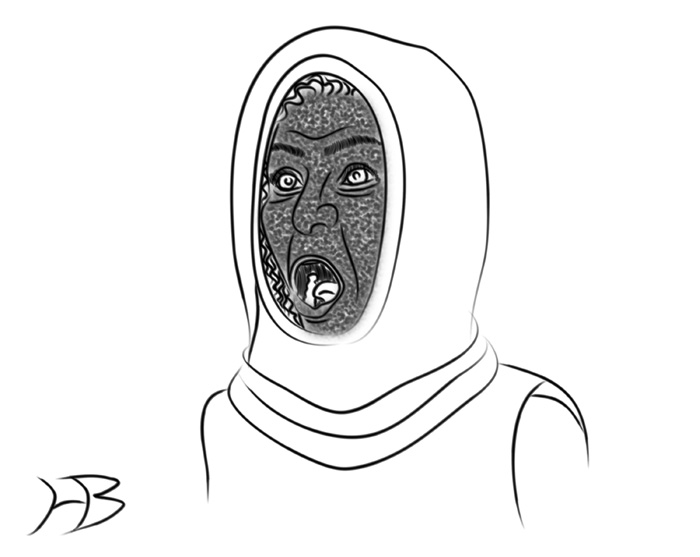
She screamed.
"Just let me talk to her."
Ibanez neither agreed nor disagreed. She just stared at the man in the expensive silk shirt and expensive tortoiseshell glasses, with his immaculate beard and his perfect slicked-back hair. The dead man. Dougall Deering.
"Please. Whatever's going on, I know she'll figure it out."
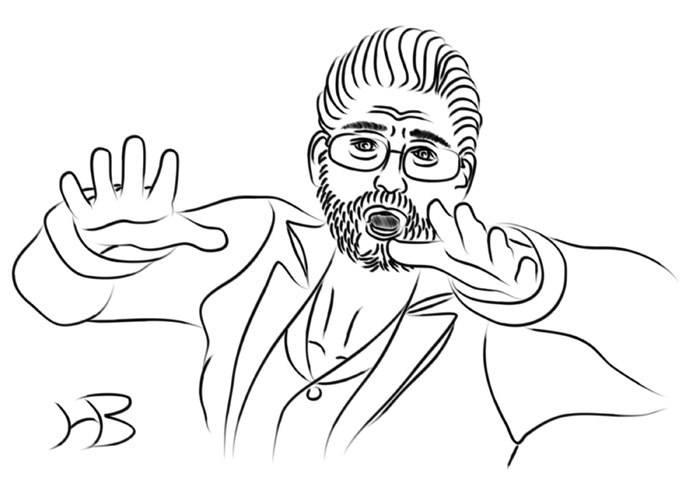
Her instructions had been clear. She was not to speak with the prisoner until after Xyank and Forth had finished speaking with McInnis. But that didn't mean she couldn't listen to him speaking. It would have been impossible not to hear him, shouting and whining and pleading in the tiny cell.
"Come on. Give me something to work with here. Is this because of the call?"
What call? she thought, but she didn't say it. She had this thing about amnestics. She hated them. As far as she knew, she'd only been subjected to them once. She wasn't keen on hearing anything that might earn her a repeat of the experience. Udo was recuperating in H&P right now from the targeted removal of an entire day of her life; Ibanez had no idea how she was going to explain that to her friend.
Deering was frantic, but he stayed put in the steel chair behind the steel table in the steel room with the mirrored wall. He knew the drill, even if he seemed moments from losing the plot. "I know something. Okay? I know something important." He took a deep breath. "What happened to Phil? Is Phil okay?"
So far as she knew, he'd never before expressed the faintest interest in the well-being of his brother. She wondered what had changed. But she didn't ask him, because he might have told her.
"Please." There were tears in his eyes. "Just tell me it worked. Tell me… tell me he's alright."
Her pager buzzed.
She left him there, sputtering impotently.
It was almost, almost enough to make her feel sorry for him.
The temporal experts were already gone when Ibanez reached the Director's office. He wasn't sitting behind the desk, as he usually was, but instead halfway to the washroom. He'd obviously been pacing.
"What's the verdict?" she asked.
He told her.
She stared at him.
What could she say? Tell me you're not serious. He was never not serious. There must be another way. When he was open to suggestions, he asked for them. I won't do it.
Then who would?
"Please." There were tears streaming down Dougall's face now, and he reached over to her — not up, of course, though the idea was embedded in the gesture — with hands clasped together as though in prayer. Supplication. An appeal for relief.
"Sit still," she said, "and do exactly as I say."
His shoulders sagged in relief, but he complied. He forced himself to stop shaking. He blinked away the tears. "Okay. I'm listening. I'm ready."
She walked behind him, and to his credit, he didn't turn around. That was good. That made it easier.
But not, of course, easy.
"He was never meant to live." McInnis stood behind his desk, back to her, staring up at the painting on his wall.
Ibanez slumped into the visitor's chair. "He did, though."
"Our experts were in perfect agreement. Whatever brought him back, he couldn't be permitted to remain. It could have triggered another deadline."
"It still could." She marvelled at how flat and uninflected her own voice sounded now.
"They don't think so. They think this will have righted the issue."
"And what are they basing that on?"
He turned, and sat down. There was no outward sign that this was affecting him at all. She saw it anyway. "I don't know. But they were quite certain."
She gripped the armrests as soon as she noticed her hands were shaking. Her service weapon felt heavy on her belt, even sitting down. "5243 didn't change at all this year. Everything was exactly the same. Everything except for Dougall Deering."
He nodded.
"You know what that suggests to me?"
He nodded again.
She told him anyway. "It suggests that two different things are happening on September the eighth, and we've been treating them as one thing. You just forced me to treat them as one thing."
"I'm very sorry about that." He pursed his lips. "I wouldn't have asked you—"
She waved it off. "It had to be me. Nobody else knows. Keep it in the family. That's not the issue. What if him coming back was a sign that something's shifted? Something's changed, and we need to know about it? Fuck, Allan," and finally she felt a little flame rising up in her again, "what if he was the thing that lets us turn the tide on this shit, and you had me put a bullet in his brain?"
McInnis blinked. "I thought you were going to snap his neck. 5243—"
"IT WASN'T 5243!" She was on her feet. "If it was 5243, he would've just fucking died again on his own. Something new just happened, and we hammered it back into the shape of something old. You have no idea how bad we might have just fucked ourselves."
"I think it more likely," he said, "that Dr. Deering's survival was symptomatic of a much more serious issue."
Her hands were still shaking. This time she solved the problem in the usual way. "And what issue is that?"
McInnis sighed. "Our best experts have been working on it for months. I promise, you'll have an answer almost as soon as I do."
"So, trust you, then. Great. Fantastic." She turned away, then turned back again. "What about Udo? What do we tell her?"
"Nothing." McInnis looked pained. "Dr. Forsythe will inform her that the repeated temporal interruptions prompted a nervous breakdown, and are likely to do so again. She may need to be amnesticized each year, following the execution of her part of the containment procedures."
Ibanez gaped at him. "You… what? You think… you think he's coming back next year, too?"
"I don't know. It's possible."
"And if he does? You're going to make me murder him again?"
"Perhaps we'll know more by then." He smiled thinly at her. "Or perhaps not. It doesn't change our duty."
Her nails were cut very short, but by this point they were still digging into the flesh of her palms. She forced herself to relax. Anger wouldn't get her anywhere with him. On this topic, probably, nothing would. "That's easy for you to say," she growled. "From your fucking chair."
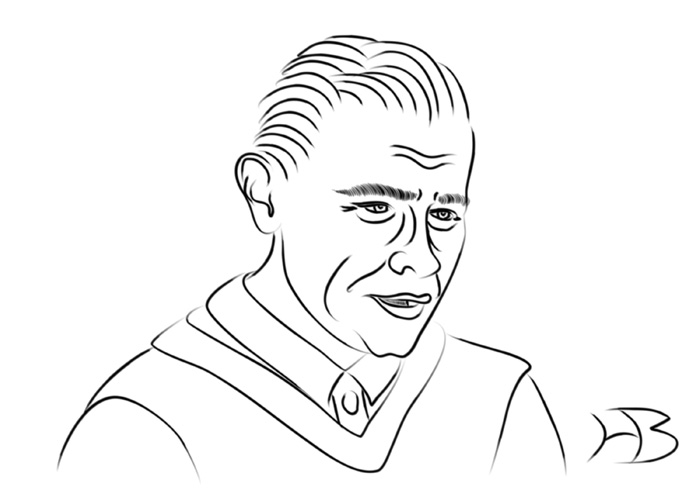
"No doubt it appears that way," he agreed.
24 November
Technician Second Class Jessie MacCrum was a ball of warm tones. Orange jumpsuit, coral hair, bright red face.
She was shouting. "You said he was nice! You used that exact word! You said 'Phil's a nice guy. You'll have fun!' What an asshole!"
Ngo never stood on ceremony. Asserting her authority always got in the way of the sort of relationships she wanted to forge with her patients. But MacCrum wasn't a patient, and Ngo's patience with this display was wearing very thin. "Calm down, technician. I'm not interested in indulging your temper tantrum."
MacCrum closed her mouth, mid-bitch. Her face grew even redder. Ngo wondered whether her head was about to explode. "You fulfilled your part of the arrangement, albeit apparently quite poorly. Your compliance is on record. It will help with your performance review, as discussed. I take it the two of you didn't schedule a second date?"
MacCrum laughed. "We didn't finish the first one. The f… the… he just started staring at that ugly grey shitstain… at 5056, in the mirror, and stopped talking to me. Didn't even say goodbye. I dumped my plate in his lap and left."
Ngo frowned. "I might need to report that to H&R. That's practically assault."
Some of the colour drained out. "Come on. It was a bad date. That's… you know."
Ngo kept her face carefully neutral.
MacCrum searched her eyes for sympathy. "It wasn't like it was hot food. And we don't wash our jumpsuits ourselves anyway."
"You dated in your jumpsuits?"
The technician's eyes narrowed. "Of course we did. I didn't want him getting any ideas. This was just, you know. Transactional." Her cheeks ballooned out. "Don't judge me. You're the one making him think anyone finds him attractive."
Ngo nodded. "Your candor is noted. You want to get back to your shift, before I note anything else?"
Huffing and puffing, the other woman saw herself out.
"Does she still have the dreams?"
Harry watched Udo's mother busy herself in the stacks, taking grimoires off the library cart and returning them to their proper places. It seemed an awfully prosaic thing for a senior researcher and Class-3 thaumaturge to bother with, so he figured it was probably for show. To put him at ease.
To make this look like less of an interrogation.
"The desert?" he hazarded. "Those dreams?"
Anjali Okorie nodded. She was a handsome woman, very dark skinned, with a wide jaw and knowing eyes. She looked nothing like her daughter. "Those dreams. They were getting worse when she left for Canada. When she was young, she used to talk about them so fondly, Obi and I thought she was playing make-belief." She smiled. "She's always had too much imagination for her own good."
Harry would have preferred the third degree on a more personal subject, if it meant he didn't need to feel like he was tattling on his girlfriend. "You'd have to ask her for the details. She doesn't like to talk about them. But yeah, they still happen. More and more often."
Anjali pretended to read the back cover of the book in her hand. "You seem very close. I understand all of you are. Have been, for a long time." She glanced at him. "A very long time."
It had been Udo's idea to visit her parents. The stations of the cross, relationship edition. They'd both had plenty of vacation time built up, and a change of scenery from their underground abattoir between annual massacres had seemed, in the abstract, appealing. In reality they'd spent precious little time together, Udo reconnecting with her old friends and Harry left doing research in Site-91's spacious manor library. With charming company, no doubt, but he might have preferred a reading partner with fewer ulterior motives.
He closed the Book of the Turning Gyre, slipped it into the briefcase on the reading desk in front of him, and favoured Anjali with a grim smile of his own. "You're asking what we're up to that takes more than a decade to settle?"
She shook her head innocently. "Of course not. I know it's classified. I just want to know how well she's handling it, you know. She's never been one to commit to any one thing for very long."
He wasn't sure what to say to that.
"Sometimes I feel like she always does the wrong thing, just because it's more familiar and comfortable. Do you know what I mean?"
"That enough for a file, you think?"
Udo flipped through the pages, looking up at her father occasionally as she did so. He wasn't watching her, and no expression of apprehension crossed his placid features. She grunted. "Probably? It's all pretty loose, though. You're sure this is one entity?"
Obi shrugged, and the leather recliner creaked under him. The manor was filled with rooms like this, little sitting rooms in out-of-the-way nooks, the kind of home a man of means would build when he meant to spend most of his time thinking and needed a tiered set of spaces for thoughts of increasing or decreasing darkness. This one was high on the decline, the windows facing west for a modicum of sunlight but never an overpowering glare. "Every one of those apparitions… well, you tell me. When do they appear?"
The point had been clear enough. "Whenever they can frighten someone into accidentally killing someone else. A mischief monster?"
"Seems like." Obi yawned, and stretched. "All fits the profile of the Hammersmith Ghost. Project CLIO collated the early entries, but nobody noticed the later ones because this was never on anybody's radar. Old and discredited case. So who cares? But if it's still active…"
"If it's still active," she agreed. She set the papers down on the drawing room table. "Could just be people making thin excuses for murder, or manslaughter. Is this…" She frowned. "Is this the most important thing you could be doing with your time right now?
Obi laughed. "The value of my time isn't what it used to be. Well, it's more valuable than ever to me, but to the Foundation? Your mother and I aren't getting any younger. Most of our big projects are behind us."
She didn't like the sound of that. "You're still young. And anyway, you're wizards. You're supposed to appreciate with age."
"I appreciate the pep talk." Obi stood up, and walked to the lit fireplace to warm his hands. "But you don't need to worry about us. We're mostly content to slip into late middle age with grace. What projects are you working on?"
When she didn't answer, he turned to look at her. "Wunderkind? What projects are you…"
He could see something on her face, something she could feel but couldn't quite express. She wondered if he understood it better than she did. She shook her head. "I guess I'm chasing ghosts too? Have been for a while. Might be time to try something new."
"That's the spirit. No pun intended." Obi stretched again, then yanked his right hand back as it swung perilously close to the fire. "Yeouch. Okay, well. I won't have my genius daughter stuck in a rut, so when you get back to 43, I want you to promise me something."
"Sure."
"You'll find something to focus your energies on that has nothing to do with that annual circus of death."
27 December
Grand Cove: Grand Bend, Lambton County, Ontario, Canada
Melissa squinted at the screen. Her computer room was dark, as it usually was. The curtains were drawn, as they always were. Windows were too much like mirrors. "And there it is again. And again. He's right. He's proving it."
In the corner, the image of Anastasios Mataxas shook its head mournfully. "He'll have such a hard time making them take it seriously, though."
"Because he's him," Melissa agreed.
"Because he's him. Maybe we can loan a little clout."
She laughed, and rubbed her eyes. "Maybe you can. I haven't got any."
"You don't think so? You were quite the rising star, once."
"And now I'm fixed in the heavens." She sighed. "Okay, boss. What's our consensus here?"
"With the exception of his work on the SCP-5243 containment procedures, which are functioning as designed, Dr. Wettle's replication studies do not replicate the originals, despite an almost slavish accuracy to their procedures. And…?"
"And his replications of the replication studies don't replicate the originals or the original replication studies." She shook her head in amazement.
"Ergo?"
"Ergo," and she said the rest in a rush to avoid having to think through the implications, "science is failing."
"That's one possibility. What might be the other?"
She'd already thought through those implications. Something in the makeup or training of most Foundation personnel made apocalyptic thinking second nature. She said it out loud for the first time.
He nodded. "Alright. Send over your highlights in batch form, and I'll compile the final packet for Dr. Wettle. I think we're almost ready for final submission."
"That'll be nice for him. A win, for a change. Isn't there a symposium coming up?" She'd never liked those internal conferences. Too many people standing up in other people's lectures and trying to change the subject to their own work or interests. She was unsurprised to find that she missed it.
Mataxas' face became grim. "I don't think this will make the symposium. I suspect, given the implications, that most of this will be Director's eyes only."
"Makes sense." She blinked blearily at him. "Well, alright. That's us for the day, yeah?"
"Almost." The frown transitioned to a sad smile. "Melissa, have you considered contact lenses?"
She shuddered. "Right on the eyes, huh? Right on the eyes." She shuddered again. "Contact. Yeah. Hey, uh," and she felt her hands shaking, even planted firmly against the keyboard and mouse, "I don't… I don't think…"
He raised his hands. "I'm sorry. I just thought it was worth mentioning. You're squinting a lot. It's not important."
"No." She tabbed over to her notepad application and began typing madly, to give her hands something to do, to stimulate her brain and move her mind down less well-worn channels. Like Ngo had taught her. "It's fine. I appreciate the concern. Maybe Forsythe can prescribe something for my dry eye. Thanks for asking."
He nodded. "Well, we'll speak again tomorrow. Fine work as always, Dr. Bradbury. You hardly need my help at this point."
She tried to laugh again, but only managed a shaky snort. "I do piece work. You're the one in charge."
"For today. Goodnight, Melissa."
She ignored the implication. "Goodnight."
The video feed shut itself.
She was about the turn off the screen when she noticed the words she'd been hammering into the notepad:
IN DEEPEST DARK I OPE THE HOODS AND FIRMLY PORTALS SHUTTER
IN DEEPEST DARK I OPE THE HOODS AND FIRMLY PORTALS SHUTTER
IN DEEPEST DARK I OPE THE HOODS AND FIRMLY PORTALS SHUTTER
IN DEEPEST DARK I OPE THE HOODS AND FIRMLY PORTALS SHUTTER
McInnis smiled at the pile of papers as though they were a person in need of reassurance. He looked up at Wettle, and the smile grew slightly wider and even, somehow, more genuine. "You've been hard at work, this past year."
"Yeah." Wettle sniffled. "I think my immune system is breaking down now that it's over. Harry says that happens after you finish a big project, sometimes."
"You have several graduate degrees," McInnis noted. "Has this not happened to you before?"
"I dunno. I broke my leg in a ski lift accident after my master's, and fell down a hill after my PhD defence, so."
"So." The Director plucked the first report off the stack on his desk, and examined the abstract. "Your subSection has completed, what was it? Over five hundred independent studies as part of this initiative, and in almost every case you've shown that conventional methods are no longer fully reliable in all cases. Is there an overall thesis you're advancing to explain this?"
"Yeah. It's in the middle somewhere. Should have come out on the top, but, you know. Printers jammed. A lot. There's like two thousand pages in there."
"Perhaps you could summarize for me."
"Sure." Wettle reached up and tucked the edges of his clip-on tie beneath his shirt collar, something he only remembered to do in situations of the utmost formality. "Science only works about half the time these days. Something's mucking up the rules of the universe, or everyone who thinks they know those rules is wrong. Maybe a bit of both."
"I see. That's the effect, then, or a few possible candidates. Cause?"
"No idea," Wettle said cheerfully.
"Mm." McInnis turned his chair, glanced up at the painting, glanced back at Wettle. "Well, that can be your project for next year, then. See if it's something we need to address. Or something we can. And suggest first steps for handling the problem."
Wettle nodded. "I could use more staff."
"I'd prefer to keep this under wraps, as much as possible. I can spare a few more technicians for your experiments, and please feel more than free to keep utilizing the talents of Drs. Mataxas and Bradbury, but we don't want to start a Site-wide panic, or worse."
"Sure," and Wettle started rocking back and forth on his heels, "but hear me out. Replication Studies Section. Full on. Really go at it. Get it all done. Large scale." He pumped his fist, for emphasis.
"Mm," McInnis murmured again. "Again, I think that might be a step too far. If you could continue addressing this project as you have been doing, that would be my preference."
"But," said Wettle.
"But?"
Wettle sighed. The mass of paper sloughed over, and a few dozen sheets slid off the desk and onto his feet. "Nothing, I guess. Same old, same old, huh?"
The Director smiled again. "Doesn't that seem apropos?"
Some things can't be explained.
But not at Site-43. Almost every aspect of this facility's unlikely functionality is made possible, at times simple or even inevitable, by a series of factors which can be, and have been in the preceding pages, explicated in precise detail. How there came to be enough space to build such a massive complex at such an unmanageable depth. Where the raw materials came from. Whence the heat, and the water, and the air. How anyone even knew to look for such a place in the first place. All of it tidily, conveniently compassable.
That, in the final analysis, is the only unexplained anomaly in the environs of Lake Huron.
Why does Site-43 seem to sit in a naturally-occuring Site-43-shaped hole?
— Blank, Lines in a Muddle
He sent the excerpt, and waited.
The answer came almost immediately.
M_Bradbury
These feel like the topic paragraphs for a conclusion.
M_Bradbury
Are you finally finishing this thing?
H_Blank
I think I am.
H_Blank
Finally stumbled on my thesis.
M_Bradbury
Took you long enough.
H_Blank
Well, you know me.
H_Blank
It's my pattern.
He waited for another response, but none came. Not from the screen, anyway.
A hand landed gently on his shoulder.
"So," said Udo. Very softly. "I've been thinking."
"Yeah." He reached up and held her hand. "I know."
It didn't take long to pack. She'd never really moved back in.
Source: SCP Foundation · CC BY-SA 3.0
Community rating
Was it worth the sleep you're about to lose?